 listicle
Smart Energy Monitors for Restaurants: Cut Costs Fast
Last Updated: November 3, 2026
Quick Summary
Smart energy monitors show restaurant owners how much power each major system draws in real time, so waste like an overcooled walk-in or an exhaust hood running after close gets caught early. Instead of discovering problems on a monthly bill, staff can act on specific equipment faults and schedule changes. Savings depend on your own baseline and how well the data gets reviewed.
- Real-time tracking reveals which equipment causes a spike, instead of only showing the total on a monthly bill.
- HVAC and refrigeration are usually the largest controllable loads and the fastest payback targets.
- Establish a baseline before changing anything so you can test each adjustment against it.
- Set back HVAC during closed hours and ramp exhaust hoods down with cooking activity.
- Monitoring also flags failing equipment and documents safe holding temperatures for food safety.
Table of Contents
- Why Restaurants Lose Money on Energy They Never See
- Real-Time Energy Consumption Tracking for Restaurant Equipment
- Reducing Restaurant Utility Costs Through HVAC and Refrigeration Monitoring
- Catching Energy Hogs, Vampire Loads, and Failing Equipment Early
- Food Safety, Staff Behavior, and Multi-Unit Scalability
- Smart Energy Monitoring ROI: Estimating Payback for Your Restaurant
- Planning Your Commercial Energy Management Systems Installation
- Frequently Asked Questions
Why Restaurants Lose Money on Energy They Never See
Restaurants spend a large share of their operating budget on utilities, yet most owners have little visibility into where that money goes. A walk-in cooler left slightly too cold, an exhaust hood running after closing, or a lighting circuit nobody remembers wiring can drain cash for months before anyone notices. Learn how proactive asset management helps catch these problems before they become costly. Smart energy monitors are designed to close that gap. The same principles apply to restaurants anywhere in the United States.
The core problem is timing. A monthly utility bill tells you the total, but not which piece of equipment caused the spike. By the time the bill arrives, the wasted energy is already spent. Visualizing energy data changes that. A 2022 study from the Wuppertal Institute for Climate, Environment and Energy's research on digitally driven energy management in small and medium-sized enterprises found that visualizing energy data lets smaller businesses adopt energy-management practices aimed at reducing both consumption and costs.
Monitoring is not a cure-all, though. Its value depends on whether someone reviews the data and acts on it. A dashboard that nobody checks produces no savings.
Real-Time Energy Consumption Tracking for Restaurant Equipment
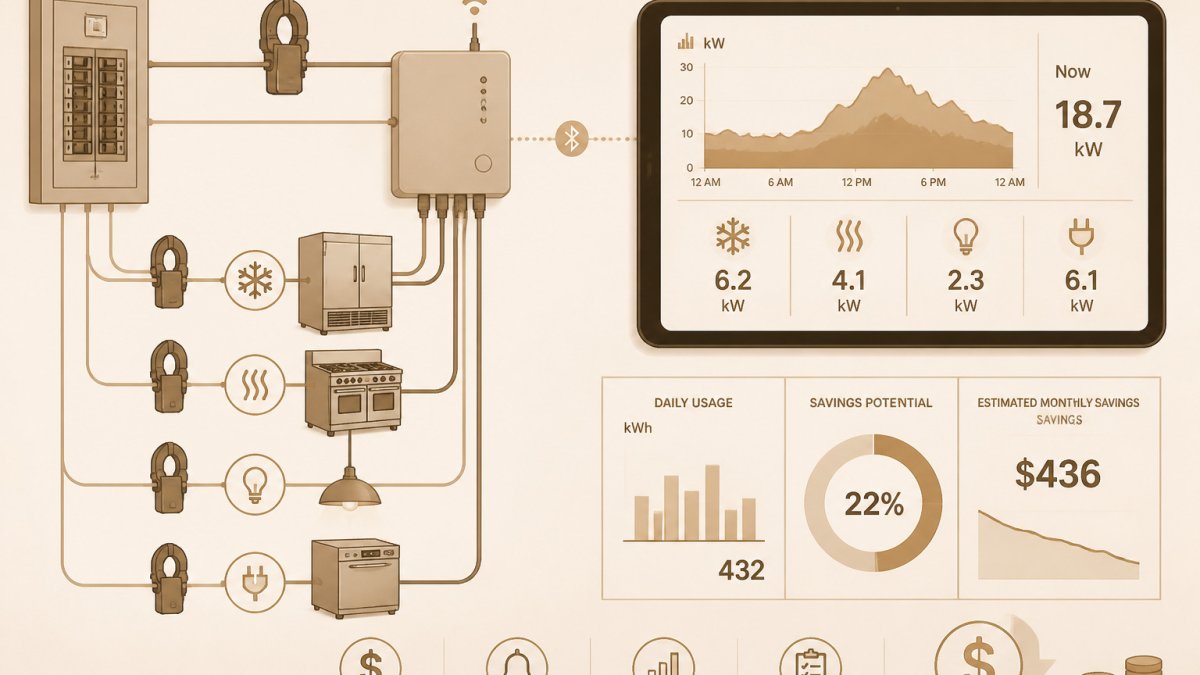
Real-time tracking shows how much power each major system draws at each moment, not just across the billing period. For a restaurant, that usually means circuit-level or equipment-level visibility into the kitchen, refrigeration, HVAC, and lighting.
The practical benefit is speed. When the walk-in cooler's load climbs overnight, staff can see it the next morning instead of discovering it on the next bill. Restaurant-focused platforms such as the Restaurant Energy Management System offered by eView IoT describe remote monitoring of equipment, temperatures, and alerts for this purpose.
What to track first:
- Walk-in coolers and reach-in refrigeration
- HVAC units and exhaust systems
- Dishwashers and cooking equipment during peak hours
- Lighting circuits in dining and back-of-house areas
Reducing Restaurant Utility Costs Through HVAC and Refrigeration Monitoring
HVAC and refrigeration are typically the largest controllable loads in a restaurant, and they are also the two systems where monitoring pays back fastest because the waste is continuous. A refrigeration compressor that runs a few minutes longer on every cycle, or an HVAC unit that cools an empty dining room for two hours after close, adds up every day of the year.
The first job of monitoring is to establish a baseline. You need to know how much each system draws during a normal operating day before you can tell whether a change helped. That baseline lets you test one adjustment at a time: raise the walk-in setpoint by a degree, shift the HVAC schedule by thirty minutes, and compare the next week's consumption against the baseline. Without a baseline, any savings claim is a guess.
Schedule-based control is the most reliable lever. Smart thermostats and building controls can set back HVAC during closed hours and pre-cool before service rather than running full output from opening. The same logic applies to exhaust hoods: a hood running at full speed over an idle line moves conditioned air out of the building and forces the HVAC to work harder, so hood controls that ramp down with cooking activity can cut both loads at once.
Refrigeration optimization works differently. Most of the savings come from catching drift and faults rather than from changing setpoints. A door gasket that fails, a condenser coil that fouls, or a defrost cycle that runs too long all show up as a gradual rise in compressor run time. Monitoring that trend lets you schedule service before the unit fails, which protects both energy and inventory. A common pattern is that the first alert a restaurant gets is not a dramatic spike but a slow upward drift that a monthly bill would never reveal.
Be realistic about the numbers. Results depend heavily on how much waste existed before monitoring. Measure your own before-and-after data against your baseline to find out what applies to your kitchen. The savings that hold up are usually the ones you can trace to a specific schedule change or a specific repair.
The article points to a few recurring cost drivers that monitoring helps expose and control.
| Source of waste | What monitoring reveals | Action the article describes |
|---|---|---|
| HVAC cooling an empty dining room | Load running after close | Set back schedule during closed hours |
| Exhaust hood at full speed over idle line | Continuous hood load | Ramp hood down with cooking activity |
| Failing refrigeration door gasket or coil | Gradual rise in compressor run time | Schedule service before failure |
| Overlong defrost cycle | Gradual rise in compressor run time | Schedule service before failure |
| Walk-in cooler drifting above setpoint | Extra energy to recover temperature | Also a food-safety risk to correct |
Catching Energy Hogs, Vampire Loads, and Failing Equipment Early
Vampire loads are devices that draw power even when they appear to be off, such as idle fryers left in standby or ice machines running longer than needed. Individually they seem minor. Combined, they add up.
Monitoring also helps with failing equipment. A compressor that suddenly draws more current than usual may be losing efficiency or nearing failure. Catching that early lets you schedule repairs before a breakdown spoils inventory.
Get your free electrical estimate →
Watch out: Do not assume a higher reading always means a fault. Some equipment draws more during warm-up or heavy use. Compare readings against normal operating patterns before acting.
Food Safety, Staff Behavior, and Multi-Unit Scalability
Refrigeration monitoring does double duty in a restaurant: it protects cost control and food safety at the same time. A walk-in cooler that drifts a few degrees above its setpoint burns extra energy trying to recover, and it also puts product at risk.
The food-safety angle is where most generic energy-monitoring content stops short. The same sensors that catch an energy-wasting overcool also document that safe holding temperatures were maintained.
Staff behavior is the other half of the equation. Energy data only saves money when the people in the kitchen act on it. A common pattern is to make energy use visible at shift level: a dashboard or weekly scorecard that shows how each shift's energy use compares with the same shift last week. When closing staff can see that an exhaust hood left running after close shows up as a distinct load, habits change faster than they do from a memo. Some operators gamify it with simple recognition for the shift that hits the lowest waste number, but the mechanism matters less than making the data visible and tying it to a routine, such as a five-minute review at shift change.
For multi-unit operators, the value scales in a different way. A single-location system tells you what one kitchen is doing. A centralized dashboard across ten locations tells you which site is the outlier. Comparing energy use per square foot, per cover, or per operating hour across sites surfaces a location that is running far hotter than its peers, and that comparison is often the fastest way to find a failing unit or a habit that spread through one store. The practical requirement is that the platform supports role-based access and a consistent naming scheme across sites, so a district manager can compare like with like without rebuilding the setup at each location. A system that works for one kitchen should extend to a chain without a separate integration project per site.
Watch out: automated temperature logging supplements but does not replace your food-safety plan. Confirm that the monitoring system's alerts reach the right person after hours, and keep a manual backup check in place for the first few weeks until staff trust the alerts.
Smart Energy Monitoring ROI: Estimating Payback for Your Restaurant
Return on investment depends on three figures: your current utility spend, the savings percentage you can realistically achieve, and the total installation and subscription cost. Start with your last 12 months of bills to establish the baseline.
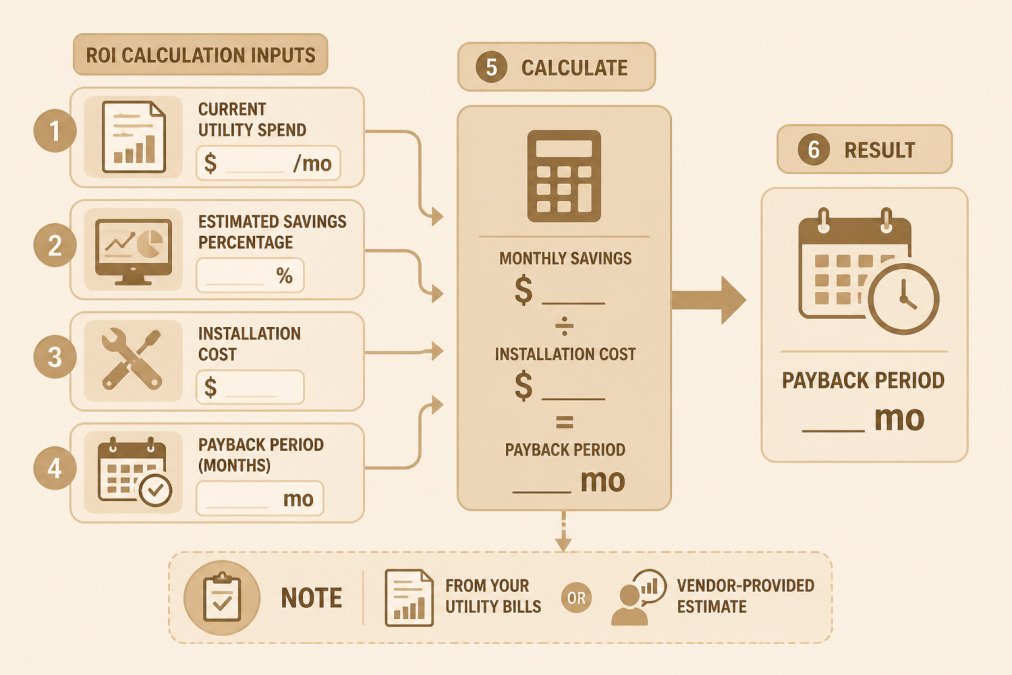
Use this simple structure:
- Annual utility spend (from your bills)
- Estimated savings percentage (from your own data or a vendor estimate you can verify)
- Annual savings = spend × savings percentage
- Payback period = total installation cost ÷ annual savings
Pricing depends on system size, scope, and service terms. See how professional energy audits quantify savings and costs to sharpen your payback estimate. Request a written quote from Light Life Electric and compare it against your own bills. Harder-to-quantify gains, such as fewer spoiled-food losses, are worth tracking separately.
Planning Your Commercial Energy Management Systems Installation
Installation involves more than mounting sensors. It requires a plan for the existing electrical system, the monitoring hardware, and the network connection. Before committing, review how to choose a commercial electrician for your business.
Commercial kitchens also have specific wiring demands. Our guide on planning electrical wiring for commercial kitchens covers what to consider before the work begins.
Light Life Electric provides commercial electrical services in Manatee and Sarasota Counties, including lighting, transformers, circuit installation, and generator solutions.
Frequently Asked Questions
What are the benefits of using a smart energy meter in a restaurant?
A smart energy meter or monitor shows restaurant operators how much electricity each major system uses, often in near real time. That visibility helps staff spot HVAC runs that do not match occupancy, refrigeration units drawing more power than normal, and lights left on in empty areas. The benefit depends on acting on the data, so the monitor works best when someone reviews the alerts regularly.
Are energy monitors worth it for a restaurant?
They can be, but the answer depends on your current utility spend, how much of it comes from HVAC and refrigeration, and what the system costs to install and maintain. Pricing depends on system scope and service terms, so request a written quote from Light Life Electric and compare it against your own bills before deciding.
Do smart energy monitors require professional electrical installation?
Many monitoring setups involve current transformers, sub-meters, or connections inside a panel, which should be installed by a licensed electrician. Light Life Electric is a Florida certified electrical contractor that handles permits and final inspection, so restaurant owners in Southwest Florida can have the installation coordinated through permits and final inspection. Ask any installer to confirm that the work passes inspection and that the system's data connects to the monitoring platform you plan to use.
Can energy monitoring help identify faulty kitchen equipment?
Yes. Remote monitoring of refrigeration and HVAC can reveal patterns that point to trouble, such as a walk-in cooler running almost continuously or a compressor drawing more power than its normal baseline. Treat monitoring alerts as signals to inspect the equipment, and confirm any results with a service technician.