 listicle
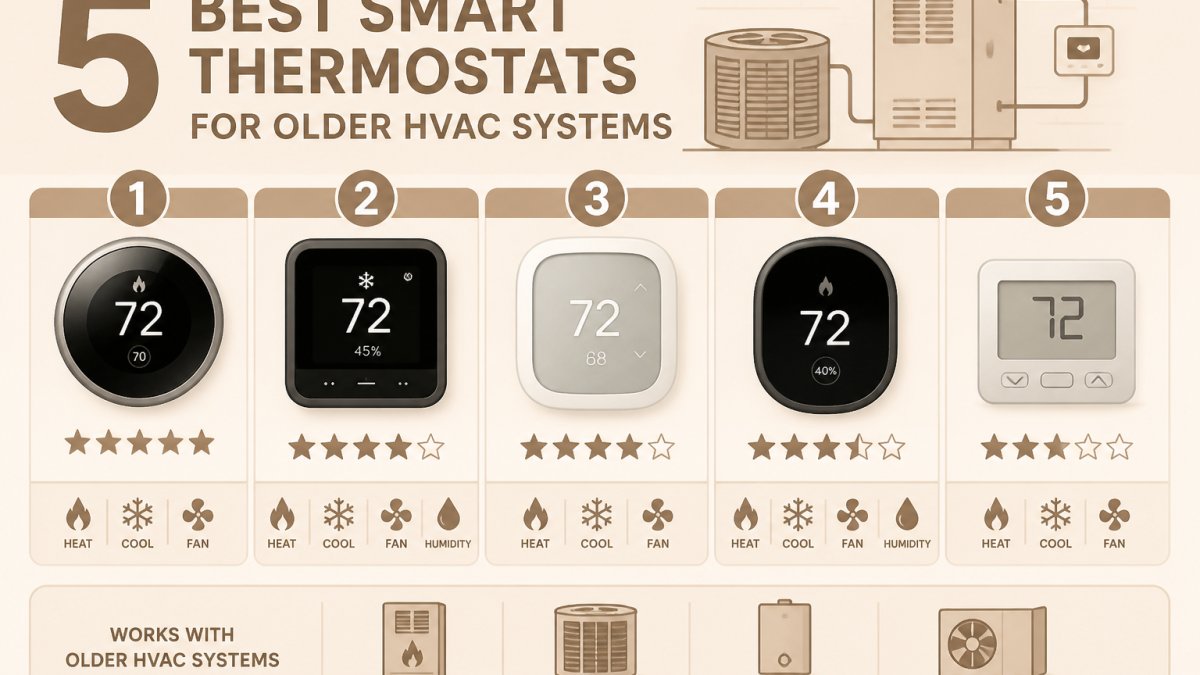
5 Best Smart Thermostats for Older HVAC Systems
Table of Contents
- Quick Comparison: Top Smart Thermostats for Older Homes
- How We Evaluated Smart Thermostat Compatibility with Older HVAC Systems
- 1. ecobee Smart Thermostat Premium: Best for Presence Sensing and Learning
- 2. Amazon Smart Thermostat: Best Budget Pick for Older Homes
- 3. Google Nest Learning Thermostat: Best for Multi-Stage Systems
- 4. Honeywell Home T9 Smart Thermostat: Best for Room Sensors and Zoning
- 5. Emerson Sensi Touch: Best Smart Thermostat Without C Wire
- Installation and Setup: What to Expect with Older HVAC Systems
- Frequently Asked Questions
Last Updated: October 9, 2026
Quick Comparison: Top Smart Thermostats for Older Homes
Finding a smart thermostat for an older HVAC system comes down to one question: will it work with the wires already in your wall? Many older homes run on two-wire heating, millivolt systems, or lack the C wire that most modern thermostats expect.
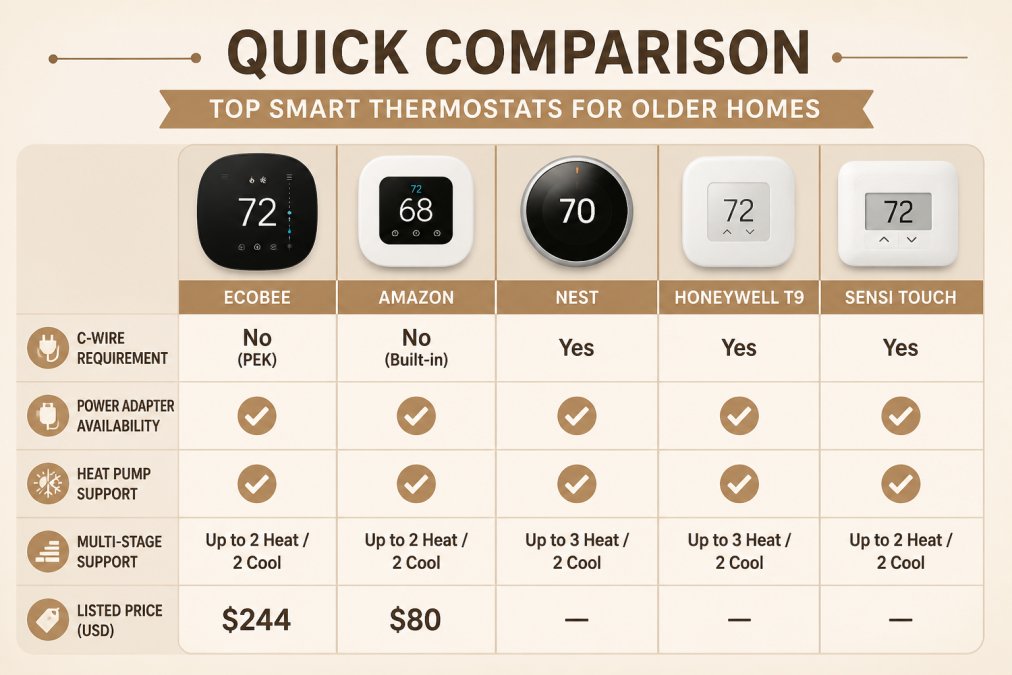
Below, we break down five models by wiring tolerance, power options, and system support, so you can buy the right one the first time.
| Model | Listed Price | C Wire Required | Power Adapter | Heat Pump Support | Multi-Stage |
|---|---|---|---|---|---|
| ecobee Smart Thermostat Premium | $244 | Yes (adapter included) | Yes, PEK included | Yes | Yes |
| Amazon Smart Thermostat | $80 | Yes | No (sold separately) | Yes | Limited |
| Google Nest Learning Thermostat | Not stated | Yes | No (sold separately) | Yes | Yes |
| Honeywell Home T9 | Not stated | Yes | No | Yes | Yes |
| Emerson Sensi Touch | Not stated | Optional | No | Yes | Yes |
How We Evaluated Smart Thermostat Compatibility with Older HVAC Systems
Most "best smart thermostat" roundups rank on app polish, voice assistants, and energy reports. That is the wrong scorecard for a home built before 1990. We scored each of the five models on four factors that actually decide whether a thermostat survives an older system, and we weighted them in this order:
- Wiring tolerance (40%), which terminal designations the thermostat accepts, and whether it can operate without a C terminal.
- Power options when no C wire exists (25%), adapter kits, battery operation, or power-stealing behavior.
- Equipment support (20%), heat pumps with auxiliary/emergency heat, two-stage compressors, multi-stage furnaces, and dual-fuel setups.
- Homeowner-completable setup (15%), how much of the install can be finished without opening the air handler or running new cable.
The wiring conditions we screened for
Older homes rarely present a clean five-wire bundle. The conditions that break modern thermostats most often are:
- Two-wire heating-only runs, a single R (or Rh) and W pair feeding a furnace, boiler, or wall heater. No C, no fan control, no cooling leg.
- Three- and four-wire heat/cool runs, R, W, Y, and G, still with no common.
- Millivolt systems, standing-pilot gas fireplaces, some floor furnaces, and older wall heaters that operate on millivolts of signal rather than 24 VAC. These are the systems most likely to be damaged or to simply fail to power a smart thermostat.
What "compatible" actually means here
Smart thermostat compatibility with older HVAC systems is the ability of the thermostat to operate correctly on the low-voltage wiring, transformer, and equipment type already installed in the home, without requiring a full rewire. That definition matters because "works with most systems" on a product page rarely means "works with a 1968 boiler."
A thermostat is only compatible if all four of these are true:
- The terminal labels on your existing subbase match terminals the new thermostat supports (or can be mapped with an adapter).
- The thermostat can draw power without a C wire, or you are willing to add one.
- The equipment type (conventional, heat pump, millivolt, line-voltage) is on the manufacturer's supported list.
How to read your own system before you buy
Before comparing models, do this once. It takes ten minutes and prevents almost every failed install:
- Shut off power at the furnace or air handler breaker, not just at the thermostat.
- Pull the old thermostat off its subbase and photograph the terminal labels and the wire colors landing on each one.
- Count the wires and note which terminals are populated. Write down the letters exactly as printed.
- Find the equipment nameplate on the furnace, air handler, or boiler and record the model number and fuel type.
- Check the manufacturer's compatibility checker for each candidate thermostat using those terminal letters, not the wire colors, which are not standardized.
We weighted C-wire alternatives heavily because that single missing wire causes most failed installs in older homes, and because the adapter, battery, and power-stealing workarounds carry very different risks depending on the equipment you have.
1. ecobee Smart Thermostat Premium: Best for Presence Sensing and Learning
The ecobee Smart Thermostat Premium is our top pick for older homes because it ships with a Power Extender Kit, so a missing C wire does not stop the install.
CNET highlights its presence sensing and learning functions, and Wirecutter names it a top pick. The tradeoff: Wirecutter notes setup is not the easiest, and the price sits well above the budget field.
Older-System Wiring and Power Options
The included PEK is the deciding feature. It lets the thermostat draw power through existing wires when no common wire is present, which is the most common blocker in pre-1990 homes. For a smart thermostat for heat pump with auxiliary heat, ecobee's published wiring support covers the auxiliary terminal, so defrost cycles and backup heat stage correctly.
2. Amazon Smart Thermostat: Best Budget Pick for Older Homes
At a listed $80, the Amazon Smart Thermostat is the cheapest way into a connected thermostat, and CNET includes it among the best models. It supports heat pumps and standard forced-air systems.
The catch is power. It expects a C wire, and the supplied specifications do not confirm older-system compatibility or include a power adapter. In an older home without a common wire, budget for an adapter or a wire run before you buy.
3. Google Nest Learning Thermostat: Best for Multi-Stage Systems
The Nest Learning Thermostat is a current leader in AC Direct's 2026 comparison and appears in multiple roundups. It handles multi-stage heating and cooling, which matters in homes running two-stage compressors or zoned equipment.
Nest's published results do not state a price, and older-system wiring compatibility is not verified in the supplied data. Treat it as a strong multi-stage option, but confirm your C wire first.
4. Honeywell Home T9 Smart Thermostat: Best for Room Sensors and Zoning
Honeywell Home's T9 earns a spot for homes that need room-level temperature control. It is named in more than one comparison, and Honeywell Home models appear in Consumer Reports' 2026 roundup.
The T9 uses remote room sensors to balance uneven temperatures, a real benefit in older two-story homes. Model-specific price and older-HVAC compatibility are not stated in the supplied results, so verify wiring before purchase.

5. Emerson Sensi Touch: Best Smart Thermostat Without C Wire
The Emerson Sensi Touch is our pick for the best smart thermostat without C wire in many older setups, because Sensi models are widely documented to run on battery power when no common wire is available. The Spruce names Copeland Sensi Touch its best overall programmable thermostat, and it appears in 2026 roundups.
Battery power is the workaround that avoids a new wire run, though you will replace batteries periodically.
Get your free electrical estimate →
Two-Wire Heating System Compatibility
For a smart thermostat for two-wire heating system setup, the Sensi Touch is the most forgiving of the five. Two-wire systems, including millivolt and line-voltage equipment, often lack a C terminal entirely, and battery operation sidesteps that. Millivolt and line-voltage systems still need a compatibility check against Sensi's published terminal list before you commit.

Installation and Setup: What to Expect with Older HVAC Systems
Most older-home installs succeed or fail on one step: identifying whether a C wire exists. But the decision tree after that step is where homeowners get into trouble, because the three common workarounds, an adapter kit, battery operation, and power stealing, are not interchangeable.
Step 1: Identify what you actually have
Turn off power at the furnace or air handler breaker, remove the old thermostat from its subbase, and photograph the terminal labels with the wires still landed. Then classify your system:
- Low-voltage conventional (24 VAC), the standard furnace/AC setup. Smart thermostats are designed for this.
- Low-voltage heat pump, same voltage, but with an O/B reversing valve terminal and often auxiliary/emergency heat.
- Millivolt, standing-pilot gas appliances. Most smart thermostats are not rated for these and can fail to power on or, in some cases, interfere with the pilot circuit.
If you are not sure which category you are in, stop here and have the equipment nameplate read by a technician. Guessing is how control boards get damaged.
Step 2: Choose a power strategy
If you have a C terminal, you are in the easy case, wire it and move on. If you do not, you have three options, and they are not equal:
Adapter kit (Power Extender Kit or equivalent). The adapter installs at the furnace control board, not at the thermostat, and repurposes an existing wire to carry common. This is the most reliable no-C-wire solution and is what the ecobee Smart Thermostat Premium ships with. It requires opening the air handler and correctly identifying the control board terminals, a job many homeowners can do, but one that carries real risk if the board is mislabeled or the wiring is non-standard.
Battery operation. The Emerson Sensi Touch and similar models run on batteries when no C wire is present. This avoids any wiring change at the furnace, which makes it the safest option for older systems with unusual or undocumented wiring.
Power stealing. Some thermostats draw a small current through the existing heating or cooling circuit to power themselves without a C wire.
Step 3: Know when to call a technician
Some older-system jobs are not homeowner work. Call a licensed electrician or HVAC technician if any of the following apply:
- You cannot identify the equipment type from the nameplate, or the nameplate is missing or unreadable.
- The system is millivolt or line-voltage.
- You need a new wire run because no spare conductor exists and an adapter is not supported by your equipment.
A compatibility check and a C-wire run are routine service calls. A miswired control board is not.
Step 4: Verify before you close up
After wiring, restore power and confirm the thermostat boots, detects the equipment type correctly, and cycles each stage. On heat pumps, verify that both heating and cooling modes engage and that auxiliary heat stages on a call for backup.
At Light Life Electric, our Florida certified electricians handle smart thermostat wiring, C-wire runs, and panel checks across Southwest Florida, from permits to final inspection.
Frequently Asked Questions
What smart thermostat works with an older HVAC system?
Most modern smart thermostats work with older HVAC systems, but compatibility depends on your wiring. Models like the ecobee Smart Thermostat Premium and Emerson Sensi Touch include power adapters that let them work without a C wire. Check your current thermostat's wiring terminals before buying. If you have a millivolt or line-voltage system, standard smart thermostats usually will not work without additional equipment.
Can you install a smart thermostat on an old furnace?
A smart thermostat can work with an old furnace if the furnace uses low-voltage wiring (typically 24 volts). If your furnace is a millivolt system or uses line voltage, a standard smart thermostat will not work directly. Check the wiring labels at your current thermostat. If you see R, W, G, Y, and C terminals, a smart thermostat is likely compatible. When in doubt, a licensed electrician can confirm compatibility.
Do smart thermostats work with two-wire heating systems?
Some smart thermostats work with two-wire heating systems, but you will need a model that supports power sharing or comes with a power adapter. The Emerson Sensi Touch is a common choice for two-wire setups. Without a C wire or adapter, the thermostat may steal power from the heating circuit, which can cause short cycling or system damage. Always verify your system type before purchasing.
Can I install a smart thermostat without a C wire?
Yes, you can install a smart thermostat without a C wire if the model supports power sharing or includes a power adapter kit. The ecobee Smart Thermostat Premium and Emerson Sensi Touch both offer C-wire alternatives. However, power-stealing thermostats can cause issues with some older systems, including flickering lights or inconsistent heating. If you are unsure, have an HVAC technician or electrician check your system first.
How do I know if a smart thermostat is compatible with my HVAC system?
Start by turning off power to your HVAC system and removing your current thermostat. Note the wire labels and terminal letters. Most manufacturers provide an online compatibility checker where you enter this information. Key factors include whether you have a C wire, the system voltage (low-voltage vs. line-voltage vs. millivolt), and whether you have a heat pump or multi-stage system. If your wiring is unusual, consult a professional.
Older HVAC systems rarely fail because of the thermostat. They fail because the wiring behind it was never set up for one. Light Life Electric can run a proper C wire, verify your low-voltage connections, and install your new thermostat so it works the first time. We are a licensed, bonded, and insured Florida certified electrical contractor offering code-compliant installations and 24/7 emergency response. Get your free electrical estimate and let us confirm your system is ready.