 how-to
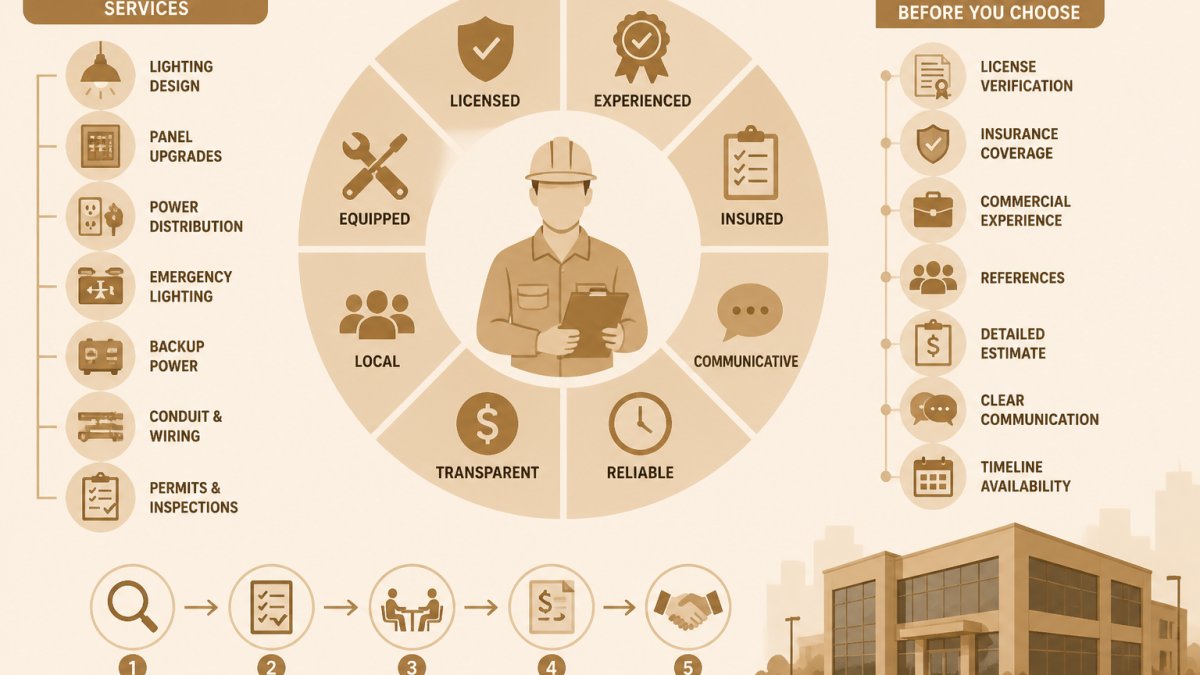
How to Choose a Commercial Electrician for Your Business
Table of Contents
- Step 1: Verify Licensing and Insurance Before Anything Else
- Step 2: Assess Commercial Experience and Technical Expertise
- Step 3: Evaluate Safety Records and Code Compliance
- Step 4: Check References, Reputation, and Workmanship Warranty
- Step 5: Understand Commercial Electrician Hourly Rates and Pricing Models
- Questions to Ask Electrical Contractors Before You Sign
- Energy Efficiency Audits and Smart Building Integration
- Frequently Asked Questions
Last Updated: October 1, 2026
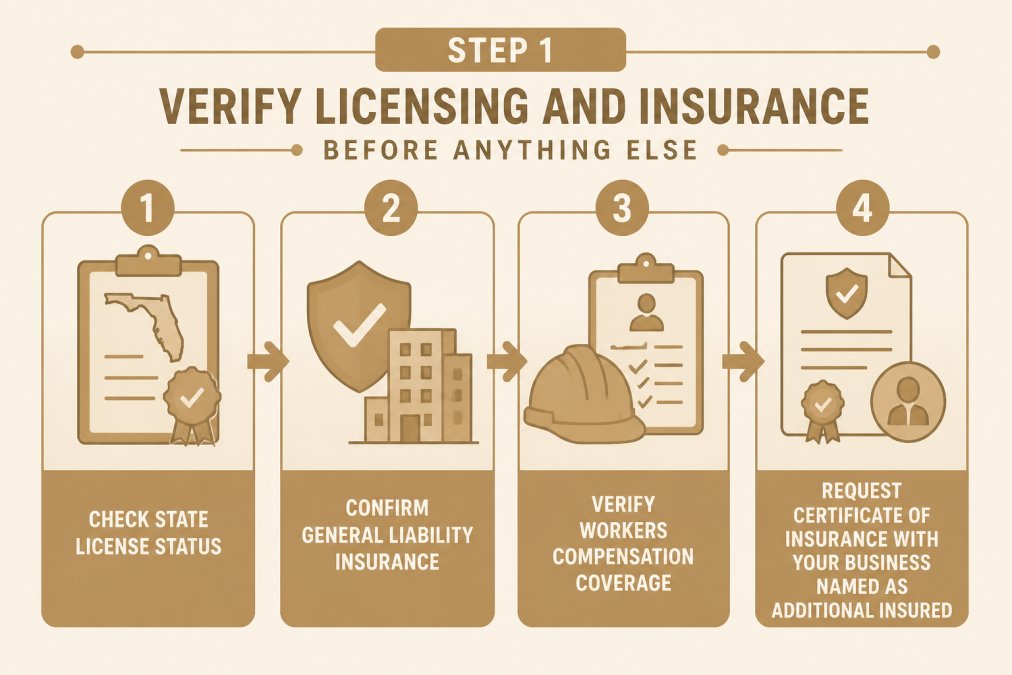
Step 1: Verify Licensing and Insurance Before Anything Else
Hiring a commercial electrician starts with paperwork, not price. Before you invite anyone on site, confirm they hold a current state electrical license and carry active insurance. This one step removes most of the risk from your project.
Florida Department of Business and Professional Regulation license lookup
What to Check on a License
- License status: active, not expired or suspended
- License type: matches commercial work, not just residential
- Qualifying agent: a master electrician tied to the license
- Complaint history: any open disciplinary cases
Insurance Coverage You Need to Confirm
- General liability: covers third-party property damage
- Workers compensation: covers injured crew members
- Auto coverage: covers company vehicles on your property
- Additional insured: your business named on the certificate
Step 2: Assess Commercial Experience and Technical Expertise
Commercial electrical work is not scaled-up residential work. Three-phase power systems, load calculations, and industrial electrical systems demand a different skill set. Ask how long the contractor has handled commercial projects and what building types they know best.
- Panel upgrades and switchgear replacement
- Three-phase power distribution
- Emergency and exit lighting circuits
- HVAC and kitchen equipment wiring
- Energy management systems and controls
Step 3: Evaluate Safety Records and Code Compliance
Safety records separate professional contractors from the rest. A serious commercial electrician follows OSHA standards, documents toolbox talks, and tracks near-miss reports. Code compliance is not optional either. Every job should pass inspection the first time.
- Ask for their OSHA recordable incident rate
- Confirm they follow NFPA 70E arc flash safety protocols
- Check that they pull a permit for every job
- Verify they schedule third-party electrical safety inspections
OSHA electrical safety standards for general industry
Step 4: Check References, Reputation, and Workmanship Warranty
References tell you what a license cannot. Call at least three past commercial clients and ask about project downtime, communication, and whether the work passed inspection without rework. A contractor with a strong reputation will hand over references without hesitation.
- How did they handle unexpected issues?
- Did they finish on the project timeline?
- Would you hire them again?
Step 5: Understand Commercial Electrician Hourly Rates and Pricing Models
Commercial electrician pricing is not a single number. It is a stack of cost drivers, and understanding them is what lets you compare bids honestly instead of chasing the lowest total.
What Actually Drives the Price
- Labor rate: Journeyman and master electrician rates differ, and prevailing wage rules apply on many publicly funded projects.
- After-hours premium: Emergency and night work typically carries a multiplier over standard business-hour rates.
- Materials and gear: Switchgear, transformers, and copper conductors are the largest variable line items, and lead times affect scheduling.
- Permit and inspection fees: Pulled by the contractor, passed through to you, and non-negotiable.
- Access and downtime: Working around occupied tenants, hot-work restrictions, and shutdown windows adds labor hours.
- Scope certainty: Unknown existing conditions (undersized panels, aluminum wiring, undocumented circuits) drive change orders.
The Three Pricing Models and Where Each Shifts Risk
| Pricing Model | How It Works | Risk Sits With | Best For |
|---|---|---|---|
| Time and materials | Pay for hours plus parts, often with a not-to-exceed cap | You | Troubleshooting, unknown scope |
| Flat rate | Fixed price per task from a published book | Contractor | Standard repairs, defined jobs |
| Project bid | One lump sum for the whole scope | Contractor | New construction, tenant improvements |
A time-and-materials job without a not-to-exceed cap is an open checkbook. Ask for the cap in writing.
How to Read an Estimate Line by Line
A professional estimate breaks the scope into verifiable lines. If you see a single lump sum with no breakdown, you cannot compare it to anything.
- Labor hours by task, not a single blended number
- Materials listed by type and quantity, with a stated markup
- Permit and inspection fees called out separately
- Disposal and dumpster costs
- Temporary power and make-safe work
- Exclusions stated explicitly (e.g., "does not include fire alarm certification")
How to Compare Bids Without Getting Burned
Normalize every bid to the same scope before you compare totals. A bid that excludes the electrical permit, disposal, or patching is not cheaper, it is incomplete. Build a one-page scope matrix: list every task down the left, put each contractor's bid across the top, and mark included, excluded, or unclear. Any "unclear" cell is a question you ask before signing.
The Long-Term ROI Angle Most Bids Ignore
The lowest first cost is rarely the lowest total cost. Ask each contractor to model the operating impact of what they propose, LED retrofits, occupancy sensors, power factor correction, or right-sizing an oversized transformer. A slightly higher install price that cuts demand charges or eliminates a recurring failure point pays for itself. Request that trade-off in writing so you can weigh it against the sticker price.
Get your free electrical estimate →
Questions to Ask Electrical Contractors Before You Sign
The right questions expose how a contractor actually operates. Use this list during vetting, and pay attention to who answers in specifics versus who deflects.
Licensing, Insurance, and Responsibility
- Are you licensed, bonded, and insured in this state, and can you send the certificate of insurance naming my business as additional insured?
- Who is your qualifying master electrician, and will that person supervise my job or hand it to a subcontractor?
- Will you pull the electrical permit, or will I? (The answer should be you, the contractor.)
- Who is my single point of contact from kickoff to closeout?
Scope, Schedule, and Response
- What is your response time under a service level agreement, and does it differ for after-hours emergencies?
- How do you handle emergency electrical services on nights and weekends, and what is the callout premium?
- Do you offer a preventative maintenance plan, and what does it include (thermographic scans, torque checks, panel inspections)?
- What does your workmanship warranty cover, for how long, and does it cover labor and materials?
Contractual Red Flags to Watch For
This is where most buyers get burned, and it is the part most guides skip. Read the contract for these terms before you sign:
- Change order policy: How are changes priced? Is there a markup cap on change-order labor and materials? A contract with no change-order process invites disputes.
- Payment schedule: Progress payments should tie to verifiable milestones (rough-in complete, inspection passed), not calendar dates. Large upfront deposits with no milestone schedule are a red flag.
- Retainage: A common pattern is holding back a percentage of each payment until final inspection and punch-list completion. If the contract has no retainage, ask why.
- Warranty terms: What is covered, what voids it, and how long is the response window for a warranty call?
- Permit and inspection responsibility: The contract should state who pulls the permit and who pays for re-inspection if work fails.
- Subcontractor management: If subs are used, who supervises them, and are they covered by the same insurance and warranty terms?
- Termination and delay clauses: What happens if the project stalls, and who bears the cost of delays caused by either party?
- Lien waivers: Progress lien waivers from the contractor and major suppliers protect you from mechanics liens on your property.
Specialized Requirements by Facility Type
Generic questions miss the fact that a retail store, an industrial plant, and a Class A office have different electrical priorities. Tailor your questions to your facility:
- Retail: Can you work around store hours and customer traffic, and do you handle signage and display circuit wiring?
- Industrial: Do you have experience with motor controls, VFDs, and three-phase power distribution at our voltage?
- Office: Can you integrate with our building management system and support networked lighting controls?
- Multi-tenant: How do you isolate work to one tenant's panel without disrupting others, and how do you handle sub-metering?
Energy Efficiency Audits and Smart Building Integration
Two areas separate forward-thinking contractors from the pack. First, energy efficiency audits. A good contractor can review your electrical infrastructure and spot wasted load, old lighting, and oversized equipment. Second, smart building integration. Modern energy management systems let you control lighting, HVAC, and load from one dashboard.
U.S. Department of Energy building energy efficiency guidance
Light Life Electric provides code-compliant work with minimal disruption.
Frequently Asked Questions
How much does a commercial electrician cost per hour?
Commercial electrician hourly rates vary based on project complexity, location, and the contractor's experience level. Rates typically account for the electrician's time, diagnostic work, and any specialized equipment needed. For an accurate estimate specific to your commercial property, request a detailed quote from the contractor. Most reputable commercial electricians provide free estimates and will break down their pricing structure before work begins.
What questions should I ask before hiring an electrical contractor?
Ask about their state license number and insurance coverage limits. Request examples of similar commercial projects they completed. Ask how they handle permits and electrical code compliance. Inquire about their project timeline and how they communicate delays. Find out if they offer a workmanship warranty and what it covers. Ask whether they provide 24/7 emergency electrical services. Get their process for handling change orders in writing. These questions to ask electrical contractors reveal whether they operate professionally.
How do I verify an electrician's license and insurance?
Start by requesting their license number and checking it through your state's licensing board website. For verifying electrical contractor insurance, ask for a certificate of insurance directly from their insurance provider, not the contractor. Confirm they carry general liability coverage and workers compensation insurance. The certificate should list your business as an additional insured. Call the insurance company to verify the policy is active and covers commercial electrical work.
What is the difference between commercial and residential electrical work?
Commercial electrical systems typically involve three-phase power systems, higher voltage requirements, and more complex circuit design than residential properties. A commercial electrician must understand load calculations for multiple tenants, commercial building codes, and industrial electrical systems. They also need experience with electrical panel upgrades that support business operations and energy management systems. Residential electricians may lack the specialized training required for commercial infrastructure.
Choosing the wrong commercial electrician costs more than money. It costs downtime, failed inspections, and safety risk. Light Life Electric is a family-owned, Florida certified electrical contractor that handles every job from permits to final inspection. We offer 24/7 emergency response, code-compliant installations, and projects finished on schedule and within budget. Get started with Light Life Electric and get your free electrical estimate today.