 ultimate-guide
Cost Benefits of Professional Energy Audits
Table of Contents
- What a Professional Energy Audit Reveals
- Immediate Cost Savings and Return on Investment
- Average Utility Savings After Energy Audit
- Home Energy Efficiency Tax Credits and Incentives
- Beyond Savings: Comfort, Health, and Property Value
- How to Prepare for an Electrical Energy Audit
- Professional Audit vs. DIY Energy Assessment
- Your Next Steps After the Audit
- Frequently Asked Questions
Last Updated: September 25, 2026
What a Professional Energy Audit Reveals
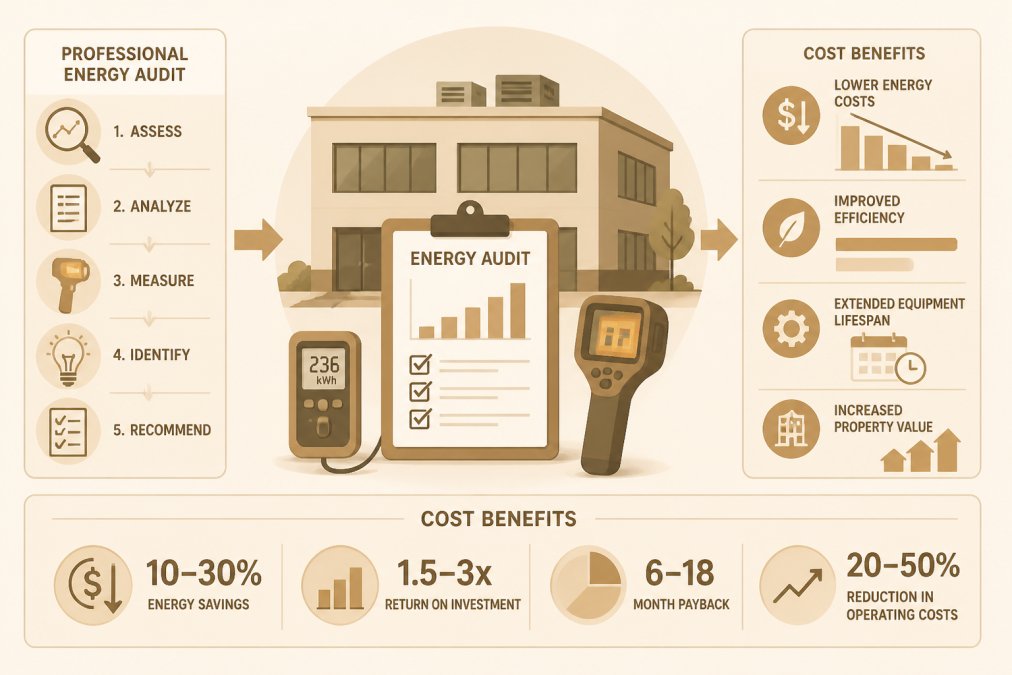
Professional energy audits are comprehensive, data-driven assessments using thermal imaging, blower door tests, and building envelope analysis to identify where energy is wasted and which upgrades deliver the greatest return.
The audit examines HVAC performance, insulation, air leaks, windows, and electrical systems, measuring thermal characteristics to reveal where conditioned air escapes and what prevents your home from performing as designed.
The audit identifies high-impact opportunities concentrated in just a few areas, allowing you to prioritize investments strategically rather than guessing.
Immediate Cost Savings and Return on Investment
Most homeowners who implement audit recommendations report measurable utility bill reductions within the first billing cycle, depending on current condition, local rates, and which upgrades they prioritize.
Energy efficiency improvements typically pay for themselves within five to seven years; homes with older HVAC systems often recover investment faster with high-efficiency replacements.
Compare annual energy savings against upgrade costs: a $2,000 air sealing project saving $400 annually delivers a five-year payback, then provides free savings for the remaining 15-25 year lifespan.
Average Utility Savings After Energy Audit
Homeowners implementing audit recommendations commonly report annual utility savings of 15-30 percent; homes with significant inefficiencies, older construction, or failing HVAC systems often see savings at the higher end.
Savings vary by upgrade: air sealing and duct sealing deliver 10-15 percent reductions; insulation adds 15-25 percent; HVAC upgrades reduce consumption 20-30 percent; LED lighting cuts lighting use 50-75 percent (though a smaller portion of total budgets).
Water heating optimization saves 5-10 percent of total energy costs; window upgrades and air infiltration control compound these benefits.
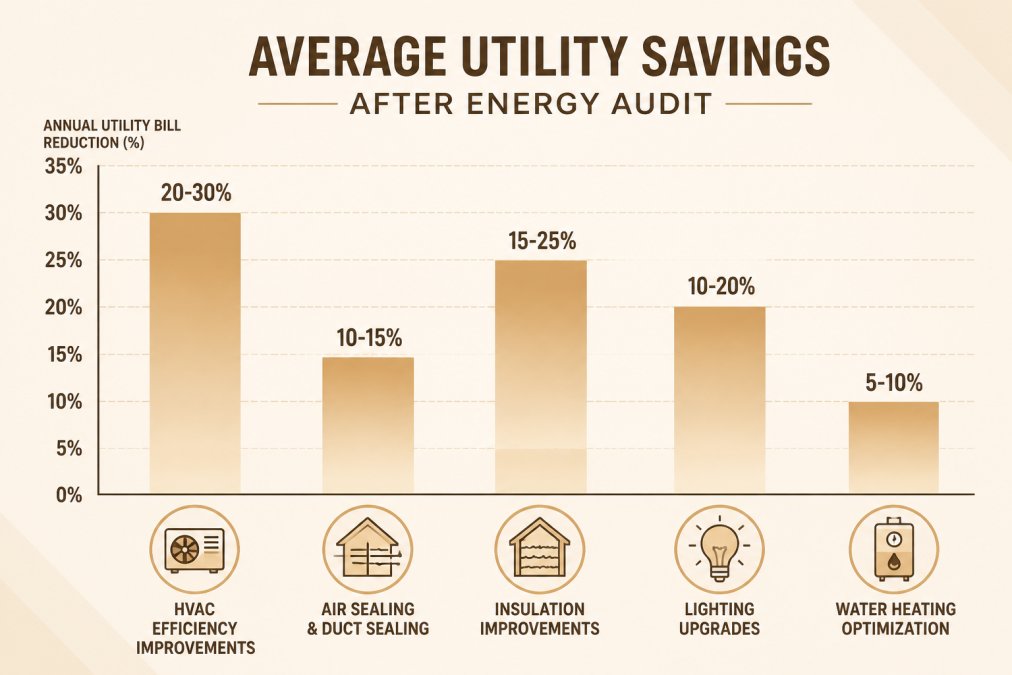
A home addressing multiple categories can realistically achieve 25-35 percent total energy consumption reduction, translating to substantial annual savings.
Home Energy Efficiency Tax Credits and Incentives
The Inflation Reduction Act created substantial tax credits for insulation, HVAC equipment, heat pumps, and water heaters, offsetting 30 percent of eligible costs, capped at $3,200 annually.
State and local programs vary widely: many offer rebates covering 50-100 percent of audit costs; utility companies rebate HVAC replacements and weatherization; some municipalities offer low-interest financing or tax abatements for efficiency targets.
The best approach is to check the Database of State Incentives for Renewables & Efficiency for programs specific to your location. Many incentive programs require that improvements be completed by certified contractors or that work meet specific efficiency standards, another reason professional guidance matters.
Combining federal tax credits, state rebates, and utility incentives can cover 50 percent or more of total project costs.
Beyond Savings: Comfort, Health, and Property Value
Beyond utility bill reduction, professional audits unlock three additional value streams: improved comfort and health, measurable resale value increases, and reduced maintenance costs.
Indoor Comfort and Health Benefits
A well-sealed envelope with proper insulation maintains consistent temperatures, reducing room-to-room variance from 5-10°F to 2-3°F, creating uniform comfort.
Air sealing paired with controlled ventilation improves indoor air quality by eliminating uncontrolled infiltration at windows, doors, outlets, and ductwork penetrations.
Better moisture control reduces mold 30-50 percent; duct sealing reduces dust circulation 20-40 percent; improved insulation lowers respiratory stress. Professional audits identify carbon monoxide risks from improperly vented appliances, life-threatening hazards invisible without professional testing.
Measurable Property Value Impact
Homes with recent efficiency upgrades and professional audit documentation sell 3-5 percent faster and command 2-4 percent higher prices, $8,000-$16,000 in a $400,000 market.
Premiums are strongest for recent (within 5 years), documented high-visibility upgrades like HVAC replacement or heat pumps; air sealing and insulation command smaller premiums unless documented with professional audit reports.
Mortgage lenders offer better interest rates for homes with Energy Star certification or recent professional energy audits, recognizing lower default risk from reduced utility costs.
The Audit Report as a Marketing Asset
Professional audit reports and completed improvements demonstrate proper maintenance and current efficiency standards, increasing buyer inquiries and offers.
Get your free electrical estimate →
Professional audit reports provide third-party credibility that DIY work cannot match, reducing buyer hesitation and negotiation friction.
Reduced Long-Term Maintenance and Replacement Costs
HVAC systems in well-sealed homes operate fewer hours, extending equipment life 3-5 years and deferring replacement costs. Proper insulation and air sealing reduce moisture damage that costs $5,000-$15,000 to remediate.
Properly insulated homes extend roof life 5-10 years; weatherstripped windows and doors require less maintenance.
How to Prepare for an Electrical Energy Audit
Gather utility bills from the past 12 months; this historical data helps auditors understand consumption patterns and seasonal variations.
List comfort complaints, cold/warm rooms, drafts, suspected waste, to help auditors prioritize investigation and connect findings to your experience.
Ensure auditor access to attic, basement, crawl space, and mechanical systems; clear pathways for visual inspection of insulation, ductwork, and equipment.
Service your HVAC system before the audit to ensure peak efficiency during testing and provide accurate baseline data.
List recent improvements or repairs so auditors understand which efficiency measures are in place and which opportunities remain.
Professional Audit vs. DIY Energy Assessment
DIY assessments catch obvious problems like missing insulation or visible leaks, but lack the precision and equipment of professional audits.
Professional audits use calibrated blower door tests, thermal imaging, and duct leakage testing to provide objective data DIY methods cannot replicate.
Professional auditors interpret data in context of your home's design, age, and condition, transforming measurements into a prioritized improvement roadmap.
DIY assessments cost $50-$200; professional audits cost $300-$800 but identify improvement opportunities worth thousands in future savings that DIY assessments miss.
| Assessment Type | Cost Range | Equipment | Accuracy | Actionability |
|---|---|---|---|---|
| DIY Visual Inspection | $0-50 | None | Basic | Limited |
| DIY Thermal Imaging | $50-200 | Consumer camera | Moderate | Moderate |
| Professional Audit | $300-800 | Calibrated equipment | High | Comprehensive |
Your Next Steps After the Audit
After receiving your audit report, the most common mistake homeowners make is treating all recommendations equally. Instead, create a prioritized implementation roadmap that sequences improvements by payback period, co-benefits, and funding availability. This strategic approach maximizes savings and allows earlier improvements to fund later ones.
Step 1: Categorize Recommendations by Payback Period
Your audit report should categorize improvements into three tiers: quick wins (payback under 2 years), medium-term investments (2-7 years), and long-term upgrades (7+ years). Quick wins typically include air sealing, duct sealing, and weatherstripping, these deliver immediate utility reductions at relatively low cost and should be your first priority. A $400 air sealing project that saves $150 annually pays back in under 3 years and improves HVAC performance for all subsequent upgrades.
Medium-term investments like insulation improvements, window replacements, or HVAC system upgrades require larger upfront costs but deliver substantial long-term savings. Long-term upgrades such as heat pump installations or solar-ready roof work may have extended payback periods but qualify for federal tax credits that dramatically improve their financial profile.
Step 2: Identify and Stack Available Incentives Before Committing
Federal tax credits under the Inflation Reduction Act cover 30 percent of costs for qualifying improvements including heat pumps, insulation, HVAC equipment, and water heaters, capped at $3,200 annually.
Step 4: Get Multiple Quotes from Certified Contractors
Step 5: Document Everything for Incentives and Future Resale
Frequently Asked Questions
What happens during a professional energy efficiency audit?
A professional energy auditor performs a comprehensive assessment of your home's energy consumption patterns. They use thermal imaging to detect heat loss, conduct a blower door test to identify air leaks, inspect your HVAC system performance, evaluate insulation levels, and review your utility bills. The auditor then provides a detailed report ranking energy-saving upgrades by cost-benefit analysis and estimated payback period, helping you prioritize improvements that deliver the best return on investment.
How much can you save on utility bills after an energy audit?
Savings vary based on your home's current condition and which upgrades you implement. Homeowners typically see 10-30% reductions in annual energy costs after addressing the issues identified in a professional audit. Air sealing and insulation improvements often yield 15-25% savings, while HVAC optimization and efficient lighting can add another 10-20%. The actual savings depend on your climate, local utility rates, and how comprehensively you address the audit recommendations.
Do energy audits qualify for federal tax credits or rebates?
Yes. The Inflation Reduction Act extended federal tax credits for home energy efficiency improvements through 2032. You can claim up to $3,200 annually for qualifying upgrades like insulation, air sealing, HVAC improvements, and heat pump installations. Many states and utility companies offer additional rebates for energy audits themselves or for implementing recommended upgrades. A professional energy auditor can identify which improvements qualify for available incentives in your area, effectively reducing your out-of-pocket costs.
How long does it take for an energy audit to pay for itself?
Most homeowners recoup the cost of a professional energy audit within 1-3 years through utility savings alone, depending on the upgrades implemented and your current energy consumption. High-impact improvements like air sealing, insulation, and HVAC upgrades often pay for themselves faster than lower-cost measures. When combined with federal tax credits and rebates, the payback period shortens significantly. The audit investment typically pays for itself multiple times over the life of your home's systems.