 listicle
Is Commercial Surge Protection Worth the Cost? (2026)
Table of Contents
- How Commercial Surge Protection Works (and Where It Fails)
- Benefits of Whole-Building Surge Protection for Commercial Properties
- Commercial Surge Protection Installation Cost: What Drives the Price
- Surge Protection Maintenance Best Practices
- Common Causes of Power Surges in Commercial Buildings
- Comparing Commercial Surge Protection Devices
- Is Commercial Surge Protection Worth the Cost? The Verdict
- Frequently Asked Questions
Last Updated: September 30, 2026
How Commercial Surge Protection Works (and Where It Fails)
Commercial surge protection is a layered defense installed at the electrical panel to divert excess voltage from sensitive equipment. It combines a metal oxide varistor (MOV), a circuit breaker, and a solid grounding path, and it is only as good as its weakest component.
The sacrificial nature of metal oxide varistors
The metal oxide varistor absorbs a surge by sacrificing itself. Each event consumes part of its capacity, and when that runs out the device can look normal while offering zero protection.
Joule rating and clamping voltage explained for buyers
Joule rating measures how much energy a device absorbs over its life; clamping voltage measures the level at which it starts diverting that energy. Higher joules and lower clamping voltages mean better protection, but neither number works alone.
Benefits of Whole-Building Surge Protection for Commercial Properties
Whole-building surge protection covers every circuit fed from your main panel, the practical advantage over plug-in strips. One installation protects HVAC equipment, elevators, lighting controls, security systems, and tenant electronics without devices at dozens of outlets.
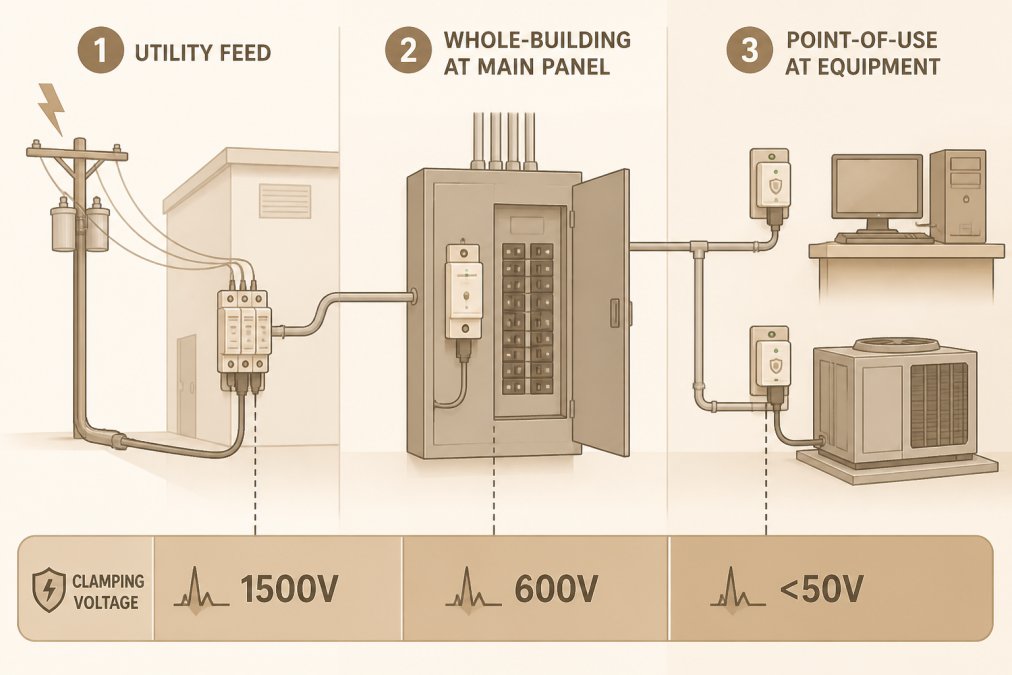
The benefits stack up in three areas:
- Equipment longevity: motors, compressors, and control boards survive more events before failing
- Fewer nuisance outages: surge damage often shows up as intermittent faults that are expensive to diagnose
- Insurance and liability clarity: documented protection supports claims and lease terms
Commercial Surge Protection Installation Cost: What Drives the Price
Commercial surge protection installation cost depends on panel configuration, device type, available breaker space, and the grounding and bonding work required. Any quote without an on-site panel inspection is a guess.
Other factors that move the number:
- Panel type and available space for a dedicated breaker
- Whether a Type 1 device is needed on the line side of the main disconnect
- Distance and routing from the panel to the grounding electrode
- Whether the work requires a permit and inspection
- Existing code deficiencies discovered during the install
Surge Protection Maintenance Best Practices
Surge protection maintenance best practices come down to checking status indicators, testing the ground path, and replacing spent modules on schedule. A device that is never inspected cannot be counted on.
Why surge protectors wear out: the sacrificial MOV
That is why the cost of surge protection is not a one-time number: it is an installed cost plus a replacement cycle. Budget for it like filter changes or belt replacements, a recurring line item, not a surprise.
A workable maintenance routine
- Inspect status indicators monthly and log the results
- Test the grounding and bonding connections annually
- Replace spent modules immediately when indicators show failure
- Re-torque panel connections during scheduled electrical maintenance
- Review event history after any major storm
- Replace the entire device on the manufacturer's recommended interval even if indicators still show green
That last item is the one most owners skip. Status indicators show whether the device has already failed, not how much capacity remains, so a device that absorbed several moderate events may still show green while near the end of its life. Following the manufacturer's replacement interval, typically every few years in a high-exposure building, is cheaper than gambling on the light.
What replacement actually costs you
The module or device itself is usually the smaller part of the number. Labor to de-energize the panel, swap the unit, verify the ground path, and re-test drives the bill, so combine surge device replacement with other scheduled electrical work rather than calling a separate service visit.
Insurance and documentation
Whether surge damage is covered depends on your policy and the cause of loss. Many commercial property policies cover lightning but exclude or limit utility switching, brownouts, and internal equipment faults. A documented maintenance record does not guarantee a claim, but it establishes the loss was not caused by neglected equipment, the argument adjusters look for when denying a claim.
Get your free electrical estimate →
Common Causes of Power Surges in Commercial Buildings
Lightning strikes are the surge cause everyone names, yet they cause a minority of the damage. Most surges in commercial buildings come from inside the facility and from the utility grid.
The usual sources break down like this:
| Surge Source | Typical Trigger | Equipment Most at Risk |
|---|---|---|
| Lightning strike | Direct or nearby strike | Everything on the panel |
| Utility switching | Grid reconfiguration, brownout recovery | Electronics, controls |
| Motor loads | HVAC, elevators, compressors cycling | Nearby circuits, controls |
| Internal switching | Large equipment powering on | Sensitive electronics |
| Wiring faults | Loose or degraded connections | Whole circuits |
Comparing Commercial Surge Protection Devices
Comparing commercial surge protection devices means matching Type 1 or Type 2 classification, surge current capacity, clamping voltage, and warranty to your building, not chasing the highest number on the box. The right device depends on where it installs and what it protects.
How to read the specs that actually matter
Most buyers compare one number and stop. Here is the order that matters:
- Surge current capacity (kA per mode): How much surge energy the device can divert in a single event. A unit rated at 50 kA per mode handles far more than one rated at 20 kA. Marketing labels often quote a combined total across all modes, which inflates the figure. Ask for the per-mode rating.
- Clamping voltage (let-through voltage): The voltage level at which the device starts diverting. Lower is better, because less excess voltage reaches your equipment. A device with high surge capacity but high clamping voltage still lets damaging voltage through.
- Joule rating: Total energy the device can absorb over its service life. Useful for comparison, but not a substitute for surge current capacity or clamping voltage. A high joule count with high clamping voltage is a poor choice for sensitive electronics.
- Modes of protection: Look for line-to-neutral, line-to-ground, and neutral-to-ground protection. A device that only protects line-to-neutral leaves a path for surges to reach equipment through the ground.
- Response time: Measured in nanoseconds. Faster is better, but almost every quality device is fast enough that this number rarely separates good units from bad ones.
Device comparison
| Device | Type | Standout Feature | Best For |
|---|---|---|---|
| Square D HEPD80 | Type 2 | LED status indicators | High-value electronics |
| Eaton CHSPT2SURGE | Type 2 | Compact load-center fit | Eaton panel buildings |
| Leviton Whole House | Type 2 | Modular, easy service | Mixed panel brands |
| Siemens FirstSurge | Type 2 | Audible surge alarm | Active monitoring needs |
| Sycom Surge Protection | Type 1/2 | Industrial-grade build | Heavy-duty facilities |
| Panamax PST-8 | Point-of-use | Noise filtration | AV and IT equipment |
| Bonbo FS140 | Type 1/2 | Weatherproof housing | Budget installations |
The smart-building angle most guides skip
Modern building systems are more sensitive than the equipment surge guides were written for. Smart thermostats, building automation controllers, networked lighting, access control panels, and IoT sensors run on low-voltage logic boards that fail at levels older appliances shrug off. A surge that was a nuisance for a 1990s rooftop unit can permanently brick a building automation controller and take HVAC scheduling, lighting scenes, and tenant access offline with it.
Is Commercial Surge Protection Worth the Cost? The Verdict
Commercial surge protection is worth the cost when a single equipment failure would exceed the installed price of protection, which describes most commercial properties. It is harder to justify for a small building with minimal electronics and clean power.
Frequently Asked Questions
How much should a good commercial surge protector cost?
Commercial surge protection pricing depends on the device type, joule rating, panel compatibility, and installation complexity. Equipment alone can range from a few hundred dollars for basic Type 2 units to over a thousand for high-capacity industrial models. Installation labor varies by electrical panel condition and whether a dedicated breaker is needed. Light Life Electric provides free estimates so you get an accurate figure for your property without surprise charges.
How often should commercial surge protection devices be replaced?
Most commercial surge protection devices last three to five years, but replacement depends on surge frequency and device type. MOV-based units degrade each time they absorb a surge, and status indicators or audible alarms signal when protection has expired. In high-lightning areas or buildings with frequent voltage spikes, annual inspections help you catch a spent device before it leaves your equipment exposed. Following surge protection maintenance best practices extends service life.
What are the primary risks of not having surge protection in a commercial building?
Without surge protection, a single large transient voltage can destroy HVAC controls, elevator boards, security systems, and tenant electronics in one event. The costs go beyond replacement hardware: business interruption, data loss, and emergency repair premiums add up fast. Recurring smaller surges shorten device longevity across the building, leading to premature failures that are hard to trace. A whole-building surge protector reduces those risks for a fraction of the potential loss.
Do commercial surge protectors protect against lightning strikes?
They help, but no surge protector can stop a direct lightning strike. A commercial surge protection device diverts the excess voltage from a nearby strike or a surge traveling through the utility grid, limiting damage to your electrical infrastructure. Proper grounding and a layered protection approach (whole-building plus point-of-use) give the best defense. If your building has sensitive electronics or critical systems, a licensed electrician can assess your grounding and recommend the right setup.
How do commercial surge protection devices differ from residential models?
Commercial surge protectors are built for higher surge capacity, longer duty cycles, and three-phase power systems common in business settings. They often include advanced monitoring, larger MOV arrays, and modular components for easier servicing. Residential units typically handle single-phase panels and lower joule ratings. For a commercial property, using a residential-grade device risks inadequate protection and voided equipment warranties. A licensed commercial electrician can match the device to your building's electrical load.