 ultimate-guide
Predictive Electrical Maintenance: The Business Case for Proactive Asset Management
Last Updated: October 24, 2026
Quick Summary
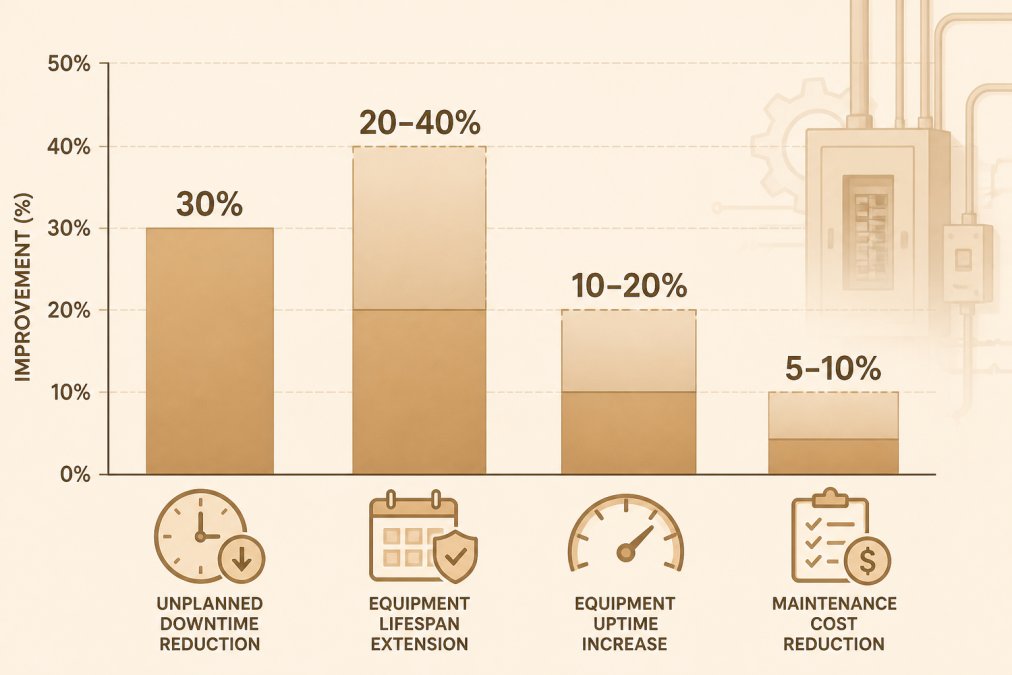
Predictive electrical maintenance uses real-time sensors and data analytics to detect potential equipment failures before they occur, enabling businesses to schedule repairs proactively and reduce unplanned downtime by 30-50% while extending asset lifespan by 20-40%.
- Predictive maintenance can reduce unplanned downtime by 30-50% compared to reactive approaches.
- Equipment lifespan can extend by 20-40% under condition-based monitoring strategies.
- Businesses achieve 5-10% reduction in overall maintenance costs and 10-20% increase in equipment uptime.
- Implementation involves five phases over 17+ weeks, starting with assessment and ending with full optimization.
- Integration with existing CMMS systems ensures predictive alerts actually drive maintenance action.
Table of Contents
- What Is Predictive Electrical Maintenance and How It Works
- Predictive vs. Preventive Maintenance: Understanding the Difference
- The Real-World Impact: How Predictive Electrical Maintenance Reduces Downtime
- Measuring Predictive Maintenance ROI: What Businesses Actually Save
- Predictive Maintenance Tools and Technologies for Electrical Systems
- Building an Electrical Maintenance Program That Works
- Getting Started: Implementation Roadmap and Common Adoption Challenges
- Schedule Your Electrical Assessment
- Frequently Asked Questions
What Is Predictive Electrical Maintenance and How It Works
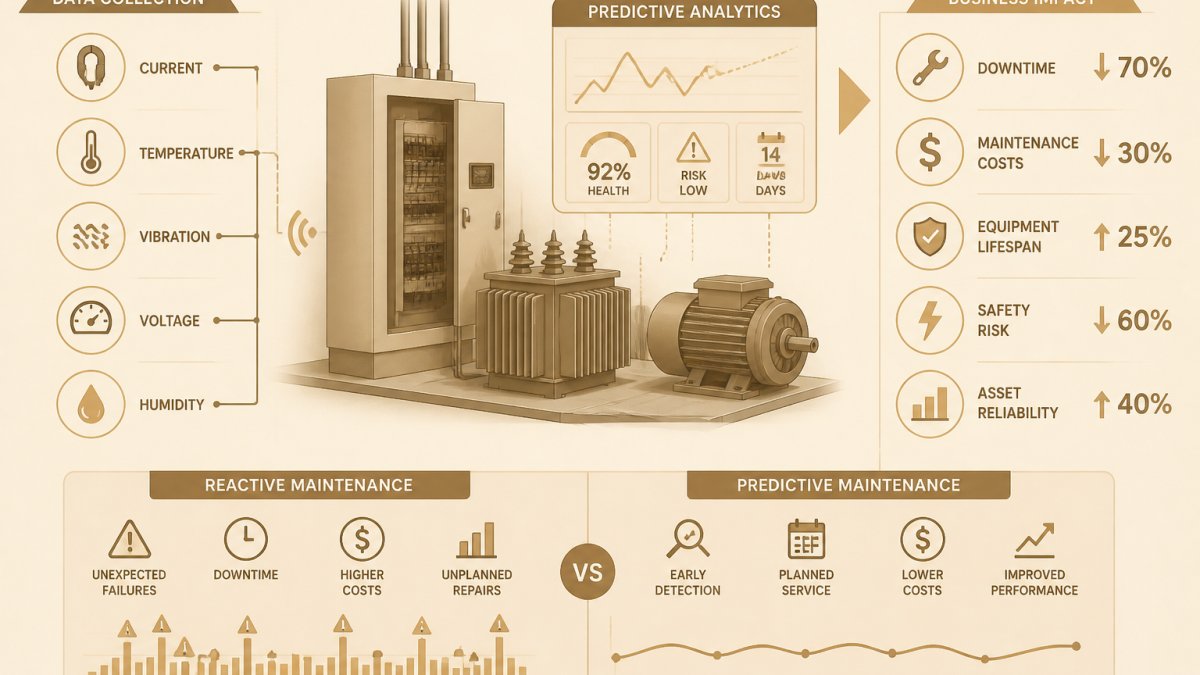
Predictive electrical maintenance is the practice of monitoring electrical system performance in real-time to detect potential failures before they occur, allowing maintenance teams to address issues proactively rather than waiting for equipment to fail. Unlike reactive approaches that respond only after a breakdown, this method uses sensors, data analytics, and condition-based monitoring to track asset health continuously.
The core mechanism relies on IIoT sensors installed on critical electrical infrastructure. These devices measure vibration, temperature, power quality, and energy consumption patterns. Machine learning algorithms analyze this real-time data to identify fault detection signatures that precede equipment failure. When the system detects an anomaly, maintenance teams receive an alert and can schedule repairs during planned downtime rather than facing unexpected outages.
This approach transforms how facilities manage their electrical infrastructure. Instead of following fixed maintenance schedules regardless of actual equipment condition, teams make decisions based on genuine performance data. A transformer running cool and stable might operate safely for months beyond its scheduled service date. One showing rising thermal signatures gets serviced immediately, preventing catastrophic failure.
Businesses that adopt condition-based monitoring gain visibility into asset lifecycle patterns they never had before, enabling smarter resource allocation and reducing the emergency calls that disrupt operations.
Predictive vs. Preventive Maintenance: Understanding the Difference
The distinction between predictive and preventive approaches fundamentally changes how maintenance budgets work and when downtime occurs. Preventive maintenance operates on a fixed schedule: replace components every six months, service equipment annually, or follow manufacturer guidelines regardless of actual condition. It's systematic and reduces reactive failures, but it often replaces parts that still have useful life remaining.
Predictive maintenance, by contrast, monitors actual equipment condition and schedules work only when data indicates it's necessary. This eliminates unnecessary interventions while catching real problems early. The trade-off is clear: preventive requires less monitoring infrastructure but generates higher material waste and scheduled downtime. Predictive requires upfront investment in sensors and analytics but extends equipment lifespan and reduces both planned and unplanned interruptions.
Consider a circuit breaker in a commercial facility. Preventive maintenance might call for replacement every five years on schedule. Predictive monitoring tracks its switching performance and electrical characteristics. If those metrics remain stable, the breaker operates safely for seven or eight years. If degradation appears in year three, the system alerts the team immediately.
The financial implication is significant. Preventive maintenance assumes a fixed cost structure. Predictive maintenance front-loads investment in monitoring but reduces total maintenance spending through better timing and reduced emergency response costs.
The Real-World Impact: How Predictive Electrical Maintenance Reduces Downtime
Unscheduled downtime is expensive. When critical electrical systems fail unexpectedly, operations halt, customers experience service interruptions, and emergency repair crews charge premium rates. The cost compounds across multiple dimensions: lost productivity, emergency labor, expedited parts procurement, and potential equipment damage from abrupt shutdown.
Research indicates that implementing advanced asset health management programs can reduce unplanned downtime by 30% to 50%. This isn't theoretical. Facilities using real-time condition monitoring catch problems at early stages when repairs are simpler and faster.
The mechanism is straightforward: predictive systems provide early warning. Learn more about minimizing disruption during system failure repair to further protect your operations.
Facilities that transition from reactive to condition-based monitoring report fewer midnight emergency calls and more predictable maintenance schedules. The operational stability allows businesses to plan confidently around their electrical infrastructure rather than treating it as a constant risk.
An additional benefit emerges over time: system reliability improves as a feedback loop. With fewer emergency failures, maintenance teams can focus on planned improvements and optimization rather than constantly fighting fires. This shift in operational tempo enables better decision-making about infrastructure upgrades and replacements.
Measuring Predictive Maintenance ROI: What Businesses Actually Save
Calculating return on investment for predictive electrical maintenance requires tracking multiple cost categories. Direct savings come from reduced emergency repair labor, avoided expedited parts costs, and lower overall maintenance material expenses. Indirect savings emerge from improved operational efficiency, reduced unplanned downtime, and extended equipment lifespan.
A 2026 market report estimates that companies using predictive maintenance can achieve a 10% to 20% increase in equipment uptime and a 5% to 10% reduction in overall maintenance costs. The uptime improvement directly translates to revenue preservation.
Equipment lifespan extension represents another significant ROI component. Research indicates that predictive maintenance strategies can extend the operational life of machinery and electrical assets by 20% to 40%. This defers capital replacement expenses by years. A transformer with a typical 25-year lifespan might operate for 30-35 years under condition-based monitoring, deferring a major capital expense indefinitely.
The ROI calculation also includes reduced labor inefficiency. Emergency repairs require overtime, expedited scheduling, and reactive problem-solving. Planned maintenance using condition-based data allows crews to work during normal hours, complete repairs more efficiently, and address multiple issues in single service visits. Many facilities report 15-20% labor productivity improvements after implementation.
The payback period depends on facility size, infrastructure complexity, and current downtime frequency. A facility experiencing frequent electrical issues sees faster payback than one with historically stable systems.
Predictive Maintenance Tools and Technologies for Electrical Systems
Implementing predictive electrical maintenance requires three core technology components: sensors for data collection, analytics platforms for pattern recognition, and integration with existing facility management systems.
Sensor technologies form the foundation. Thermal imaging cameras detect heat signatures indicating electrical stress or component degradation. Vibration sensors identify mechanical problems in motors and rotating equipment. Power quality monitors track voltage stability, harmonics, and energy consumption patterns. These devices communicate continuously with central monitoring systems, creating a real-time picture of electrical infrastructure health.
Analytics platforms process this sensor data to identify fault detection patterns. Machine learning algorithms compare current readings against historical baselines and known failure signatures. When patterns emerge that precede equipment failure, the system generates alerts. The sophistication of these algorithms determines accuracy:
Integration with existing CMMS (Computerized Maintenance Management Systems) is critical. Predictive insights must flow into the same work order system your maintenance teams already use. When an alert generates, it should automatically create a work order with priority level, estimated duration, and required parts. This integration eliminates manual data transfer and ensures alerts actually trigger action.
The technology stack varies by facility size and complexity. Small commercial properties might use basic thermal monitoring and simple analytics. Large industrial facilities implement comprehensive IIoT sensor networks with advanced machine learning models. The key is matching technology sophistication to infrastructure criticality and operational requirements.
Building an Electrical Maintenance Program That Works
Successful implementation of predictive electrical maintenance requires more than purchasing sensors. It demands organizational change, staff training, and integration with existing maintenance workflows.
Get your free electrical estimate →
Start by auditing your current electrical infrastructure. Light Life Electric offers commercial electrical services including circuit installation, lighting, transformers, and generator solutions to support your maintenance program. Identify critical systems where failure has the highest operational or safety impact.
Next, establish baseline performance data. Before predictive analytics can identify problems, the system needs months of normal operating data to understand what "healthy" looks like for your specific equipment. This baseline period typically runs 60-90 days.
Training your maintenance team is essential. Predictive maintenance shifts their role from reactive troubleshooting to proactive planning.
Integration with your existing maintenance scheduling is critical. Predictive insights must flow into the same work order system your team already uses. When an alert indicates a developing problem, it should automatically create a work order with the right priority level.
Systematic review of predictive maintenance practices found that condition-based monitoring significantly improves maintenance outcomes. However, success depends on implementation quality and organizational commitment. Many facilities fail because they install sensors but don't change their maintenance workflows or training accordingly.
You can contact Light Life Electric to discuss how to assess your electrical infrastructure and develop a condition-based monitoring strategy tailored to your facility.
Getting Started: Implementation Roadmap and Common Adoption Challenges
The path to predictive electrical maintenance involves distinct phases, each with specific objectives and potential obstacles.
Phase 1: Assessment and Planning (Weeks 1-4) Begin by cataloging your electrical infrastructure and identifying which systems matter most for operations.
Phase 2: Technology Selection and Installation (Weeks 5-12) Choose sensors and analytics platforms that match your facility's complexity and budget constraints.
Phase 3: Baseline Data Collection (Weeks 9-16) Let the system collect normal operating data for 60-90 days. During this period, suppress alert generation.
Phase 4: Alert Tuning and Workflow Integration (Weeks 13-20) Enable alerts gradually, starting with your highest-confidence detection algorithms. Integrate alerts into your existing work order system.
Phase 5: Full Implementation and Optimization (Weeks 17+) Expand monitoring to additional assets based on lessons learned. Continue training your team.
Common Adoption Challenges
The most frequent obstacle is organizational resistance. Maintenance teams accustomed to reactive work sometimes resist the shift to proactive planning.
Cybersecurity risks emerge when adding networked sensors to your electrical infrastructure.
Skill gaps appear when teams lack training on new monitoring tools or data interpretation. Budget for formal training and ongoing support.
Integration challenges occur when predictive alerts don't connect smoothly to existing maintenance workflows. Invest time in CMMS integration and workflow design.
Market Research Future report on predictive maintenance market projects continued growth in predictive maintenance adoption, driven by businesses recognizing these implementation challenges and investing in solutions that address them directly.
The services Light Life Electric provides include assessment of your electrical infrastructure and guidance on implementing condition-based monitoring.
Schedule Your Electrical Assessment
Predictive electrical maintenance transforms how businesses manage electrical infrastructure risk. The shift from reactive responses to condition-based monitoring reduces unplanned downtime, extends equipment lifespan, and lowers total maintenance costs. Implementation requires planning, technology investment, and organizational commitment, but the operational benefits justify the effort.
Light Life Electric helps businesses in Southwest Florida assess their electrical infrastructure and develop maintenance strategies that improve reliability. We understand the specific challenges of electrical systems in our climate and operational environment. Get your free electrical estimate to discuss how predictive maintenance approaches could benefit your facility's performance and safety.
| Benefit | Impact | Timeline |
|---|---|---|
| Unplanned downtime reduction | 30-50% fewer emergency failures | 6-12 months |
| Equipment lifespan extension | 20-40% longer operational life | Ongoing |
| Maintenance cost savings | 5-10% reduction in total costs | 12-18 months |
| Equipment uptime increase | 10-20% higher availability | 6-12 months |
Frequently Asked Questions
What is the main difference between predictive electrical maintenance and preventive maintenance?
Preventive maintenance follows a fixed schedule regardless of equipment condition, while predictive electrical maintenance uses real-time data from sensors and monitoring systems to identify issues before they occur. Preventive maintenance may result in unnecessary service calls and component replacements. Predictive maintenance addresses problems only when data indicates they are developing, reducing labor costs and unnecessary downtime while extending asset lifespan by 20-40%.
How much can a business save with predictive maintenance ROI?
Companies implementing predictive maintenance achieve 5-10% reductions in overall maintenance costs and 10-20% increases in equipment uptime, according to 2026 research. Additionally, predictive electrical maintenance can reduce unplanned downtime by 30-50% and extend equipment operational life by 20-40%. The exact ROI depends on facility size, equipment criticality, and current maintenance practices, so a customized assessment determines your specific savings potential.
What predictive maintenance tools are most effective for electrical systems?
Common predictive maintenance tools for electrical systems include thermal imaging to detect overheating components, vibration analysis for motor and bearing health, power quality monitoring to track voltage and current patterns, and IIoT sensors for real-time asset health data. Condition-based monitoring systems integrate these tools to provide centralized visibility. The right combination depends on your facility's critical infrastructure, equipment types, and existing CMMS integration capabilities.
How do I build an electrical maintenance program that actually reduces downtime?
Start by identifying critical electrical assets and installing condition-based monitoring sensors. Establish baseline performance data, set fault detection thresholds, and integrate real-time data into your maintenance scheduling system. Train your team to interpret predictive analytics and respond to alerts before equipment fails. Partner with a certified electrical contractor to design a program tailored to your facility's needs, ensuring proper sensor placement, data analysis, and maintenance optimization from day one.