 how-to
Signs of an Overloaded Electrical Circuit
Last Updated: October 23, 2026
Quick Summary
An overloaded electrical circuit occurs when the total electrical demand on a circuit exceeds its safe capacity, typically 15 or 20 amps. Common signs include flickering lights, warm or discolored outlets, frequently tripped breakers, buzzing sounds, and burning smells near outlets or the electrical panel.
- A 15-amp circuit safely handles about 1,440 watts continuously; a 20-amp circuit handles about 1,920 watts.
- Flickering lights when appliances turn on signal voltage drops from circuit stress and demand spikes.
- Warm outlets or brown, black, or charred marks around outlets require immediate attention from a licensed electrician.
- Never plug multiple high-draw appliances like microwaves, hair dryers, and toasters into the same circuit outlet.
- Daisy-chaining power strips creates fire hazards and masks overload problems; have an electrician add circuits instead.
Table of Contents
- What an Overloaded Electrical Circuit Means
- Overloaded Circuit Symptoms You Can See
- Frequently Tripped Circuit Breakers and Blown Fuses
- Audible and Olfactory Warning Signs
- What Causes a Circuit to Overload
- How to Prevent Overloaded Circuits
- When to Call a Licensed Electrician
- Frequently Asked Questions
What an Overloaded Electrical Circuit Means
An overloaded electrical circuit occurs when the total electrical demand on a circuit exceeds its safe capacity.
Your electrical panel contains circuit breakers or fuses designed to protect wiring from overheating.
Recognizing the warning signs early prevents dangerous situations and costly repairs.
Overloaded Circuit Symptoms You Can See
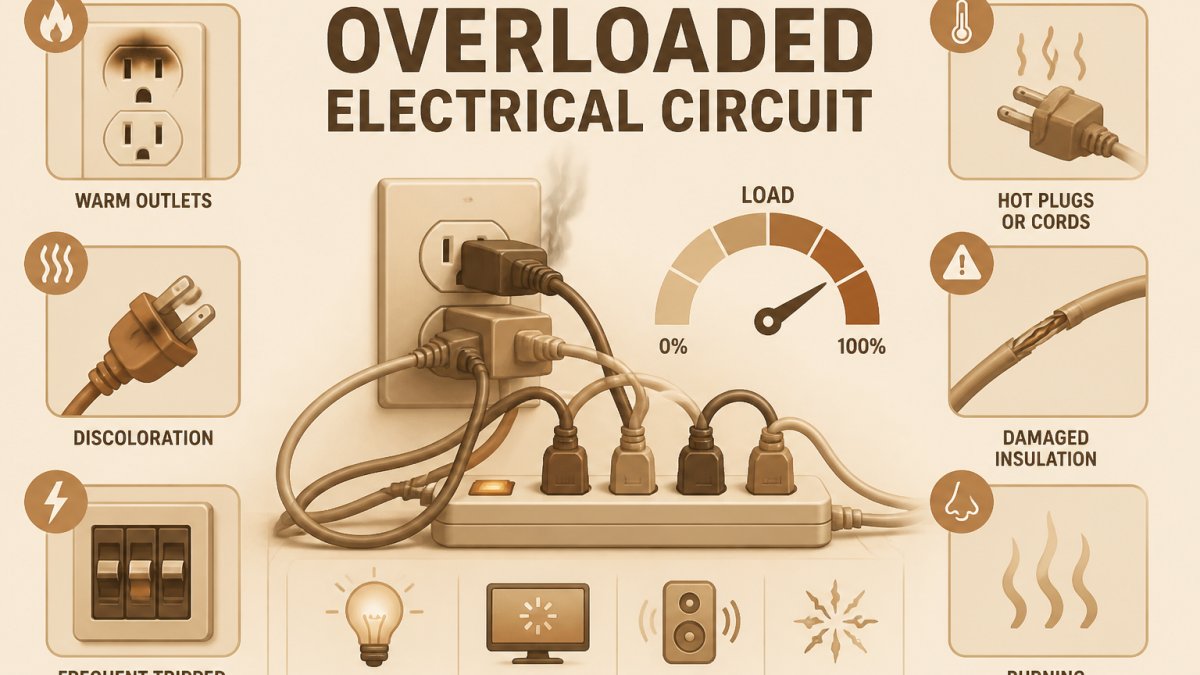
Visual signs of an overloaded circuit are often the first clues. Look for these specific indicators around your outlets and switches.
Flickering, Blinking, or Dimming Lights
Lights that flicker or dim when you turn on an appliance signal circuit stress, because voltage drops when demand spikes.
This means the circuit is struggling to deliver steady power, which stresses your electrical system and shortens the life of bulbs and appliances.
Warm or Discolored Outlets and Wall Plates
Feel the area around your outlets. They should be cool to the touch. Warm outlets mean excessive current is flowing through them, generating heat.
Brown, black, or charred marks around outlets are red flags, and discolored wall plates indicate the outlet behind them is overheating.
Frequently Tripped Circuit Breakers and Blown Fuses
A circuit breaker that trips occasionally is normal. But frequent tripping means your circuit is regularly exceeding its capacity.
What Happens When a Breaker Trips
When a breaker trips, it's doing its job, stopping current flow to prevent a fire.
If the same breaker trips repeatedly, especially within hours or days, you have an overloaded circuit. Learn specific troubleshooting steps to identify and resolve the underlying cause.
Blown Fuses as an Older Home Warning Sign
Older homes use fuses instead of circuit breakers. A blown fuse looks like a small cylinder with a blackened window, designed to fail safely before wiring overheats.
If you're replacing fuses frequently, your circuits are overloaded. Consider reviewing your home's electrical system through a circuit breaker box vs fuse box comparison to understand how older systems differ from modern ones.
Audible and Olfactory Warning Signs
Some warning signs assault your senses. Listen and smell carefully around your electrical panel and outlets.
Buzzing Sounds from Outlets or Switches
A buzzing or humming sound from an outlet or switch indicates loose connections or arcing electricity.
This is serious: your outlet or switch is damaged and poses a fire risk. Never ignore buzzing sounds; they require immediate professional inspection.
Burning or Melting-Plastic Odors
A burning smell near outlets, switches, or your electrical panel is an emergency warning sign, often resembling burning plastic or rubber. Discover prevention strategies for electrical fires in older homes to reduce hazards in your wiring.
This odor indicates overheating insulation or melting components inside the outlet or panel. According to the Electrical Safety Foundation International guidance on home electrical hazards, burning odors near electrical equipment require emergency professional assessment.
What Causes a Circuit to Overload
An overload is only one of several reasons a circuit fails, and the symptoms overlap enough that homeowners often misread the cause. The fixes differ, and some faults are far more dangerous than a simple overload.
The overload mechanism
An overload happens when the total current drawn by everything on a circuit exceeds its rating long enough to heat the wiring.
A simple example: a 1,500-watt microwave plus a 1,500-watt toaster is 3,000 watts, well past a 20-amp circuit's 1,920-watt working limit.
Overload vs. short circuit
A short circuit is a direct, low-resistance path between hot and neutral, or hot and ground. It draws massive current almost instantly, and the breaker trips immediately, often with a snap or pop. An overload builds gradually and usually trips after seconds to minutes of use.
Overload vs. ground fault
A ground fault is current leaking from hot to ground, often through water, a damaged cord, or a failed appliance. It may not trip a standard breaker at all, which is why kitchens, bathrooms, garages, and outdoor outlets use ground-fault circuit interrupter (GFCI) devices.
Overload vs. loose connection
A loose connection, such as a backstabbed outlet or a wire not tightened under a terminal screw, creates resistance and local heat without necessarily drawing enough current to trip the breaker. That's why a warm or discolored outlet can exist on a circuit that never trips, and why a loose connection is arguably more dangerous than an overload: the breaker may never act.
Overload vs. utility-side problems
If lights across the whole house dim or brighten together, or your neighbors notice the same thing, the cause may be on the utility side rather than in your wiring. Whole-house flicker with no appliance pattern is worth reporting to your utility; a single misbehaving circuit is almost always a premises problem.
Get your free electrical estimate →
Too many appliances on one circuit
Most overloads come down to load concentration. Common high-draw appliances and typical wattage:
- Microwave: 1,000-1,500 watts
- Hair dryer: 1,200-1,800 watts
- Toaster: 1,200-1,500 watts
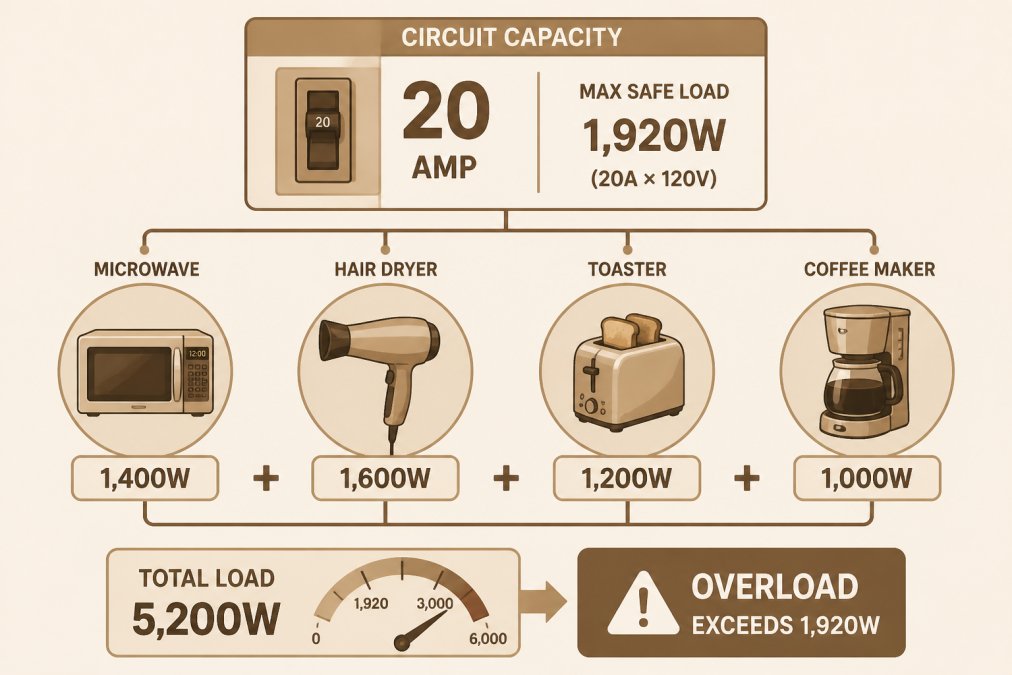
A microwave and toaster together already pass 2,500 watts on a 20-amp circuit. Add a coffee maker and the circuit trips to protect the wiring.
Power strips and extension cords as hidden culprits
A power strip does not increase circuit capacity; it only adds outlets. Plugging several high-draw devices into one strip still puts the entire load on a single circuit. Daisy-chaining strips compounds the problem and is a recognized fire hazard.
Older homes and undersized circuits
Homes built before the 1960s often have 15-amp circuits, fewer of them, and wiring never designed for today's appliance loads.
Common household appliances draw varying amounts of power, and running multiple high-draw devices on the same circuit quickly exceeds safe limits.
| Appliance | Typical Wattage | Notes |
|---|---|---|
| Microwave | 1,000-1,500 watts | High draw, common overload trigger |
| Hair dryer | 1,200-1,800 watts | Among the highest-draw appliances |
| Toaster | 1,200-1,500 watts | High draw, often combined with other devices |
| Space heater | 1,000-1,500 watts | Significant load, seasonal use |
| Coffee maker | 800-1,200 watts | Moderate draw, frequently used |
| Washing machine | 500-1,000 watts | Lower draw than kitchen appliances |
How to Prevent Overloaded Circuits
Prevention is far simpler than dealing with repeated failures. These strategies reduce overload risk significantly.
Distribute Appliances Across Multiple Circuits
The easiest fix is spreading demand across different circuits. Use outlets on different circuits for high-draw appliances.
First, map your circuits: flip breakers one at a time and note which outlets go dark. Once you know your layout, avoid plugging multiple power-hungry devices into outlets on the same circuit.
For example:
- Run your microwave on one circuit
- Plug your toaster into an outlet on a different circuit
- Use a third circuit for your coffee maker
This simple distribution prevents most overloads.
Know Your Circuit Capacity and Load
Most modern homes have 15-amp or 20-amp circuits; older homes might have 15-amp circuits only.
Calculate the total wattage of devices you want to run simultaneously and stay below 80% of your circuit's capacity: about 1,150 watts continuously on a 15-amp circuit and 1,540 watts on a 20-amp circuit.
If you're unsure about your home's capacity, learn more about upgrading electrical capacity for homes to understand long-term solutions.
Avoid Daisy-Chaining Power Strips
Never plug a power strip into another power strip. This creates fire hazards and masks overload problems.
If you need more outlets, have a licensed electrician add circuits or outlets. It costs more upfront but prevents dangerous situations and gives you peace of mind.
When to Call a Licensed Electrician
Not every warning sign carries the same urgency. Some mean "stop and fix this today," others mean "get out and call for help." Sorting symptoms into tiers keeps you from panicking over a dimming lamp or ignoring a genuine hazard.
Tier 1: Act immediately, then call
These signs mean the circuit is already generating dangerous heat or arcing. Reduce the load and get professional help the same day.
- A breaker that trips again within minutes of being reset, or trips with nothing new plugged in
- An outlet, switch, or wall plate that is warm to the touch or shows brown, black, or charred marks
- A cord or plug that feels hot, or a plug that has visible scorching
Safe sequence: unplug devices on that circuit if you can do so without touching a hot or damaged plug, switch the breaker to OFF (not just reset it), and leave it off until an electrician inspects it.
Tier 2: Emergency, evacuate and call 911
Treat these as a fire in progress, even if you do not yet see flames:
- Smoke coming from an outlet, switch, cord, or the electrical panel
- Sparks or a popping, snapping sound at an outlet or panel
- A strong burning or melting-plastic smell that does not clear when you turn the circuit off
Get everyone out, call 911 from outside, and do not re-enter to flip breakers. If the panel itself is smoking or sparking, do not approach it at all.
Tier 3: Schedule an electrician soon
These are not emergencies, but they will not fix themselves and often point to a circuit that is chronically at its limit:
- Flickering or dimming lights that happen only when a specific appliance starts
- A breaker that trips every few weeks or months under heavy use
- Lights that dim elsewhere in the house when the air conditioner or dryer kicks on
What an electrician will actually check
A licensed electrician does not just reset the breaker. A typical visit includes measuring the actual load with a clamp meter, checking breaker and wire sizing against the circuit's rating, tightening or replacing backstabbed or loose connections, testing outlets for grounding and polarity, and inspecting the panel for heat damage or double-tapped breakers.
If you notice any Tier 1 or Tier 2 sign, access emergency electrical repair services rather than waiting for a scheduled appointment. For older homes, where outdated wiring may not handle modern appliance loads, a professional capacity assessment can help prevent problems.
Frequently Asked Questions
What are the main danger signs of an electrical overload?
The most common warning signs of an overloaded electrical circuit include frequently tripped circuit breakers, flickering or dimming lights, warm or discolored outlets and wall plates, buzzing sounds from outlets, and burning or melting-plastic smells. If you notice any of these signs, reduce the electrical load on that circuit immediately by unplugging non-essential appliances. Multiple warning signs together indicate a serious hazard that requires professional attention from a licensed electrician.
Can an overloaded circuit cause a fire?
Yes, an overloaded circuit poses a genuine fire hazard. When a circuit carries more electrical load than it is designed to handle, wiring and connections overheat. This heat can damage insulation, cause arcing, and ignite nearby materials. Warm outlets, discolored wall plates, and burning smells are all fire-risk indicators. Never ignore these signs. If you suspect overload, stop using that circuit and contact a licensed electrician to assess and resolve the problem before a fire develops.
Why does my circuit breaker keep tripping?
A circuit breaker that keeps tripping is designed to protect your home by cutting power when the electrical load exceeds the circuit's capacity. This is a safety feature, not a defect. Common causes include running too many appliances simultaneously on the same circuit, a short circuit, or a ground fault. If a breaker trips once, unplug some devices and reset it. If it trips repeatedly, stop resetting it and call a licensed electrician to diagnose whether you have an overload, a fault, or an undersized circuit that needs upgrading.
How do I distinguish an overloaded circuit from a short circuit?
An overloaded circuit typically trips gradually when you plug in or turn on too many devices at once. A short circuit usually causes an immediate trip and may produce a burning smell or spark. Overload warning signs develop over time: warm outlets, flickering lights, and frequent breaker trips. Short circuits are often sudden and accompanied by a distinct burning odor or visible damage to cords. When in doubt, do not attempt to diagnose it yourself. A licensed electrician can test the circuit, identify the root cause, and recommend safe repairs or upgrades.