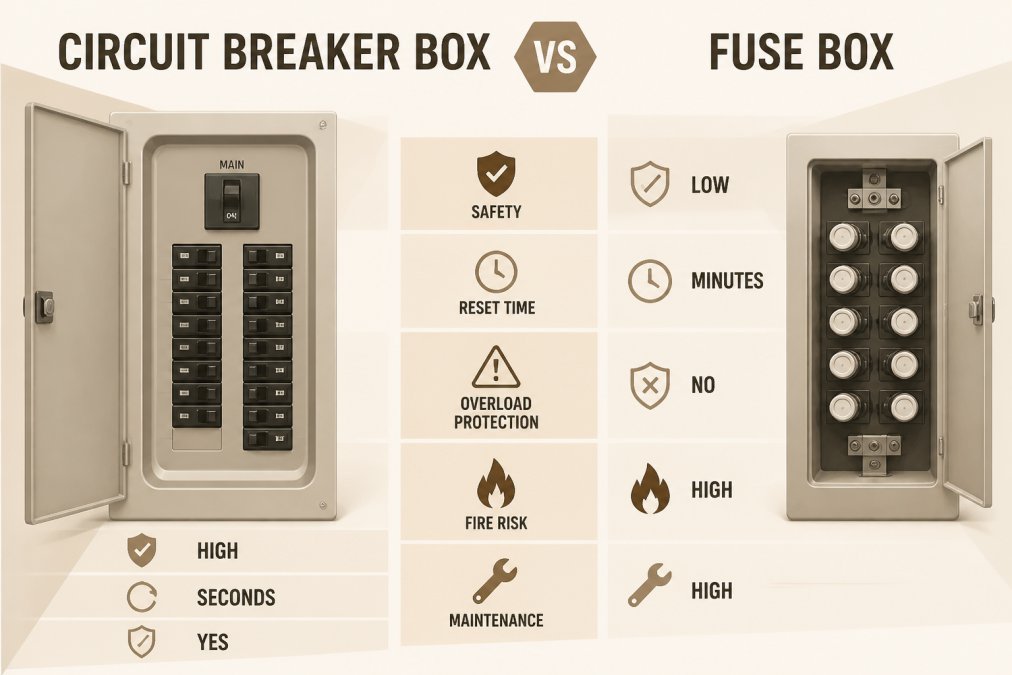
 comparison
Circuit Breaker Box vs Fuse Box: Safety Comparison
Table of Contents
- Circuit Breaker Box vs Fuse Box: Core Safety Differences
- Signs of an Outdated Electrical Panel
- Why Replace a Fuse Box with a Circuit Breaker Panel
- How to Tell If Your Electrical Panel Needs Replacing
- Electrical Panel Upgrade Cost and Installation
- Modern Circuit Breaker Technology and Smart Options
- Frequently Asked Questions
Last Updated: September 21, 2026
Circuit Breaker Box vs Fuse Box: Core Safety Differences
A circuit breaker box and a fuse box serve the same fundamental purpose: they protect your home's electrical system from overload and short-circuit damage. But the way they work, how they fail, and what that means for your safety couldn't be more different. Understanding the circuit breaker box vs fuse box safety comparison is essential if you're living in an older home or considering an electrical upgrade.
Here's the core distinction: fuses are one-time-use devices that melt when current exceeds their rating. Circuit breakers are automatic switches that trip and can be reset. This difference shapes everything from how quickly your home responds to electrical emergencies to whether your insurance company will insure you at standard rates.
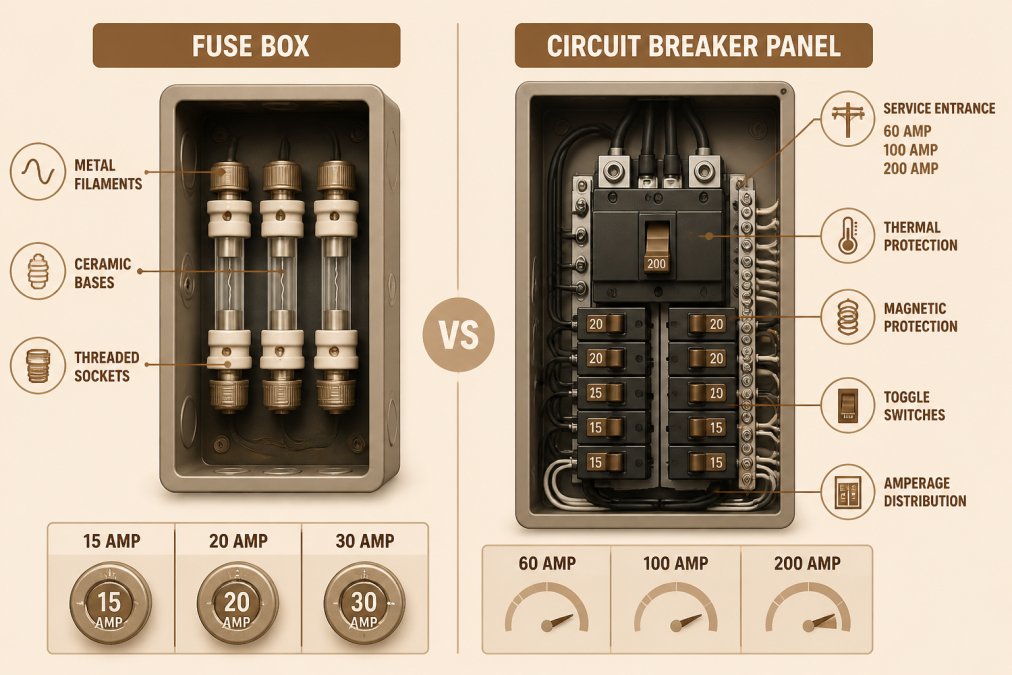
How Circuit Breakers Work
A circuit breaker is an automatic switch that interrupts electrical flow when it detects an unsafe condition. Inside the breaker, two protection mechanisms work together: thermal protection and magnetic protection.
When current flows through a circuit breaker, it passes through a bimetallic strip. If current stays elevated for several seconds, the strip heats up and bends, triggering the switch to flip off. This thermal protection handles sustained overloads like a refrigerator running constantly on an undersized circuit.
Magnetic protection kicks in instantly when current spikes dramatically, what happens during a short-circuit. A coil inside the breaker generates a magnetic field proportional to the current. When current surges beyond the breaker's rating, the magnetic field becomes strong enough to pull a latch, snapping the switch open in milliseconds. This prevents electrical fire hazard conditions that could develop within seconds of a short-circuit.
The critical advantage: once the dangerous condition clears, you simply flip the breaker back on. No replacement parts needed. No waiting for a hardware store to open. The same breaker protects your home indefinitely.
How Fuses Work
A fuse operates on a simpler principle: a metal filament melts when current exceeds its rating. The filament sits inside a ceramic or glass tube, surrounded by arc-extinguishing material. When current flows through the filament, resistance generates heat. If current stays above the fuse's rated amperage, the filament reaches its melting point and breaks the circuit.
The problem is irreversibility. Once a fuse blows, it's destroyed. You must physically remove it, identify the correct replacement amperage, and install a new fuse. In the dark, during an emergency, under stress, this becomes a real safety issue. People sometimes install a fuse with the wrong amperage rating, bypassing the protection entirely.
Fuses also lack the speed of magnetic protection. They rely on the filament's heat capacity, which means they respond more slowly to short-circuits than circuit breakers do. In a true electrical emergency, those extra milliseconds matter. The longer a short-circuit persists, the greater the risk of electrical fire hazard conditions developing inside walls or appliances.
Signs of an Outdated Electrical Panel
An aging electrical panel creates risk even if it hasn't failed yet. Watch for these warning signs that your system needs attention.
Frequent tripping or blown fuses. If your breakers trip regularly or you're replacing fuses weekly, the panel is signaling that your electrical load exceeds its capacity. This isn't a minor inconvenience, it's your system telling you it's working beyond its design limits. A professional electrician should evaluate whether you've added too many devices or whether the panel itself needs upgrading.
Flickering lights or dimming when appliances start. This indicates voltage drops under load, suggesting the panel or service entrance can't deliver sufficient current to all your devices simultaneously. It's a sign the electrical distribution system is stressed.
Burning smell near the panel or scorch marks on the cover. This is an immediate red flag. Overheating components can ignite, creating an electrical fire hazard. Do not ignore this. Call a licensed electrician immediately.
Panel is warm to the touch. The electrical panel should be cool. Heat indicates resistance in connections or components working beyond capacity.
Rust or corrosion on the panel exterior. Moisture inside the panel degrades components and increases short-circuit risk. This is especially common in humid climates.
The panel is more than 25-30 years old and still uses fuses. Age alone isn't disqualifying, but combined with fuse technology, it signals that your home's electrical infrastructure predates modern appliance demands. Today's homes use far more electricity than homes from the 1990s.
Why Replace a Fuse Box with a Circuit Breaker Panel
The shift from fuses to circuit breakers represents a fundamental safety advancement. Modern electrical code requires circuit breaker technology in all new construction and upgrades. Understanding why reveals the real safety gap.
Safety Concerns with Old Fuse Boxes
Fuse boxes create several specific hazards that circuit breaker panels eliminate.
Get your free electrical estimate →
Slow response to short-circuits. A short-circuit can generate thousands of amps in milliseconds. Fuses rely on filament melting, which takes longer than the magnetic trip mechanism in circuit breakers. Those milliseconds allow current to flow through wiring, creating intense heat. If that wiring runs through a wall cavity, heat can ignite insulation or framing lumber. Electrical fire hazard conditions develop rapidly.
Temptation to bypass protection. When someone blows a 20-amp fuse repeatedly, they're tempted to install a 30-amp fuse instead. The circuit now "works", until it doesn't. The wiring behind the walls, designed for 20 amps, overheats under 30-amp current. Insulation degrades. Fires start inside walls where nobody can see them until it's too late.
Difficulty replacing fuses in emergencies. In the dark, during a power failure, finding the right fuse and installing it correctly is harder than flipping a breaker. People make mistakes. Wrong amperage fuses go in. Fuses get installed backwards or loosely. Each mistake degrades protection.
No support for modern safety features. Fuse boxes cannot accommodate AFCI (Arc-Fault Circuit Interrupter) or GFCI (Ground-Fault Circuit Interrupter) protection. These devices detect dangerous electrical conditions that fuses cannot sense. AFCI breakers detect arc-faults, the precursor to many electrical fires. GFCI breakers protect against shock hazards, especially critical in bathrooms and kitchens. Modern code requires these; fuse boxes simply cannot provide them.
Limited capacity for modern homes. Older fuse boxes typically provided 60-amp or 100-amp service. Today's homes commonly require 200-amp service to safely power air conditioning, electric heating, multiple appliances, and charging stations. Fuse box architecture doesn't scale to modern demands.
Insurance and Home Value Impact
The circuit breaker box vs fuse box safety distinction has financial consequences beyond the upgrade cost.
Insurance companies recognize the risk difference. Homes with fuse boxes often face higher premiums or coverage restrictions. Some insurers require a panel upgrade before they'll write a policy. If you're shopping for homeowners insurance, a fuse box becomes a negotiating disadvantage.
Home buyers and appraisers view fuse boxes as a liability. During a home inspection, an inspector will flag an old fuse box as a concern. Buyers may demand a price reduction to cover the upgrade cost, or they may walk away entirely. In competitive markets, a fuse box can make your home harder to sell.
If you're planning renovations or additions, electrical code requires any new circuits to use a modern panel. You cannot simply add circuits to an old fuse box.
How to Tell If Your Electrical Panel Needs Replacing
Beyond the warning signs listed above, several specific conditions indicate that replacement is necessary rather than optional.
Electrical Panel Upgrade Cost and Installation
An electrical panel upgrade is a significant home improvement project. Understanding the scope and process helps you prepare.
DIY vs. Professional Installation
This is not a DIY project. Working on your home's main electrical panel is illegal without a license in most jurisdictions. The service entrance carries the full current from the utility company, potentially hundreds of amps. A mistake at this point can cause electrocution, arc-flash injuries, or fires.
Modern Circuit Breaker Technology and Smart Options
Circuit breaker technology continues to evolve. Today's panels offer capabilities that go far beyond simple overload protection.
Frequently Asked Questions
Which is safer, fuses or circuit breakers?
Circuit breakers are significantly safer than fuses. Breakers automatically reset after tripping and respond instantly to overloads and short-circuits through both thermal and magnetic protection. Fuses rely on a metal filament that melts, requiring manual replacement. Circuit breakers also better protect against electrical fire hazards and meet current National Electrical Code standards. Many insurance companies offer lower premiums for homes with modern breaker panels.
What are the main signs of an outdated electrical panel?
An outdated electrical panel may have frequent tripped breakers, a fuse box instead of breakers, rust or corrosion around the service entrance, a 60-amp or 100-amp service (most modern homes need 200-amp), flickering lights, or a burning smell near the panel. If your home was built before 1980 and still has the original electrical panel, it likely needs evaluation. A professional inspection can identify whether your electrical distribution system meets current safety standards.
Should I replace my fuse box with a circuit breaker panel?
Yes, if you still have a fuse box, replacement is strongly recommended for safety, code compliance, and insurance purposes. Fuse boxes cannot handle the electrical load of modern appliances and lack AFCI/GFCI protection required by code. Upgrading to a circuit breaker panel reduces fire risk, improves home value, and may lower insurance costs. Contact a licensed electrician for an assessment of your current electrical panel and upgrade options.
How much does it cost to change a fuse box to a breaker box?
Electrical panel upgrade cost varies based on your home's size, current amperage, local labor rates, and whether additional wiring work is needed. Factors include the service entrance condition, circuit count required, and permit fees. Rather than estimate costs, contact a licensed electrician for a detailed quote. Light Life Electric provides free electrical estimates and handles the entire process from permits to final inspection, ensuring code-compliant installation.
Are fuse boxes against current electrical codes?
While fuse boxes are not explicitly banned by the National Electrical Code, they do not meet current safety standards for new installations or major upgrades. Modern code requires AFCI and GFCI protection, automatic overload protection, and higher amperage capacity, capabilities fuses cannot provide. Most jurisdictions require fuse box replacement during home sales or renovations. A professional electrician can confirm code requirements for your property.