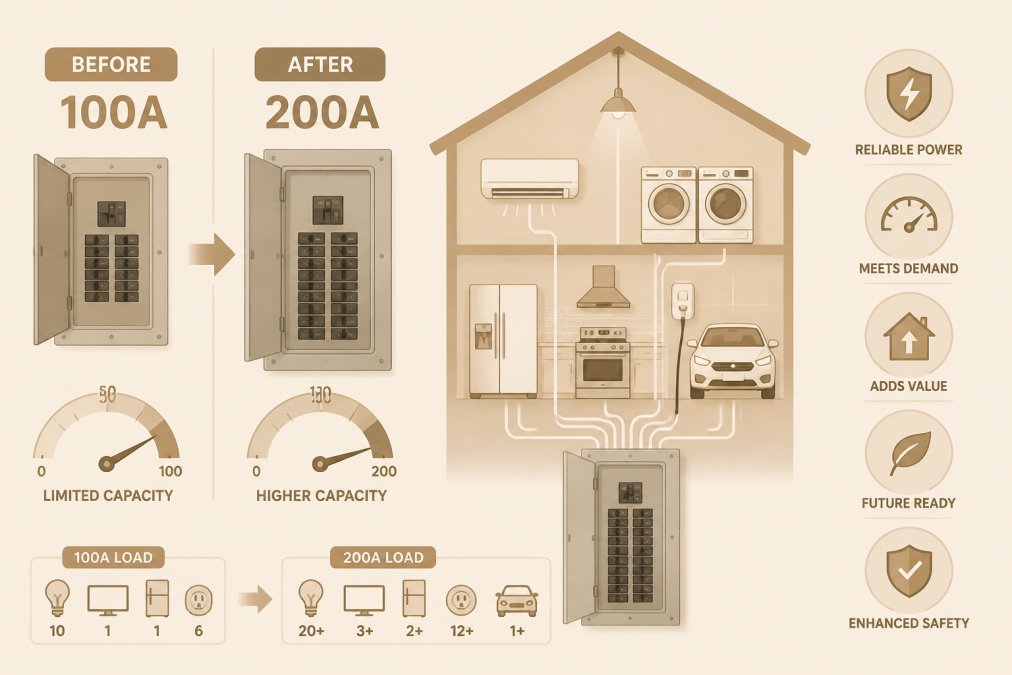
 ultimate-guide
Benefits of Upgrading Electrical Capacity for Homes
Table of Contents
- What an Electrical Capacity Upgrade Actually Involves
- How to Tell If Your Electrical Panel Needs Replacing
- Safety, Capacity, and Modern Appliance Demands
- The Cost of a 200 Amp Service Upgrade and What Affects It
- Does a New Electrical Panel Increase Home Value?
- Future-Proofing: Solar, EV Chargers, and Smart Home Systems
- The Permit and Inspection Process, Step by Step
- Frequently Asked Questions
Last Updated: September 22, 2026
What an Electrical Capacity Upgrade Actually Involves
Upgrading electrical capacity for homes means replacing an undersized service panel and its incoming service with one rated to carry more amperage, so the home can power modern loads without tripping breakers or overheating wiring. At Light Life Electric, we handle these upgrades from permit to final inspection, and the benefits of upgrading electrical capacity for homes go well beyond simply stopping nuisance trips. It is the foundation for safe, reliable power in a modern household.
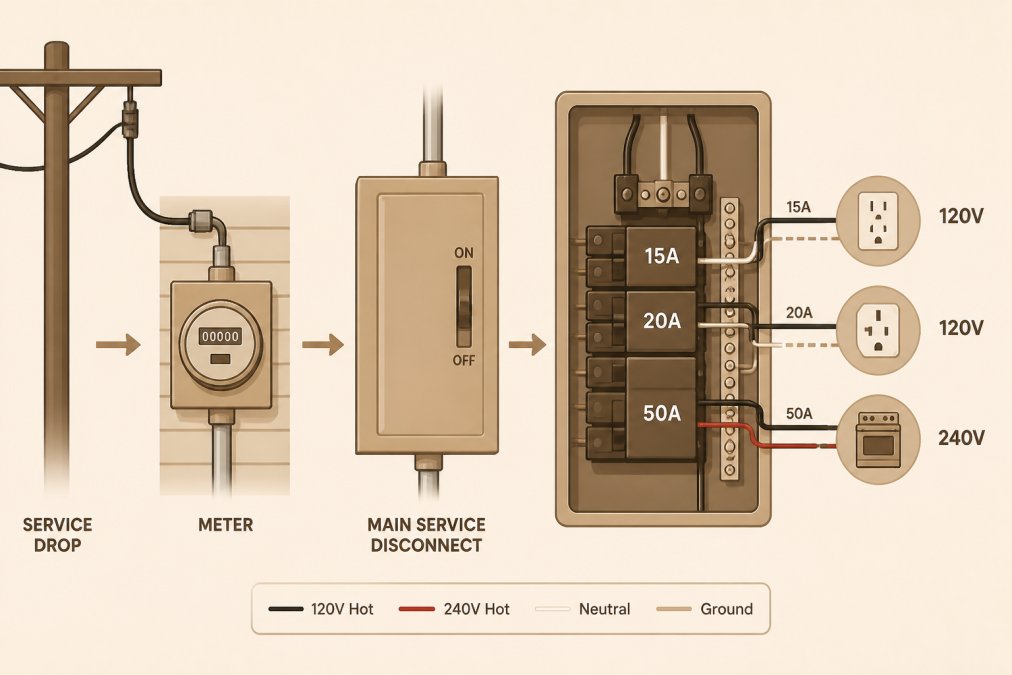
The work itself follows a clear path:
- The utility disconnects power at the service drop
- The old meter base and main service disconnect come out
- A new panel and heavier service conductors go in
- Individual circuit breakers are mapped to their loads
- The utility reconnects and the system is tested
Amperage, Load, and the Service Panel
Amperage is the measure of how much current a service can carry, and electrical load is the total demand your appliances place on it. Older homes often have 60-amp or 100-amp service panels, while many modern households need 200 amps to run everything at once. The service panel, sometimes called the breaker box, is where power is divided into circuits and where the main service disconnect lives.
How to Tell If Your Electrical Panel Needs Replacing
Knowing how to tell if electrical panel needs replacing starts with recognizing the warning signs. Flickering lights, tripped breakers, and warm panel covers are not quirks to live with; they are signals that your electrical infrastructure is straining. A common mistake is resetting a breaker repeatedly instead of asking why it tripped in the first place.
Warning Signs You Should Not Ignore
- Breakers that trip when multiple appliances run together
- Lights that dim when the HVAC or a microwave kicks on
- A panel that feels warm or smells faintly burnt
- Rust, scorch marks, or corrosion inside the panel
- Fuses instead of breakers, or a panel with no room left for new circuits
Safety, Capacity, and Modern Appliance Demands
Modern homes draw far more power than they did a generation ago. Heat pumps, induction ranges, tankless water heaters, and EV charging stations each pull serious wattage, and running them on an undersized panel invites overloaded circuits and nuisance trips. A capacity upgrade addresses this directly by giving every major appliance its own properly sized circuit.
The Cost of a 200 Amp Service Upgrade and What Affects It
Most homeowners want a number before they commit, and the honest answer is a range rather than a single figure. The honest answer is a range rather than a single figure. Your actual price depends on the specifics of your home, which is why a free on-site estimate beats any generic number.
The main cost drivers include:
- Utility scope. If the utility must upgrade the service drop or transformer, that work is sometimes free and sometimes billed to you. Ask the utility early, it is the single biggest swing factor.
- Distance and routing. The run from the meter to the panel, and whether new conduit or trenching is required, drives labor hours fast.
- Indoor vs. outdoor, accessible vs. finished. A panel in a finished basement or behind drywall costs more to reach and restore than one in an open garage.
- Permit and inspection fees. These vary widely by jurisdiction and are usually passed through at cost.
- Added circuits or a sub-panel. If the upgrade is also your chance to add a dedicated EV, heat pump, or shop circuit, that adds material and labor.
- Mast, meter base, and grounding. Older services often need a new mast and updated grounding and bonding to pass inspection.
Incentives That Can Offset the Cost
- Federal tax credits. Residential clean energy and efficiency credits can apply to qualifying electrical work tied to solar, battery storage, or certain efficiency upgrades (Residential Clean Energy Credit). Credit amounts and eligibility rules change, so confirm current terms before you file.
- Utility rebates. Many utilities offer rebates for panel upgrades that enable EV charging, heat pumps, or managed charging programs. Check your utility's electrification page directly.
- State and local programs. Some states and municipalities layer additional rebates on top, often income-qualified.
- Manufacturer and installer promotions. EV charger and battery makers periodically bundle incentives with installation.
A straightforward swap costs far less than a job that requires new conduit runs, mast replacement, or utility coordination. The honest answer to "how much is this going to cost" is that it varies, and any contractor who quotes a firm number before seeing your panel is guessing.
Does a New Electrical Panel Increase Home Value?
A new electrical panel does increase home value in most cases, because buyers and appraisers treat a modern, code-compliant service as a sign of a well-maintained home. During a property appraisal, an updated panel with capacity for modern loads removes a common objection that can stall a sale or trigger a repair negotiation.
Get your free electrical estimate →
Future-Proofing: Solar, EV Chargers, and Smart Home Systems
Future-proofing is where a capacity upgrade pays off most, and it is the angle most guides skip. A 200-amp service is not just "more power", it is the hub that lets solar, storage, EV charging, and smart energy management work together instead of competing for the same limited breaker space.
Solar and Battery Storage
Solar PV and battery storage need dedicated breaker space and a proper interconnection method. On a 200-amp service, a common approach is a supply-side connection or a line-side tap, which avoids the 120% busbar rule that limits how much backfed solar a panel can accept. If your panel is already full or your busbar rating is low, the solar installer may require a panel upgrade before they will interconnect, so doing the upgrade first often saves a second project later.
Level 2 EV Charging
A Level 2 EV charger draws far more current than a standard 120V outlet can safely supply, and it typically needs a dedicated 240V circuit. On an older 100-amp service, adding a 40- or 50-amp EV circuit can push the load calculation past what the service can support. A 200-amp service gives you the headroom, and it also opens the door to load-management strategies, such as a smart splitter or a charger that pauses when the range or dryer runs, that let you charge without a service upgrade in some cases.
Smart Home Energy Management Systems (HEMS)
This is the piece most homeowners have not heard of yet. A HEMS is a hub that monitors and shifts load across circuits to avoid peak demand charges and to keep total draw under the service limit. It can prioritize the EV charger, defer the water heater, and report circuit-level usage in an app. For a HEMS to work well, the panel needs to be modern, labeled, and have spare capacity, which is exactly what a capacity upgrade delivers.
The Permit and Inspection Process, Step by Step
The permit and inspection process protects you, and skipping it creates real problems. Most jurisdictions require a permit for a service upgrade, and the work must pass an electrical inspection before the utility will reconnect power. Here is how it typically unfolds:
- Pull the permit. Your contractor files the application, often with a load calculation and panel specs.
- Schedule the utility disconnect. The utility cuts power so the old service can be removed safely.
- Complete the rough-in. The new panel, service conductors, and grounding are installed.
- Pass the rough inspection. An inspector verifies the work meets NEC (National Electrical Code) requirements.
- Reconnect and finalize. The utility restores power, and a final inspection confirms the finished system.
| Step | Who Handles It | Typical Timing |
|---|---|---|
| Permit application | Contractor | Before any work |
| Utility disconnect | Utility + contractor | Day of work |
| Rough inspection | Local inspector | After rough-in |
| Final inspection | Local inspector | After reconnect |
Frequently Asked Questions
How do I know if my home needs an electrical capacity upgrade?
Common signs include breakers that trip frequently, flickering lights when appliances turn on, and a panel that feels warm. If your home has a 100-amp service and you are adding an EV charger, solar, or a large HVAC system, a load calculation will likely show you need more capacity. An electrician can perform this calculation and tell you if an upgrade is necessary.
Does upgrading an electrical panel increase home value?
Yes, a new electrical panel can increase home value. Appraisers and buyers view a modern, code-compliant panel as a safety feature and a sign of an updated home. It can also make your home eligible for certain financing or insurance benefits. The exact impact depends on your local market and the overall condition of the home.
Is a 200-amp service upgrade necessary for modern homes?
For many modern homes, especially those with electric vehicles, heat pumps, and electric ranges, a 200-amp service is necessary to handle the electrical load. Older homes with 100-amp service may struggle to support these appliances without constant tripping. A load calculation by a licensed electrician will determine if 200 amps is the right size for your needs.
How long does an electrical panel upgrade take to complete?
A typical panel upgrade takes one to two days for the electrical work, but the entire process, including permits and inspection, can take one to two weeks. The timeline depends on your local permitting office and whether any additional wiring updates are needed. Your electrician should provide a clear schedule before starting.