 ultimate-guide
Why Luxury Smart Home Automation Is Popular in 2026
Table of Contents
- Why Luxury Smart Home Automation Is Popular: The Demand Driving High-End Properties
- Luxury Smart Home Features That Buyers Expect in 2026
- The Benefits of Home Automation Beyond Convenience
- Home Automation Cost: What Drives the Investment in Luxury Systems
- Privacy, Cybersecurity, and Data Ownership in Integrated Systems
- Smart Home System for Luxury Homes: Planning, Installation, and Retrofit Decisions
- Conclusion: Why Luxury Smart Home Automation Is Here to Stay
- Frequently Asked Questions
Last Updated: October 13, 2026
Why Luxury Smart Home Automation Is Popular: The Demand Driving High-End Properties
Walk through a newly built high-end property and you will rarely find a single light switch that does not also respond to a phone, a voice command, or a schedule. That is the clearest sign of why luxury smart home automation is popular: it turns a large, complicated house into a system that anticipates the people living in it.
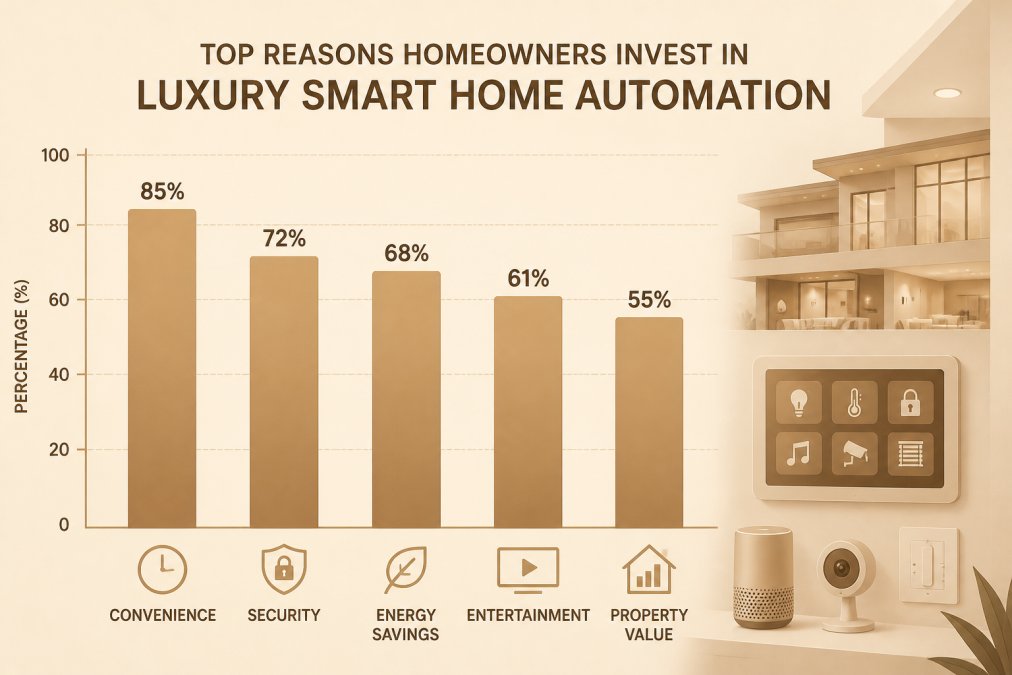
The appeal is not novelty. According to the Consumer Technology Association's smart home research, convenience, security, and energy management consistently rank as the top reasons households adopt connected systems.
Below, we explain what is actually driving demand, what a luxury smart home costs to run over time, and how to plan an installation that still works in ten years.
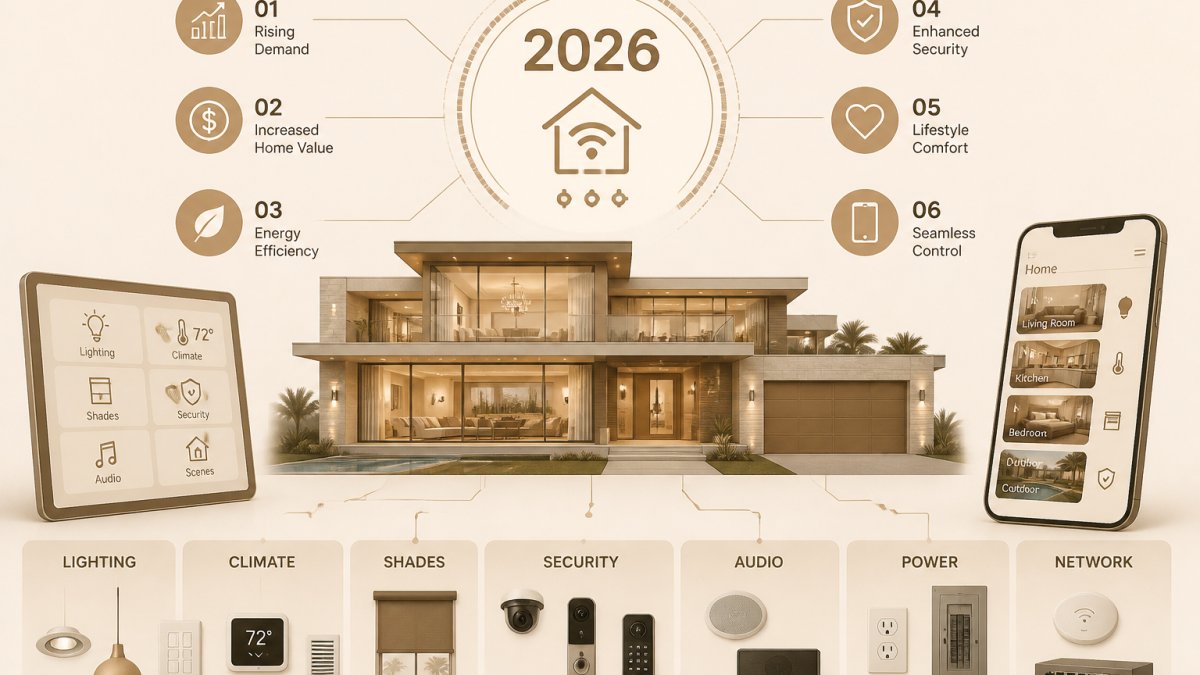
Luxury smart home automation is the integration of lighting, climate, audio, security, and shading into one coordinated system controlled from a single interface, rather than a collection of separate apps.
Luxury Smart Home Features That Buyers Expect in 2026
Buyers touring high-end properties now treat certain capabilities as standard, not upgrades. The features below are the ones that generate the strongest reactions during a walkthrough.
Unified Control Across Lighting, Climate, Audio, and Security
Unified control means one interface, one app, and one set of scenes running the entire property. Instead of juggling a thermostat app, a lighting app, and a separate security panel, the homeowner manages everything from a single dashboard or wall keypad.
The practical difference shows up in daily routines. A single "evening" command can dim the lighting, lower the shades, set the thermostat, and arm the perimeter. System integration also matters for reliability: a professionally installed platform keeps devices communicating on a stable network rather than competing for bandwidth.
Personalized Scenes and Automated Routines
Custom scenes are the feature homeowners actually talk about. A "morning" scene raises shades, warms the bathroom floor, and starts the news in the kitchen. An "away" scene locks doors, adjusts climate, and switches lighting to a lived-in pattern.
Automated routines take this further by triggering on time, occupancy, or sunrise and sunset. What most guides miss is that the value is not the technology itself, it is the removal of dozens of small daily decisions.
The Benefits of Home Automation Beyond Convenience
The benefits of home automation extend well past turning lights on with your voice, and the strongest case for them is measurable rather than aspirational. The reason luxury automation keeps gaining share is that it attacks the three costs a large property generates every month: energy waste, staff and service overhead, and risk.
Energy efficiency that shows up on the utility bill
Energy efficiency is the most quantifiable benefit. The U.S. Department of Energy's Energy Saver guidance notes that heating and cooling account for the largest share of a typical home's energy use, and that a programmable or smart thermostat can cut heating and cooling costs by roughly 10% a year when schedules are actually followed.
Sustainability and energy savings matter most to owners facing high utility bills across several zones. The mechanism is straightforward, occupancy sensors, daylight harvesting, and zoned HVAC scheduling remove the human error that drives most waste.
Security, access control, and peace of mind
Remote monitoring lets an owner check a property while traveling, and smart locks with access control mean a contractor, housekeeper, or dog walker can enter without a physical key. The practical upgrade over a consumer doorbell is the audit trail: professional platforms log who entered, when, and which door, and can revoke a code the moment a vendor relationship ends. That is a risk-management feature, not a gadget.
Accessibility and aging in place
Voice-controlled lighting, automated doors, and climate routines that run without being asked support households with changing needs. For a family planning to stay in a home through retirement, these features are less about novelty and more about avoiding a forced move later. A common pattern is to design the lighting and access layers for accessibility from the start, because retrofitting them after a mobility change is far more disruptive.
Comfort, and the resale signal
Comfort and peace of mind rank just as high as efficiency. But the benefit buyers respond to during a walkthrough is the demonstration: a single command that dims lighting, lowers shades, sets the thermostat, and arms the perimeter. That moment is also a resale signal, a documented, professionally installed system reads as maintained infrastructure rather than a pile of consumer devices.
Home Automation Cost: What Drives the Investment in Luxury Systems
Home automation cost is driven by scope, not by any single device. The number of controlled zones, the amount of new wiring required, and whether the property needs a dedicated network all move the total far more than the brand of a light switch. Most guides stop there. The more useful question is what the system costs to own over ten years, and what it returns.
Get your free electrical estimate →
The four cost buckets
Think in terms of total cost of ownership rather than purchase price. A luxury system has four recurring buckets:
- Design and installation, engineering, licensed electrical work, permits, cabling, and programming. This is the largest upfront line and the one most sensitive to whether walls are open.
- Hardware, controllers, keypads, dimmers, thermostats, cameras, locks, and audio. Priced per zone or per device, so scope scales it directly.
- Subscriptions and cloud services, remote access, camera storage, and monitoring. These are the costs owners forget to budget, and they recur every month for the life of the system.
- Maintenance and support, firmware updates, scene adjustments, device replacement, and service calls. Professional-grade platforms typically include a support agreement; consumer devices usually do not.
Why professional systems and consumer devices diverge on cost
Consumer smart-home devices often hide their real cost in replacement cycles and troubleshooting time. A device that costs little upfront but needs replacing every few years, plus the hours spent re-pairing it, can cost more over a decade than a professionally specified component that simply keeps working. Professional-grade systems front-load design and installation but spread that cost across a longer service life and a single support relationship.
Return on investment
ROI in luxury automation comes from three places, and only one of them is resale:
- Energy savings, zoned climate control and lighting schedules reduce waste, and the U.S. Department of Energy's Energy Saver guidance puts smart-thermostat savings at roughly 10% a year on heating and cooling when schedules are followed.
- Operational savings, automated access, lighting, and climate reduce the labor hours needed to manage a large property, and reduce the risk of a costly failure (a frozen pipe, an unsecured door).
- Resale value, a documented, professionally installed system is a buyer-facing feature. Real-estate professionals commonly treat smart-home capability as a differentiator in the high-end segment, though its dollar contribution varies by market and should not be assumed.
What actually moves the number
| Cost Driver | What It Covers | Why It Matters |
|---|---|---|
| Controlled zones | Lighting, climate, shading circuits | More zones means more wiring and programming |
| Network infrastructure | Dedicated access points and cabling | Reliability depends on a stable backbone |
| System integration | Linking subsystems into one platform | Prevents app sprawl and lock-in |
| Installation labor | Licensed electrical work and permits | Code compliance and safety |
| Ongoing support | Updates, adjustments, service | Keeps the system working long-term |
| Subscriptions | Remote access, storage, monitoring | Recurring cost owners forget to budget |
Before you sign
Pricing depends on the size of the property and the systems specified, so we quote each project individually. Before signing anything, review the Federal Trade Commission's guidance on home improvement contracts and get your own written quote that separates hardware, labor, subscriptions, and support so you can compare true ten-year cost rather than sticker price.
Privacy, Cybersecurity, and Data Ownership in Integrated Systems
Privacy and cybersecurity are the questions luxury buyers ask more often every year. A connected property generates a constant stream of data about occupancy, movement, and habits. Who owns that data, and where it is stored, deserves a straight answer before installation.
A few practical safeguards reduce risk substantially:
- Put cameras and locks on a separate network segment from personal devices
- Change default credentials on every controller and router
- Enable two-factor authentication on any cloud account tied to the system
- Confirm where recordings and logs are stored, and for how long
- Ask whether the system keeps working if the internet goes down
Data ownership should be settled in writing. The homeowner should know which cloud services hold their information and how to export or delete it if they change systems.
Smart Home System for Luxury Homes: Planning, Installation, and Retrofit Decisions
A smart home system for luxury homes succeeds or fails at the planning stage. The most common mistake is buying devices first and designing the infrastructure later. Start with a wiring and network plan, then choose the platform.
Retrofit projects are entirely workable, but they follow different rules. Where walls are already finished, wireless controls and existing conduit reduce disruption; where a renovation is underway, running dedicated cabling now avoids expensive rework later.
This is where a licensed electrical contractor earns their place.
Conclusion: Why Luxury Smart Home Automation Is Here to Stay
The demand behind why luxury smart home automation is popular comes down to one thing: it makes a complex property effortless to live in. Convenience, energy efficiency, security, and resale value all point the same direction, and buyers now expect these systems rather than admire them.
If you are planning a smart home installation or a lighting upgrade, the wiring and panel work decide whether the system performs or frustrates. Light Life Electric handles custom lighting design, panel upgrades, and complete electrical systems for new construction, with code-compliant installations and projects completed on schedule and within budget. Get your free electrical estimate and start with a system built to last.
Frequently Asked Questions
Is home automation worth it for a luxury property?
For luxury homeowners, automation typically pays off through energy savings, increased property value, and daily convenience. A smart home system for luxury homes can reduce energy use by optimizing lighting and climate based on occupancy. Real estate agents report that automated features increase buyer appeal and resale value. The key is choosing a professional-grade platform that scales with your property and integrates with existing systems.
What does luxury smart home automation include?
Luxury smart home features include unified control of lighting, climate, audio, video, security, and access systems. Custom scenes automate routines like morning lighting or evening security. Distributed audio and video distribution deliver entertainment throughout the home. Professional systems also offer remote monitoring, voice control, and integration with third-party devices. The focus is on reliability, personalization, and seamless operation across an estate-scale property.
How much does it cost to automate a luxury home?
Home automation cost varies widely based on property size, system complexity, and whether you are retrofitting or building new. Luxury systems typically involve professional design, wiring, and programming, which adds to the investment. Pricing depends on the number of rooms, controlled subsystems, and chosen platform. For an accurate estimate, consult a certified integrator who can assess your specific property and requirements.
Can smart home systems help reduce energy use?
Yes. Automated lighting, climate control, and shading adjust based on occupancy, daylight, and time of day, cutting unnecessary energy use. Smart thermostats learn your schedule and preferences, while lighting scenes dim or turn off in unoccupied rooms. These optimizations lower utility bills and support sustainability goals. For luxury properties with large square footage, the savings can be substantial over time.