 how-to
Why Custom Lighting Improves Home Safety and Security
Table of Contents
- 1. Custom Lighting vs. Generic Security Lights: Why Design Matters
- 2. How Outdoor Lighting Improves Home Security
- 3. Security Lighting Placement: A Zone-by-Zone Plan
- 7. Avoiding Glare and Light Trespass in Your Design
- Conclusion: Custom Lighting as a Long-Term Safety Investment
- Frequently Asked Questions
Last Updated: October 12, 2026
1. Custom Lighting vs. Generic Security Lights: Why Design Matters
Most homeowners buy a floodlight, point it at the driveway, and call it done. That leaves gaps. Custom lighting is a planned system of fixtures placed to solve specific problems: dark corners, blind spots, and unsafe steps. At Light Life Electric, we design these systems for homes across Southwest Florida.
Generic security lights are one-size-fits-all: they blast light in one direction and ignore how your property works. Custom lighting does three things a single floodlight cannot:
- Covers every approach a person could take to your home
- Lights what needs lighting without spilling onto your neighbor's yard
- Works with your cameras, not against them
What Actually Makes Lighting "Custom"
"Custom" is not a marketing word for a nicer fixture. It is a set of design decisions made for your property alone. Five levers do most of the work:
1. Placement. A generic kit gives you one fixture by the back door. A custom plan puts a fixture where the risk is: the dark side of the garage, the gate the fence hides, the window the shrubs cover. Placement is decided by walking the property at night and marking every spot where you cannot see your footing or who is approaching.
2. Beam direction and shielding. The same fixture can light a face or blind a camera depending on where it points.
**3.
4. Color temperature. Light color is measured in kelvin (K). Warm light (around 2700K-3000K) is easier on the eyes and reads as residential.
5. Controls. Timers, photocells, motion sensors, and dimming let one system behave differently at 7 p.m. and 2 a.m.
Why This Matters for the Keyword
If you search for why custom lighting improves home safety and security, the improvement comes from design decisions, not fixtures. A $40 floodlight placed correctly outperforms a $400 fixture placed badly. A custom plan means someone has thought about your specific risks, the blind side yard, the unlit stair, the camera that needs a clear view, and chosen placement, beam, color, and control to solve them.
2. How Outdoor Lighting Improves Home Security
Outdoor lighting improves home security by removing the cover of darkness intruders rely on. When your property is well lit, anyone approaching can be seen from the street, from inside the house, and on camera. That visibility is the core of deterrence.
Deterring Burglars and Reducing Hiding Spots
Burglars look for homes that are easy to approach and quick to leave, and darkness helps on both counts. Shrubs by a window, a dark side gate, or an unlit back door all give someone a place to work unseen.
- Light the side yard where a fence creates a shadow
- Light the space behind tall landscaping near windows
- Light the rear door and any gate that opens to an alley
When a home is clearly visible from multiple angles, the risk of being spotted goes up. Most intruders move on to an easier target.
Supporting Security Cameras and Surveillance
Security cameras need light to record usable footage. A camera watching a pitch-black corner captures noise, not a face. Lighting and cameras work as a pair.
Get your free electrical estimate →
Here is what most people miss: too much light in the wrong place can wash out a camera image. A bright fixture aimed at the lens creates glare that hides detail.
We aim fixtures to light faces and pathways while keeping the camera's view clear.
According to guidance from the National Institute of Justice on lighting and crime, lighting is one of the most studied tools for reducing crime, though results depend on how it is installed and maintained.
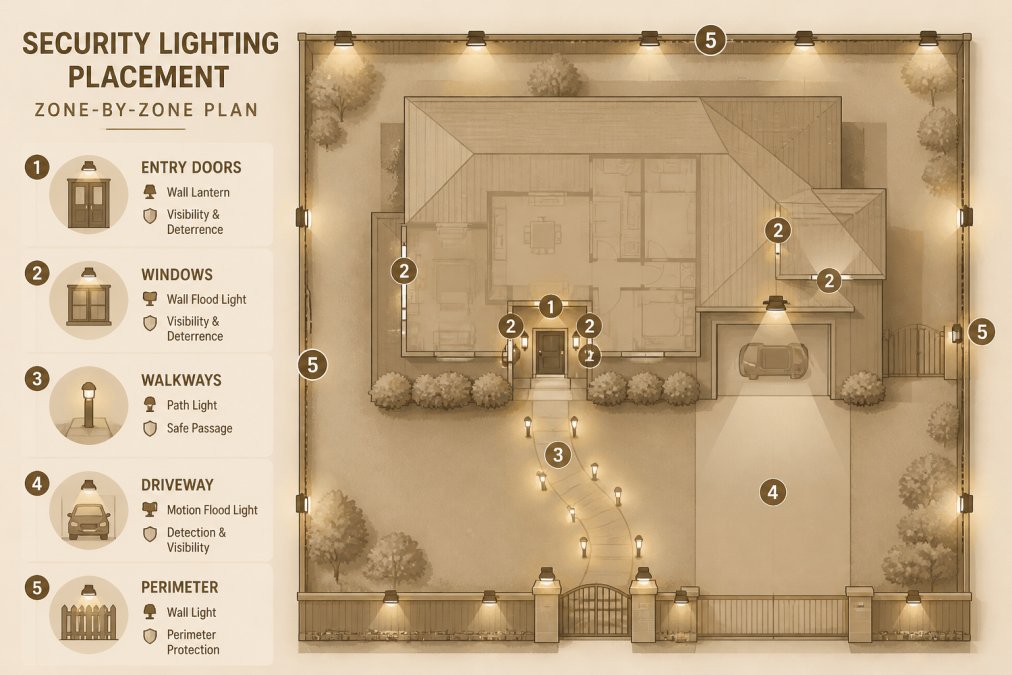
3. Security Lighting Placement: A Zone-by-Zone Plan
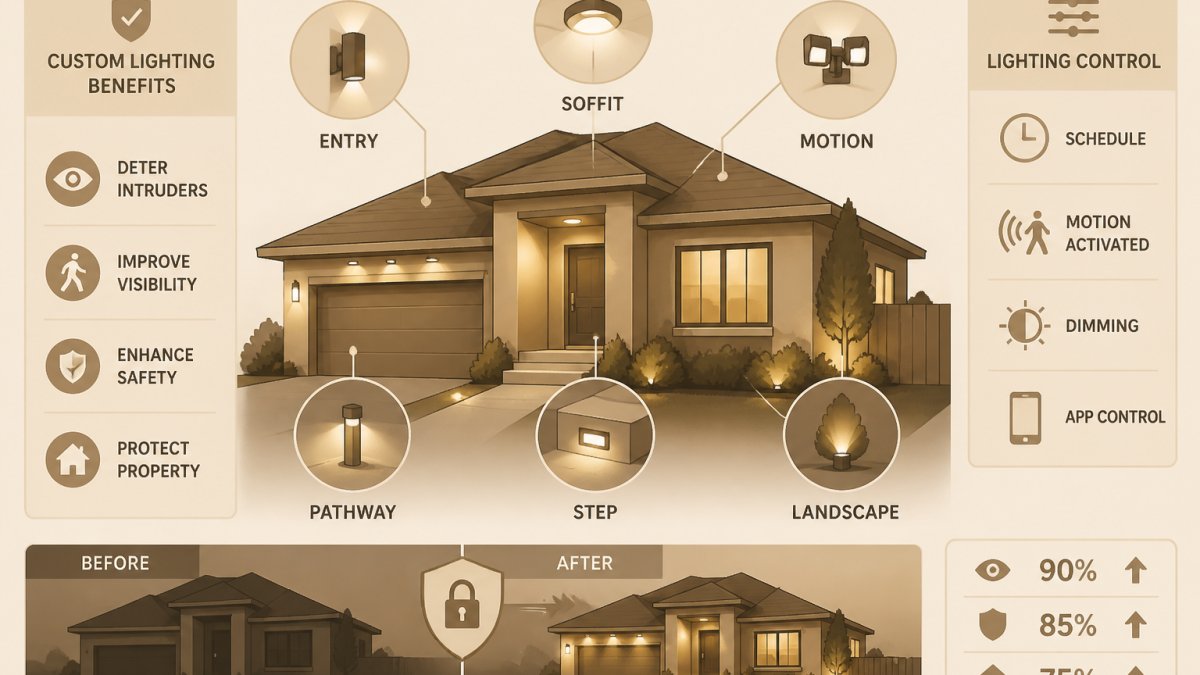
Security lighting placement works best when you treat your property as a set of zones instead of one big space. Each zone has a job: plan the job first, then pick the fixture.
7. Avoiding Glare and Light Trespass in Your Design
Glare and light trespass are the two failures that ruin a lighting plan. Glare is light that hits your eyes directly and blinds you. Light trespass spills onto a neighbor's property. Both are avoidable with the right fixtures and aim.
- Use shielded fixtures that direct light down
- Aim beams at the ground, not across property lines
- Keep bright fixtures away from bedroom windows, yours and your neighbor's
Responsible illumination also protects wildlife and keeps the night sky darker. A well-designed system lights your property, not the whole block.
Conclusion: Custom Lighting as a Long-Term Safety Investment
A dark property is a risk you can fix. Custom lighting turns that risk into a system that works every night, in every season.
At Light Life Electric, we handle the whole job, from design and permits to final inspection.
Get your free electrical estimate and let us build a lighting plan that protects your home for years to come.
Frequently Asked Questions
Do security lights use a lot of electricity?
Not necessarily. Modern LED security lights use a fraction of the power of older incandescent or halogen fixtures. A typical LED floodlight might draw 15 to 30 watts, while an equivalent halogen model can use 150 watts or more. If you run several lights for eight hours a night, the difference adds up. Motion sensors also cut energy use by only activating when needed. Upgrading to energy-efficient outdoor lighting can lower operating costs while maintaining strong illumination for safety.
Where should security lights be placed around a home?
Focus on entry points first: front and back doors, garage doors, and any ground-floor windows. Then cover walkways, driveways, and dark corners where intruders might hide. Place motion sensor lights at side gates and blind spots. Path lighting should guide steps and turns without creating glare. A custom security lighting placement plan ensures even coverage and avoids dark zones that can leave your home vulnerable.
Can poorly placed outdoor lighting create glare or dark spots?
Yes. Lights aimed outward or mounted too low can cause glare that blinds you and washes out security camera images. Overly bright fixtures can also create harsh shadows that hide intruders. To avoid this, use shielded fixtures, aim them downward, and layer lighting with different brightness levels. A custom design balances illumination, minimizes light trespass, and keeps your property safe and comfortable.
How can lighting reduce trips and falls around a home?
Good pathway lighting illuminates steps, uneven pavement, and changes in elevation, helping you see where you're walking. Motion sensor lights that turn on automatically when you approach can prevent falls in dark areas. For older adults or anyone with mobility concerns, well-placed lights along walkways and entryways are a simple, effective safety upgrade. Pair lighting with clear pathways and handrails for the best protection.