 how-to
How to Repair a Frayed Appliance Cord Safely
Last Updated: November 6, 2026
Quick Summary
A frayed appliance cord is a shock and fire hazard, so stop using the appliance first. Repair is only reasonable when the damage is limited to the outer jacket; if the jacket is cut or split, or wires are exposed, replace the cord. Never cover damage with electrical tape.
- Unplug the appliance and let the cord cool before inspecting it.
- Replace the cord if the jacket is cut through or deeply split.
- Exposed copper or bare wire means stop using the appliance immediately.
- Electrical tape hides damage and is not a real repair.
- Match replacement cords to the original's voltage, amperage and wire gauge.
Table of Contents
- Why a Frayed Appliance Cord Is a Fire and Shock Hazard
- Check the Damage: When Repair Is Possible and When to Stop
- Why Electrical Tape on a Frayed Cord Is Not a Real Fix
- Step-by-Step: Unplug, Test, and Prepare the Cord for Repair
- Appliance Cord Replacement: Doing It Right
- What to Do If You See Exposed Wires on a Power Cord
- Booking a Safety Inspection With Light Life Electric
- Frequently Asked Questions
Why a Frayed Appliance Cord Is a Fire and Shock Hazard
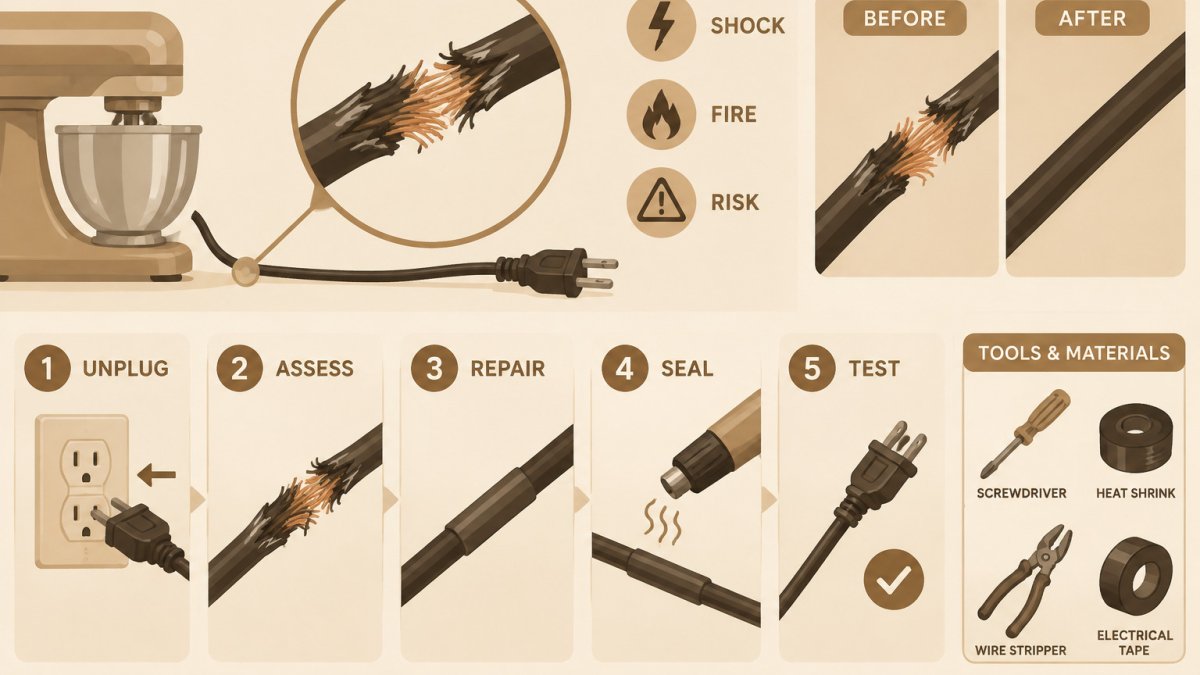
A frayed appliance cord is one of the most common electrical hazards in the home. When the outer jacket splits, the insulation under it can crack, and bare conductors can touch each other or metal parts of the appliance, causing a short circuit, shock, or fire.
The risk comes from three places: exposed copper can shock the person holding the appliance, hot spots can form where insulation is damaged, and a loose or broken connection inside the plug can overheat. A cord that looks only slightly worn can still carry a dangerous fault.
Key point: If the cord is damaged, stop using the appliance until the problem is fixed or the cord is replaced.
Check the Damage: When Repair Is Possible and When to Stop
Not every damaged cord needs to be thrown away. The first job is to decide whether the damage is limited to the outer jacket or has reached the wires inside. That decision drives everything that follows, and getting it wrong is how people get hurt.
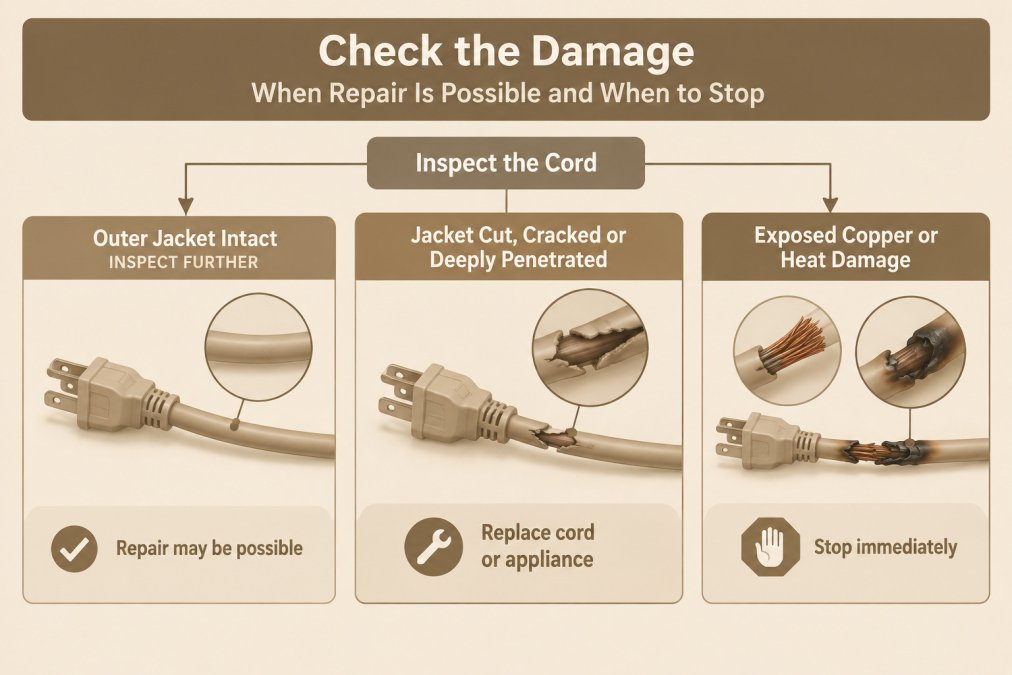
According to the Occupational Safety and Health Administration, repair or replacement of a flexible cord is required when the outer jacket is deeply penetrated. OSHA interpretation on minor damage to a flexible cord's outer jacket That interpretation is written for workplace equipment, but the principle is useful at home: deep damage means the cord has to be replaced.
Put on basic PPE before you touch the cord
You do not need a full electrician's kit to inspect a cord, but do not handle a suspect cord with bare hands. Insulated work gloves rated for electrical contact, safety glasses, and closed-toe shoes cover the realistic risks during a visual and tactile inspection. Skip the gloves only if the cord is already unplugged and confirmed dead with a non-contact voltage tester.
Inspect the full length, not just the visible spot
A cord that looks fine at the fray can be damaged elsewhere. Work from the plug to the appliance end and check each zone:
- Plug and prongs: Look for bent prongs, a cracked plug body, discoloration, or a loose plug face. A plug that wiggles in the outlet signals a worn contact.
- Strain relief: The molded collar where the cord meets the plug and the appliance is the most common failure point. Feel for stiffness, cracks, or a collar that has pulled away.
- Cord jacket along its length: Run your hand slowly and feel for lumps, flat spots, soft areas, or kinks that do not relax, signs of broken strands under an intact jacket.
Use this quick check
| Condition | What it means | Action |
|---|---|---|
| Surface scuffs, outer jacket intact | Minor wear | Monitor, then inspect again |
| Jacket cut or split, wires not visible | Possible deep damage | Replace the cord |
| Exposed copper or bare wire | Shock risk | Stop using immediately, replace |
| Scorching, melting, or burn smell | Overheating | Stop using, have the appliance checked |
| Cracks near the plug or appliance end | Loose internal connection | Replace the cord |
| Cord feels warm in normal use | Undersized cord or failing connection | Stop using, have the circuit checked |
When to stop and walk away
Some conditions put the cord beyond a homeowner repair. Stop and replace the cord, or call a licensed electrician, if any of these are true:
- You can see bare wires or copper anywhere along the cord.
- The jacket is cut through or deeply split.
- The plug or cord feels hot, smells of burning, or has discoloration.
If you are unsure, the safest choice is replacement. A licensed electrician can inspect the outlet and the appliance side of the circuit if the problem keeps returning.
Legacy versus modern appliances
The inspection criteria above apply to any cord, but the repair path differs by appliance age. Older appliances often use two-wire cords without a ground and molded plugs that cannot be opened, so a damaged cord almost always means full replacement by a technician. Modern appliances more often use three-wire grounded cords with detachable plugs and replaceable strain reliefs, giving a homeowner a realistic path to a plug-only repair.
Document what you find
Before you repair or replace anything, photograph the damage and note the appliance model, the cord's rating label, and where on the cord the damage sits. If the cord fails again, that record tells you whether the problem is the cord or the appliance, and it helps with warranty claims or when an electrician inspects the circuit.
Why Electrical Tape on a Frayed Cord Is Not a Real Fix
Many online guides suggest wrapping electrical tape around a damaged cord. Fire Administration recommends replacing an appliance with a cracked, damaged, or loose cord instead of covering the damage. U.S. Fire Administration guidance on appliance and electrical safety
Tape does not restore the cord's insulation. It can slip, peel, or trap heat. It also hides the damage from anyone who checks the cord later. Treat tape as a short-term barrier at most, never as a repair.
Watch out: Tape hides damage. A cord that looks covered may still have bare wire underneath.
Step-by-Step: Unplug, Test, and Prepare the Cord for Repair
If you have decided the cord can be fixed, work carefully.
Step 1: Unplug the appliance. Pull the plug from the wall, not the cord.
Get your free electrical estimate →
Step 6: Decide on the repair method. A plug or strain relief can sometimes be replaced.
A common mistake is trying to splice a damaged section into the middle of a cord. Splices add weak points.
Appliance Cord Replacement: Doing It Right
Replacing the cord is usually the safest fix. The goal is a cord that matches the original's electrical rating and is terminated so the connection cannot pull loose. Most failures after a DIY replacement trace back to a mismatched cord or a poor terminal connection, not the cord itself.
Match the replacement cord correctly
Use a replacement cord with the same voltage, amperage, and wire gauge rating as the original; a cord that is too thin can overheat under load. Read the markings printed on the jacket or molded into the plug, typically a voltage rating (commonly 125V or 250V), an amperage rating, and a wire gauge in AWG. A common household appliance cord is 16 AWG or 18 AWG; heavier appliances such as space heaters and window air conditioners often use 14 AWG or 12 AWG.
Match the replacement to the appliance:
- Use the same number of conductors (two-wire or three-wire with ground).
- Keep the same plug type, or use a plug rated for the appliance.
- Match the cord length closely. A much longer cord increases voltage drop and can cause the appliance to run hot.
Step-by-step replacement
- Unplug the appliance and confirm it is dead. Pull the plug from the wall, not the cord. Test with a non-contact voltage tester before touching any conductor.
- Photograph the existing wiring. Take a clear photo of how the old cord connects inside the appliance before disconnecting anything, the single most useful step if you get interrupted.
- Open the appliance housing. Remove the screws or panel that gives access to the terminal block, and keep the screws in a cup.
- Disconnect the old cord. Loosen the terminal screws and pull the conductors free. Note which conductor went where, typically black to hot, white to neutral, and green to ground on a three-wire cord.
- Remove the old strain relief. Replace it if cracked or deformed; a reused strain relief is a common cause of repeat fraying.
- Strip the new cord's conductors. Strip about 3/8 inch of insulation from each conductor without nicking the copper strands; a nicked strand weakens the connection and can overheat.
- Terminate the conductors. Wrap each conductor clockwise around its terminal screw and tighten firmly. For stranded wire, a crimp-on ferrule or terminal ring is more reliable than bare wire under a screw.
- Reinstall the strain relief. Clamp the new cord so the jacket, not the conductors, bears any pull, leaving a small amount of slack inside the housing.
- Reassemble and test. Close the housing, plug in, and test briefly. Then unplug and feel the cord and plug for warmth; noticeable warmth in normal use signals a mismatch or loose connection.
Watch out: Reversing the hot and neutral conductors on a polarized plug will still let the appliance run, but it leaves the appliance's switch on the neutral side and creates a shock risk during servicing. Match the conductor colors to the terminals exactly.
When to hand it to a technician
When the cord connects inside the appliance, many models require a qualified technician. Opening some appliances can expose you to live parts or capacitors that hold a charge after unplugging. If the cord connects to a terminal block or internal wiring you cannot clearly identify, call a licensed electrician. The same applies to appliances still under warranty, opening the housing can void coverage.
What replacement parts cost
Pricing depends on the appliance, cord type, and supplier. Check current costs with the manufacturer or a local supplier and compare against a service call before deciding to do the work yourself.
What to Do If You See Exposed Wires on a Power Cord
Exposed wires are an immediate shock and fire hazard. Do not touch the cord with bare hands.
- Turn off the appliance and unplug it if you can do so safely.
- If the cord is still live or you cannot unplug it, switch off the breaker that powers the outlet.
- Keep children and pets away from the area.
- Do not try to tape or patch the cord.
- Replace the cord or call for emergency help if the wires are sparking, smoking, or hot.
For a damaged outlet or a breaker that keeps tripping, a licensed electrician can help quickly. If the outlet itself shows burn marks or the breaker trips repeatedly, the problem may be in the wiring, not the cord.
Booking a Safety Inspection With Light Life Electric
If a cord keeps fraying, an appliance trips a breaker, or an outlet feels warm, the cause may be more than a bad cord.
Light Life Electric is a family-owned electrical contractor serving Southwest Florida. Explore our electrical services, or read our hiring guide for residential electricians if you are comparing options.
If you are facing an active hazard, see our emergency repairs page for urgent help. For more on handling a fault on your own before we arrive, read 5 steps to take during an electrical emergency at home. If you suspect a short circuit at an outlet, our guide on how to identify short circuits in outlets safely explains what to look for.
Get your free electrical estimate from Light Life Electric today.
Frequently Asked Questions
Can you safely repair a frayed appliance cord?
Sometimes, but only for minor outer-jacket wear. Deep penetration of the outer jacket, exposed conductors, or heat damage mean the cord should be replaced. Wrapping tape over damage is not a safe repair. If you are unsure, unplug the appliance and have a licensed electrician or the manufacturer assess it before using it again.
Should you use electrical tape on a frayed appliance cord?
No. Electrical tape can hide damage and may loosen with heat, movement, or moisture, which leaves live conductors exposed. Replacing an appliance with a cracked, damaged, or loose cord is safer than covering the damage. Tape can be a temporary note to yourself to stop using the appliance, but it should never be treated as a repair that makes the cord safe to use.
When should a damaged appliance cord be replaced?
Replace the cord when the outer jacket is cut or deeply penetrated, when conductors or insulation are visible, when the plug or cord is hot, discolored, or smells of burning, or when the cord is loose at the plug or the appliance. If the cord is permanently attached and the appliance is otherwise working, a qualified repair technician should replace the cord. Continuing to use a damaged cord increases the risk of shock and fire.
Can a frayed power cord cause an electrical fire?
Yes. Damage to a cord's insulation can expose conductors, allow arcing, and cause overheating, which can ignite nearby materials. Replacing any appliance with a cracked, damaged, or loose cord is the safer choice. Check cords regularly, keep them away from heat sources and water, and do not run them under rugs or furniture where damage can go unnoticed.