 how-to
How to Identify Short Circuits in Outlets Safely
Last Updated: October 30, 2026
Quick Summary
Short circuits in outlets show up as a burning smell, buzzing, sparking, scorch marks on the faceplate, or a breaker that trips as soon as the outlet is used. If you notice any of these, stop using the outlet right away and have a licensed electrician check it rather than repeatedly plugging devices in.
- Stop using the outlet immediately if you notice a burning smell, sparks, or scorch marks.
- Repeated breaker tripping is a warning sign, not a nuisance to reset over and over.
- Turn off power at the breaker and confirm it is dead with a voltage tester before inspecting.
- Test for shorts with a multimeter only after the circuit is de-energized and verified dead.
- Call a licensed electrician if you cannot isolate the fault or see melted insulation inside the box.
Table of Contents
- Signs of a Short Circuit in an Outlet
- What Causes an Outlet to Short Circuit
- Short Circuit, Ground Fault, Overload, or Faulty Appliance: How to Tell the Difference
- Safety Steps and Tools Before You Inspect an Outlet
- How to Test an Electrical Outlet for a Short With a Multimeter
- Why a Breaker Keeps Tripping After Plugging Something In
- Booking Your Outlet Inspection With Light Life Electric
- Frequently Asked Questions
Short circuits in outlets are one of the most serious electrical problems a homeowner can face.
The warning signs are not always obvious. Many homeowners only notice a problem after a breaker trips repeatedly or a faceplate looks scorched.
- The breaker trips and cuts power when a short occurs.
- Repeated tripping is a warning, not a nuisance. Follow a step-by-step guide to troubleshooting and resetting a tripping breaker.
- Heat, sparks, and burning smells mean stop using the outlet immediately.
Short circuits are not the only cause of outlet problems. Learn how to tell an overloaded circuit apart from a short.
Signs of a Short Circuit in an Outlet
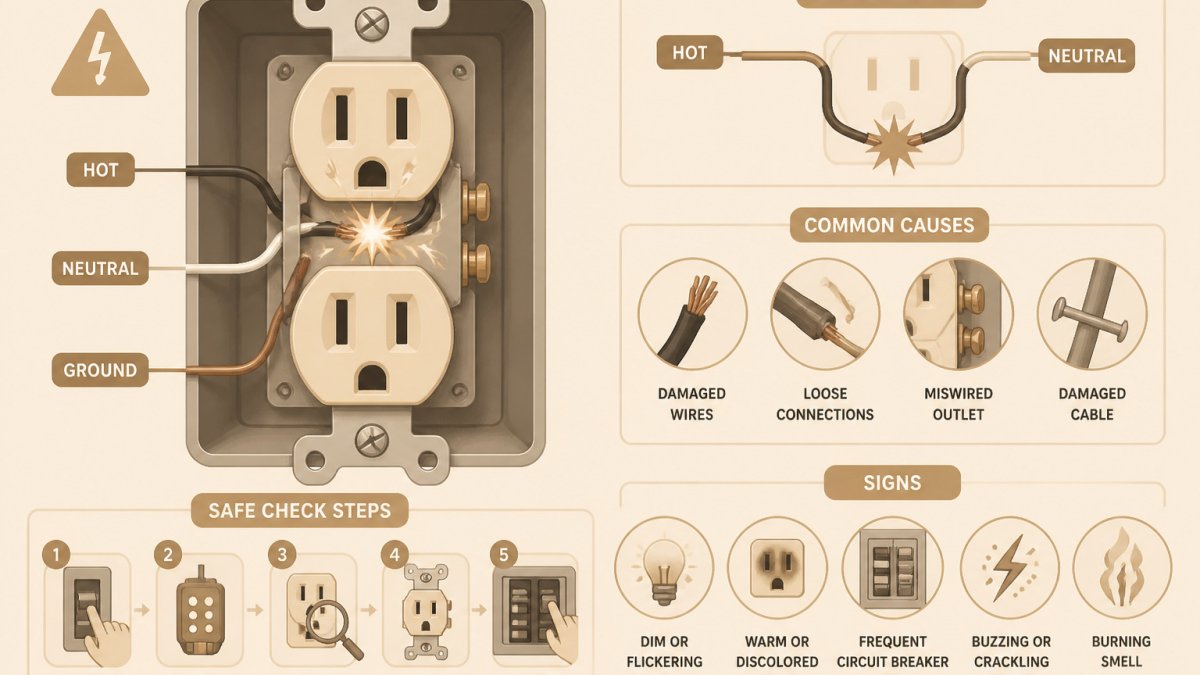
Short circuits in outlets usually show themselves through a few clear signs: a burning smell, buzzing, sparking, or a discolored faceplate. A breaker that trips right away when you use the outlet is another strong signal.
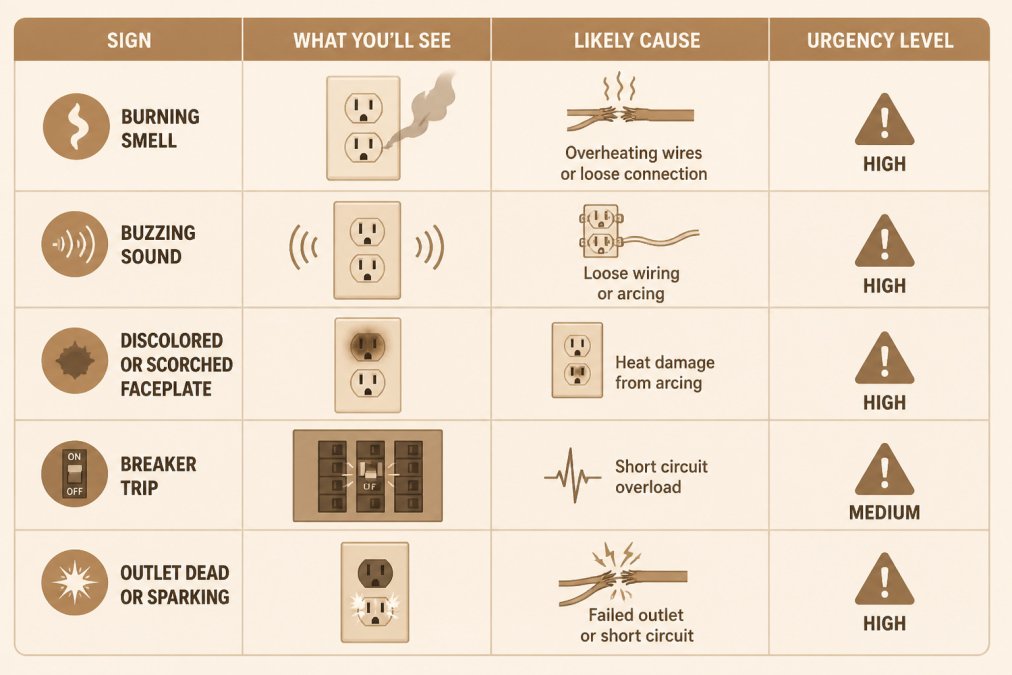
- A burning or plastic smell near the outlet
- Buzzing or crackling sounds
- Scorch marks or discoloration on the faceplate
If you notice any of these, stop using the outlet right away. You can book an outlet inspection and repair service if you want a licensed electrician to check it.
What Causes an Outlet to Short Circuit
Loose connections are one of the most frequent causes. Review the common causes of sparking and burning outlets. When a wire is not tightly secured under a terminal screw, it can arc and heat up over time.
- Damaged or frayed wire insulation exposing bare conductors
- Wires pinched or nicked during installation or renovation
- Moisture or corrosion inside the outlet box
Many of these problems develop slowly, so a warm outlet or a faint burning smell should never be ignored.
Short Circuit, Ground Fault, Overload, or Faulty Appliance: How to Tell the Difference
Four different faults produce the same symptom, a dead outlet or a tripped breaker, and homeowners routinely replace the wrong component because the symptoms overlap. The decision tree below is outlet-specific: it walks from the receptacle to nearby outlets to the breaker, so you can narrow the fault before you spend money or open a box.
The four faults at a glance
- Short circuit: Hot and neutral (or hot and ground) conductors touch directly. Current spikes almost instantly. The breaker trips immediately, often with a snap or a small flash at the outlet, and may not reset until the fault is cleared.
- Ground fault: Current leaks from hot to ground, often through moisture, a damaged cord, or a failing appliance. A GFCI receptacle or breaker trips, sometimes before the standard breaker, and the reset button pops out.
- Overload: Too many devices draw more current than the circuit is rated for. The breaker trips after a delay, usually minutes into use, and holds when the load is reduced.
Outlet-specific diagnostic flow
Work through these steps in order. Stop at the first step that produces a clear answer.
- Is the outlet dead, or is the breaker tripped? Reset the breaker once. If it holds with nothing plugged in, the fault is downstream, go to step 2. If it trips immediately with nothing plugged in, the fault is in the outlet or its wiring, go to step 4.
- Does the outlet work with a known-good device? If yes, the outlet is fine and the problem is the original appliance. If no, go to step 3.
- Do nearby outlets on the same circuit work? If nearby outlets work, the fault is localized to this outlet or its pigtail. If the whole circuit is dead, the fault is upstream, at the breaker, a junction box, or a shared neutral.
- Is there a GFCI upstream? Press reset on any GFCI receptacle or breaker feeding the circuit. A tripped GFCI mimics a dead outlet and is the most common false alarm. If it will not reset, the ground fault is still present, go to step 5.
- Does the breaker trip immediately, or after a delay? Immediate trip with no load points to a short circuit or a hot-to-ground fault. Delayed trip under load points to an overload. A trip only when one appliance is plugged in points to that appliance.
- Does the outlet show heat, scorch marks, or a burning smell? Any of these overrides the flow, stop using the outlet and call an electrician. Heat and scorch marks are short-circuit or arcing signatures, not overload signatures.
A common pattern: the breaker trips only when the microwave and the coffee maker run together. That is an overload, not a short. Move one appliance to a different circuit and the trips stop. If they do not stop, the fault is in the wiring.
What to do after you identify the fault
- Short circuit or ground fault: Leave the circuit off. Do not reset the breaker repeatedly, each reset sends fault current through damaged insulation and can start a fire inside the wall. Document what you saw (which outlet, which device, whether the breaker tripped immediately or after a delay) and arrange a licensed electrician.
- Overload: Redistribute the load across circuits. If the same circuit trips with a normal load, the circuit may be undersized or shared with more devices than it was designed for, an electrician can verify.
- Faulty appliance: Stop using the appliance. Test it on a different circuit to confirm. Do not open the appliance unless you are qualified; internal shorts are common in heating appliances and older motors.
Repeated breaker resets are a common way homeowners turn a minor outlet problem into a serious one. A breaker that trips more than once for the same outlet should be treated as a fault until an electrician proves otherwise.
Special cases and the limits of homeowner diagnosis
Some faults cannot be found at the outlet, and knowing when to stop is part of the skill:
- Intermittent faults: A short that appears only when the receptacle is wiggled, when the house settles, or when a specific appliance vibrates the cord is often a loose connection or a nicked conductor inside the wall. A multimeter at the outlet may read normal between events.
- Shared circuits: Outlets in different rooms can share a circuit, and a fault in one room can trip the breaker for another. Map the circuit before you assume the fault is where the dead outlet is.
- Older wiring: Aluminum branch wiring, cloth-insulated conductors, and backstabbed receptacles are common in older homes and fail in ways that look like shorts. These are not homeowner repair items.
If you have worked through the flow and the fault is still not clear, stop. The next step is a licensed electrician with a circuit tracer and an insulation tester, not another breaker reset.
Safety Steps and Tools Before You Inspect an Outlet
Safety comes first. Turn off power to the outlet at the breaker before touching any wires, and confirm the outlet is dead with a voltage tester. Never assume a breaker label is accurate.
Gather these tools before you start:
Get your free electrical estimate →
- A non-contact voltage tester
- A multimeter that can measure voltage, continuity, and resistance
- A flashlight
A few safety rules are important:
- Work with dry hands and dry surroundings.
- Do not work on wiring that feels hot or smells burned.
- Stop and call a licensed electrician if you see scorch marks inside the box or if the wiring looks damaged.
How to Test an Electrical Outlet for a Short With a Multimeter
This is the part of the job where readers get hurt. A resistance or continuity test is only valid on a circuit that is completely de-energized, and "completely" means verified at the outlet, not just at the breaker handle. The procedure below is the same one a licensed electrician follows: lock out, verify, test, interpret, and stop when the reading does not make sense.
Never perform a resistance or continuity test on a live circuit. A multimeter in ohms or continuity mode sends its own small current through the probes; if the circuit is live, that current path includes line voltage and the meter can be damaged or explode, and the probes can arc. Voltage tests only on live circuits. Resistance and continuity tests only after lockout and verification.
Step 1: De-energize and lock out the circuit
- Identify the breaker that controls the outlet. Do not trust the panel label alone, labels are frequently wrong, especially in older panels that have been reworked.
- Switch the breaker to OFF.
- Apply a lockout device or, at minimum, tape the breaker handle in the OFF position and place a tag on the panel noting who is working and why. This prevents a household member from resetting the breaker while your hands are in the box.
- If the outlet is on a multiwire branch circuit (two hot conductors sharing a neutral, common in kitchens and laundry areas), both breakers must be off. A single-pole tester will not reveal the second live leg.
Step 2: Verify the outlet is actually dead
- Use a non-contact voltage tester first, holding it near the slot openings and then near each terminal screw after the cover is removed. A non-contact tester is a screening tool, not a confirmation tool.
- Confirm with a multimeter set to AC voltage (typically the 200 V or autorange AC setting). Probe hot to neutral, hot to ground, and neutral to ground. Every reading should be near zero volts.
- Test the meter on a known-live outlet first to prove the meter and leads work. A meter that reads zero because the battery is dead is worse than no meter.
- If any reading is above a few volts, stop. The circuit is not fully off, and you have a wiring or panel problem that requires an electrician.
If the outlet box contains more than one set of hot conductors, treat the box as live until every conductor is verified.
Step 3: Set up the multimeter correctly
- Mode: continuity (the beep symbol) or resistance (Ω). Continuity is faster for a go/no-go check; resistance gives you a number to record.
- Range: if the meter is manual-ranging, select the lowest ohms range (typically 200 Ω).
- Leads: black lead in COM, red lead in the V/Ω jack. Confirm the leads are seated fully.
Step 4: Expose the terminals safely
- Remove the cover plate.
- Remove the two screws holding the receptacle to the box.
- Pull the receptacle straight out by the yoke, not by the wires. Do not yank; old insulation cracks.
- Photograph the wiring before you touch anything. You will want the reference if a wire comes loose.
Step 5: Test each conductor pair
With the meter in continuity or ohms mode, test these three pairs and record each result:
- Hot to neutral, the classic short-circuit path.
- Hot to ground, a hot-to-ground short, which often trips a GFCI before a standard breaker.
- Neutral to ground, a neutral-to-ground fault, which can be a shared-neutral or bootleg-ground problem rather than a true short.
For each pair, hold one probe on the terminal screw or the stripped conductor and the other on the matching terminal. Wiggle the receptacle slightly while watching the reading, an intermittent short will often show continuity only when the device is moved.
Step 6: Interpret the readings
| Reading | What it usually means |
|---|---|
| No continuity, OL, or very high resistance (megohms) | Conductors are isolated, normal |
| Continuity beep or near-zero ohms between hot and neutral | Short circuit in the outlet, the wiring, or a device on the circuit |
| Continuity between hot and ground | Hot-to-ground short or miswired receptacle |
| Continuity between neutral and ground | Shared-neutral, bootleg ground, or neutral-to-ground fault |
| Reading changes when you wiggle the receptacle | Loose connection or intermittent fault |
A healthy outlet shows no continuity between hot, neutral, and ground. Any unexpected continuity is a fault until proven otherwise.
Step 7: Isolate before you condemn the outlet
A continuity reading at the outlet does not prove the outlet is bad. The short may be downstream on the same circuit. To isolate:
- Disconnect the receptacle from the circuit (remove the hot, neutral, and ground conductors from the terminals).
- Retest the receptacle terminals themselves. If continuity disappears, the fault is in the wiring, not the receptacle.
- Retest the disconnected circuit conductors. If continuity remains between hot and neutral with the receptacle removed, the short is in the cable or another device on the circuit.
Stop and call a licensed electrician if: any voltage is present after lockout, you see scorch marks or melted insulation inside the box, the box contains aluminum wiring, the conductors are backstabbed and you cannot free them without damage, or you cannot isolate the fault with the steps above. Do not re-energize a circuit you have not cleared.
Why a Breaker Keeps Tripping After Plugging Something In
A breaker that trips each time you plug in a device usually means one of three things. The device may have an internal short, the outlet may have a fault, or the circuit may be overloaded.
Many homeowners ask whether this is a quick fix. Often it is not. Resetting the breaker repeatedly can hide a dangerous problem and increase the risk of fire.
Booking Your Outlet Inspection With Light Life Electric
If you have seen any of the warning signs in this guide, do not wait. Contact Light Life Electric to request an estimate.
Our Florida certified electricians are fully licensed, bonded, and insured, and we handle the process from permits to final inspection. Get your free electrical estimate today.
Frequently Asked Questions
How do you test an electrical outlet for a short with a multimeter?
Turn off the breaker feeding the outlet and confirm the outlet is dead with a non-contact voltage tester. Set your multimeter to the continuity or resistance (ohms) setting, then touch the probes to the hot and neutral slots. A reading near zero ohms with a continuity beep suggests a short, while an open circuit or very high resistance is normal. Test ground to neutral and hot to ground as well. If you are unsure how to interpret the readings, stop and call a licensed electrician rather than guessing with live wiring.
What are the signs of a short circuit in an outlet?
Common signs include a burning smell, buzzing or crackling sounds, scorched or discolored plug slots or faceplates, sparking when a device is plugged in, and a breaker that trips repeatedly. Flickering lights on the same circuit can also point to a short or loose connection. Any of these signs warrants turning off power to the outlet and avoiding its use until it has been inspected. A burning smell or visible melting should be treated as an emergency.
What causes an outlet to short circuit?
The most common causes are damaged insulation that lets the hot and neutral wires touch, loose connections at the terminals that arc over time, a faulty or damaged appliance plugged into the outlet, and moisture or debris bridging conductors. Overloaded circuits can also heat wiring until insulation fails. Because several of these causes sit inside the wall, a visual check alone often cannot confirm the source.
Why does my breaker keep tripping after I plug something in?
When a breaker trips immediately after you plug in a device, the most likely cause is a short in the device, its cord, or the outlet wiring. A faulty appliance is a frequent culprit, so try the device on a different outlet first. If the breaker still trips with nothing plugged in, the fault is likely in the circuit wiring and should be inspected by a licensed electrician. Repeatedly resetting a tripping breaker without fixing the cause can cause overheating.