 how-to
Can You Install a Smart Thermostat on an Oil Furnace?
Last Updated: October 25, 2026
Quick Summary
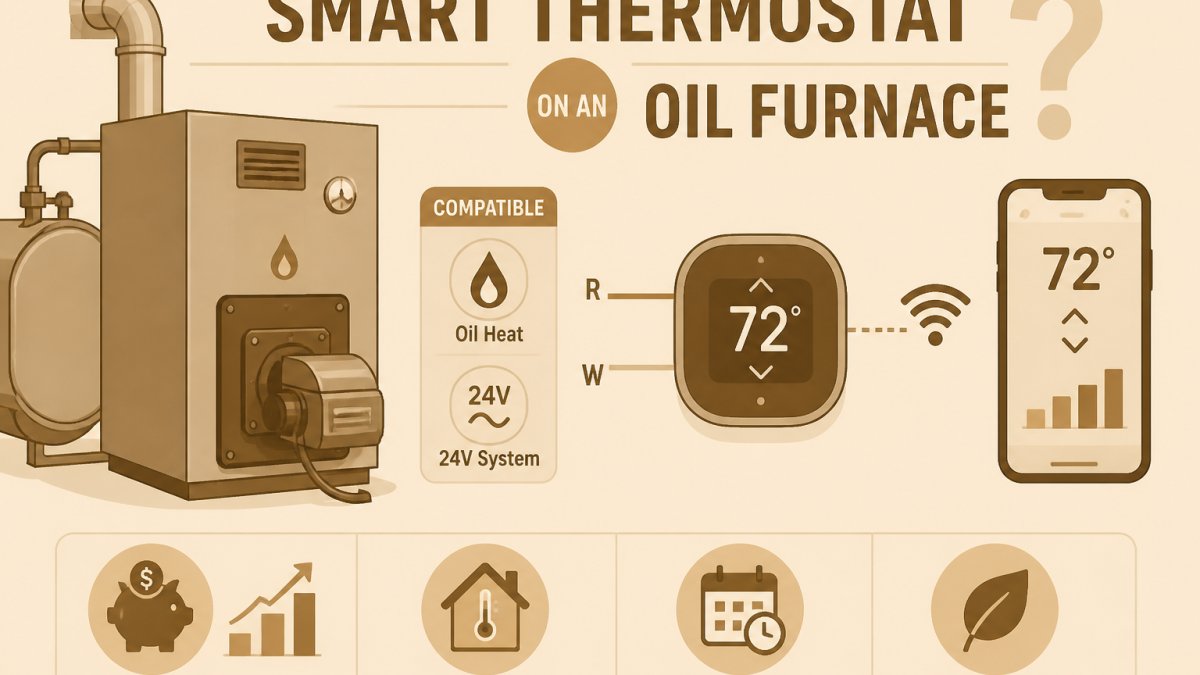
A smart thermostat oil furnace installation is possible but requires understanding your system's wiring and power needs. Most oil furnaces use two-wire systems without a C wire, so you'll need to add one, use a power-stealing adapter, or select a battery-powered model to ensure reliable operation.
- Oil furnaces and boilers use different control logic than gas systems and often lack a continuous 24-volt power supply.
- Power-stealing adapters draw current from the heating circuit but may cause connectivity issues on systems with high-impedance transformers.
- Battery-powered smart thermostats eliminate the C-wire problem but require battery replacement every 1-2 years.
- Smart thermostats on oil furnaces can save 5-10% of heating costs if used thoughtfully, not the advertised 10-15%.
- Running a new C wire requires a licensed electrician and should not be attempted as a DIY task.
Table of Contents
- Why Oil Furnace Owners Should Consider Smart Thermostats
- Smart Thermostat Compatibility with Oil Furnace Systems
- Understanding C Wire for Smart Thermostat Installation
- Oil Furnace Thermostat Wiring: Two-Wire Systems Explained
- Smart Thermostat for Two-Wire Heating Systems
- Energy Savings and Real-World Performance
- Getting Professional Installation for Your Oil Furnace Smart Thermostat
- Frequently Asked Questions
Why Oil Furnace Owners Should Consider Smart Thermostats
Oil furnace owners often assume a smart thermostat oil furnace installation isn't compatible with their heating systems. That assumption costs them money. A smart thermostat for oil furnace systems can deliver real energy savings and remote control capabilities, but only if you understand your system's wiring and power requirements first.
The U.S. smart thermostat market is estimated at $1.21 billion in 2025 and $1.41 billion in 2026, with a forecast of $4.83 billion by 2034, according to Market Data Forecast's 2026 smart thermostat market analysis. Installed smart thermostats in the U.S. are expected to reach 38.3 million units in 2026, according to Utility Dive's smart thermostat adoption forecast.
The barrier isn't capability, it's compatibility. Oil furnaces and boilers use different control logic than gas systems. Most run on two-wire thermostats without a continuous 24-volt power supply. Before you buy, you need to know whether your system can support a smart thermostat, and what workarounds exist if it can't.
Smart Thermostat Compatibility with Oil Furnace Systems
Not all oil heating systems are created equal. Compatibility depends on whether you have a furnace or a boiler, and how your current thermostat connects to it.
Oil Furnaces vs. Oil Boilers: What's the Difference?
An oil furnace heats air and distributes it through ducts. An oil boiler heats water and sends it through pipes to radiators or baseboards. The distinction matters because they signal their thermostats differently.
Oil furnaces use a simple on-off signal. When the thermostat calls for heat, it closes a circuit that energizes the burner relay.
Oil boilers work similarly but often include a circulator pump that moves hot water through the heating zone. Some boilers manage multiple zones with zone valves, adding complexity to the thermostat circuit.
Most smart thermostats are engineered for forced-air gas furnaces. They expect a common wire (C wire) for continuous 24-volt power and use standard HVAC relay logic. Oil systems often lack a C wire, and some boiler systems require different control sequences.
Hot-Water Baseboard and Hydronic Heating Considerations
Hot-water baseboard heating and hydronic heating systems present a specific challenge. These systems use a boiler to heat water, then rely on a circulator pump to push that water through baseboards or radiant tubing.
A thermostat for a hot-water baseboard system must signal both the boiler (to fire up) and the circulator pump (to move water). If your thermostat only controls the boiler, the pump won't run and no heat reaches your rooms.
Smart thermostats designed for hydronic systems handle both signals. However, many consumer-grade smart models don't. Before purchasing, confirm that the thermostat supports your specific boiler and pump configuration.
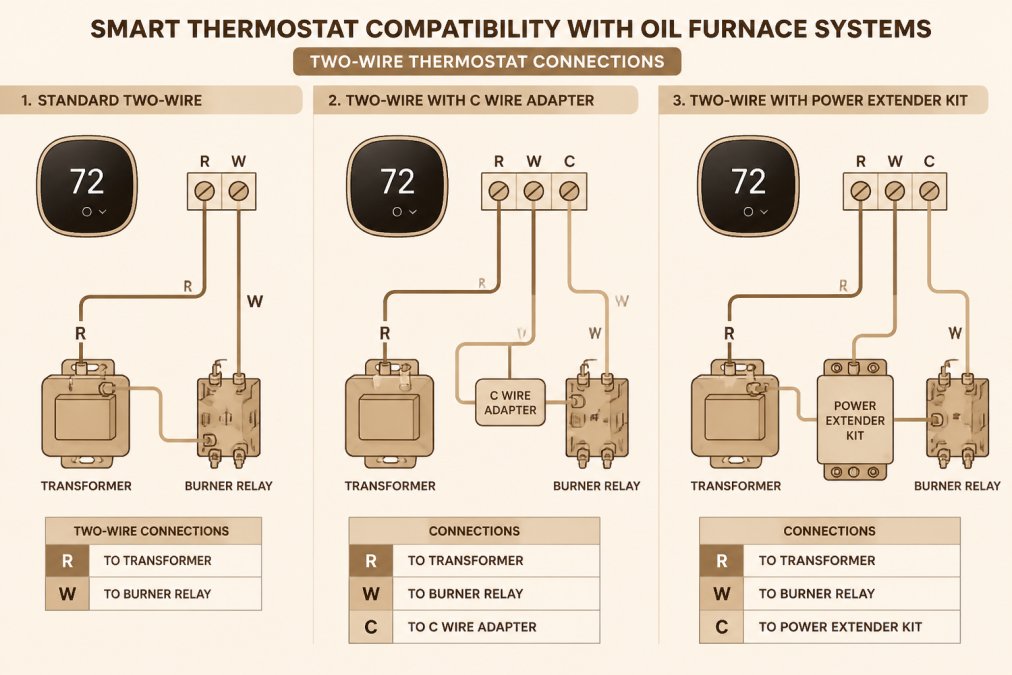
Understanding C Wire for Smart Thermostat Installation
The C wire for smart thermostat systems is the common, or return, wire in a 24-volt control circuit. It provides continuous power to the thermostat's electronics, allowing Wi-Fi connectivity, display operation, and remote access via a smartphone app.
Most oil furnaces and boilers were installed without a C wire. Older thermostats drew minimal power and didn't need it.
According to ENERGY STAR's smart thermostat guidance, an oil boiler or furnace may need an adapter to work with certain smart thermostats. Most smart thermostats require a C wire for continuous 24-volt power. If your system lacks one, you'll need to add it or use an alternative power solution.
Power-Stealing and Battery-Powered Alternatives
Power-stealing is a workaround used when a C wire isn't available. The thermostat draws a small amount of current from the heating circuit itself, typically through the R (power) and W (heat call) terminals.
Power-stealing works in many oil furnace installations, but it's not foolproof. If your furnace has a high-impedance transformer or an older relay, the voltage drop may be too great and the thermostat won't power up.
Battery-powered smart thermostats sidestep the C-wire problem entirely. They run on AA or AAA batteries and communicate via Wi-Fi without needing a hardwired power source.
The safest approach is to install a proper C wire from the furnace transformer to the thermostat location. This guarantees reliable power and full smart thermostat functionality.
Oil Furnace Thermostat Wiring: Two-Wire Systems Explained
Most oil furnaces use a two-wire thermostat system for a smart thermostat oil furnace: one wire carries 24-volt power from the transformer, and the other carries the heat-call signal back to the burner relay.
Get your free electrical estimate →
R Terminal and W Terminal Basics
The R terminal is the power input. It connects to the 24-volt hot leg of the furnace transformer. The W terminal is the heat call output.
In a two-wire system, there is no separate return path (common wire). The thermostat completes the circuit through the furnace frame or a dedicated ground wire. This works fine for a simple on-off thermostat that draws almost no power. A smart thermostat, however, needs continuous power to maintain Wi-Fi connectivity and display status.
Some smart thermostats are designed to work on two-wire systems by using power-stealing techniques. Others require a C wire to be added. Check the thermostat's specification sheet before buying to confirm compatibility with your two-wire oil furnace.
Smart Thermostat for Two-Wire Heating Systems
A smart thermostat for two-wire heating systems must be chosen carefully. Not every smart model works on two-wire setups. Many assume a C wire is present or that the system is a standard gas furnace with both heat and cooling.
Look for models explicitly rated for two-wire or heating-only operation. The thermostat should clearly state support for oil furnaces or two-wire systems in its compatibility documentation.
At Light Life Electric, we recommend verifying compatibility with your specific furnace model before purchase. Call the thermostat manufacturer with your furnace make and model, and ask directly: "Will this thermostat work on my oil furnace without a C wire?" A clear yes or no from the manufacturer protects you from compatibility headaches after installation.
Zone Valves and Multiple Heating Zones
Some oil-heated homes use zone valves to control heat to different areas independently. Each zone has its own thermostat or zone controller, and the valve opens or closes to allow hot water flow to that zone.
A smart thermostat controlling a single zone must send a signal to its zone valve in addition to calling for heat at the boiler. If the thermostat doesn't support zone valve operation, the valve won't open and that zone won't heat.
Some zoned systems use a separate zone controller that manages all zone valves, while the thermostat only controls the boiler. In this case, the smart thermostat needs to work only with the boiler, and the zone controller remains unchanged. Understand your current setup before shopping for a replacement thermostat.
Energy Savings and Real-World Performance
Smart thermostats promise energy savings through programmable schedules and remote access. The reality is more nuanced.
Savings depend on how you use the thermostat. If you set a schedule and stick to it, you'll likely save money by reducing heating when the home is empty or occupied but unoccupied (like at night).
Oil heating is also less forgiving than gas heating. Oil burners have a minimum cycle time, they can't fire for just a few minutes without wasting fuel. Short heating cycles triggered by aggressive thermostat adjustments can actually increase oil consumption.
Set realistic expectations: a smart thermostat on an oil furnace can save 5-10% of heating costs if used thoughtfully, but it's not a magic solution. The biggest savings come from adding insulation, sealing air leaks, and maintaining your furnace, not from the thermostat alone.
Getting Professional Installation for Your Oil Furnace Smart Thermostat
Installing a smart thermostat on an oil furnace is straightforward if your system has a C wire already. If it doesn't, the job becomes more complex.
Running a new C wire requires opening walls, routing wire through studs, and connecting it safely at both ends. This is a job for a licensed electrician, not a DIY task.
Light Life Electric can help you assess whether your oil furnace is compatible with a smart thermostat and handle the installation safely. Our team ensures the installation meets code and that your furnace operates reliably.
If you're in Southwest Florida and ready to upgrade your heating control, get a free electrical estimate for smart thermostat installation. We can also discuss how to wire a smart thermostat without a C wire if your furnace lacks one, and review smart thermostat options for older HVAC systems to find the right fit for your setup. For immediate questions or emergency electrical needs, contact Light Life Electric at any time, we're available 24/7 to help.
A smart thermostat on an oil furnace is possible, but it requires understanding your system's wiring and power needs. Whether you have a furnace or boiler, two-wire or multi-zone heating, the right thermostat paired with proper installation delivers convenient control and modest energy savings.
| Feature | Two-Wire Oil Furnace | Oil Boiler with Circulator | Zoned Oil System |
|---|---|---|---|
| Smart Thermostat Compatibility | Requires C-wire addition or power-stealing | Requires pump signal support | Requires zone valve control |
| Installation Complexity | Low to moderate | Moderate | Moderate to high |
| C-Wire Needed | Yes (unless battery model) | Yes (unless battery model) | Yes (unless battery model) |
| Remote Access Available | Yes, if powered properly | Yes, if powered properly | Yes, if thermostat supports zones |
| Energy Savings Potential | 5-10% with proper use | 5-10% with proper use | 5-10% with proper use |
Frequently Asked Questions
How do I know if a smart thermostat is compatible with my oil furnace?
Check your current thermostat's wiring: if it has only two wires (R and W terminals), you have a heating-only system. Verify whether your oil furnace is a forced-air furnace or a boiler, as they use different control logic. Most smart thermostats work with oil furnaces, but compatibility depends on your system's power requirements and whether a C wire is available. ENERGY STAR recommends verifying compatibility before purchase, especially for oil-heating systems that may need an adapter. Contact the thermostat manufacturer with your furnace model number for confirmation.
Does a smart thermostat for an oil furnace need a C wire?
A C wire provides continuous 24-volt power and is ideal for smart thermostats. Many oil furnaces lack a C wire, which is why power-stealing technology and battery-powered options exist. If your furnace doesn't have a C wire, you can install a wire adapter (which requires running new wire to the thermostat), use a battery-powered model, or choose a thermostat with power-stealing capability. However, power-stealing can reduce thermostat responsiveness. Professional installation ensures you select the right power solution for your specific oil heating system.
Can I use a smart thermostat with a two-wire oil furnace?
Yes, most smart thermostats work with two-wire systems (R and W terminals) found in oil furnaces. The challenge is power: two-wire systems provide limited voltage. Battery-powered smart thermostats are a straightforward option for two-wire setups. Alternatively, you can add a C wire adapter if your furnace has a transformer, though this requires professional installation. Some thermostats use power-stealing to draw minimal current from the heating circuit, but this may affect performance. Verify your thermostat's two-wire compatibility rating before purchase.
Will a smart thermostat save money on my heating oil consumption?
Smart thermostats can reduce heating costs through programmable schedules and remote control, but savings are not guaranteed. The American Council for an Energy-Efficient Academy reviewed field tests of advanced thermostats and found results ranged from modest positive savings to negative savings, depending on user behavior and system type. Actual savings depend on how consistently you use scheduling features, how much you adjust temperature remotely, and your home's insulation. Many homeowners see the biggest benefit from avoiding unnecessary heating when away, which a smart thermostat automates. Realistic expectations: modest reductions in heating oil use, not dramatic cuts.