 how-to
How to Fix a Tripping Circuit Breaker: 2026 Guide
Table of Contents
- How to Identify a Tripped Circuit Breaker
- Steps to Reset a Tripping Circuit Breaker Safely
- Troubleshooting Overloaded Circuits: Finding the Real Cause
- Signs of a Bad Circuit Breaker You Shouldn't Ignore
- Safety Precautions at the Breaker Panel
- When to Replace a Circuit Breaker vs. DIY Reset
- When to Call a Professional Electrician
- Frequently Asked Questions
Last Updated: August 27, 2026
A tripping circuit breaker is one of the most common electrical complaints homeowners deal with, and most guides stop at "flip it back to ON." That's not good enough. A repeatedly tripping breaker can signal anything from a simple overloaded circuit to a dangerous wiring fault that needs immediate attention. Knowing the difference could protect your home and your family.
This guide covers how to fix a tripping circuit breaker step by step, how to identify the real cause behind the trip, and when the problem is beyond a DIY reset.
How to Identify a Tripped Circuit Breaker
A tripped circuit breaker is a safety device that has automatically interrupted electrical current to protect a branch circuit from damage or fire. The breaker doesn't fail when it trips, it does exactly what it's designed to do.
Visual Identification: What a Tripped Breaker Looks Like
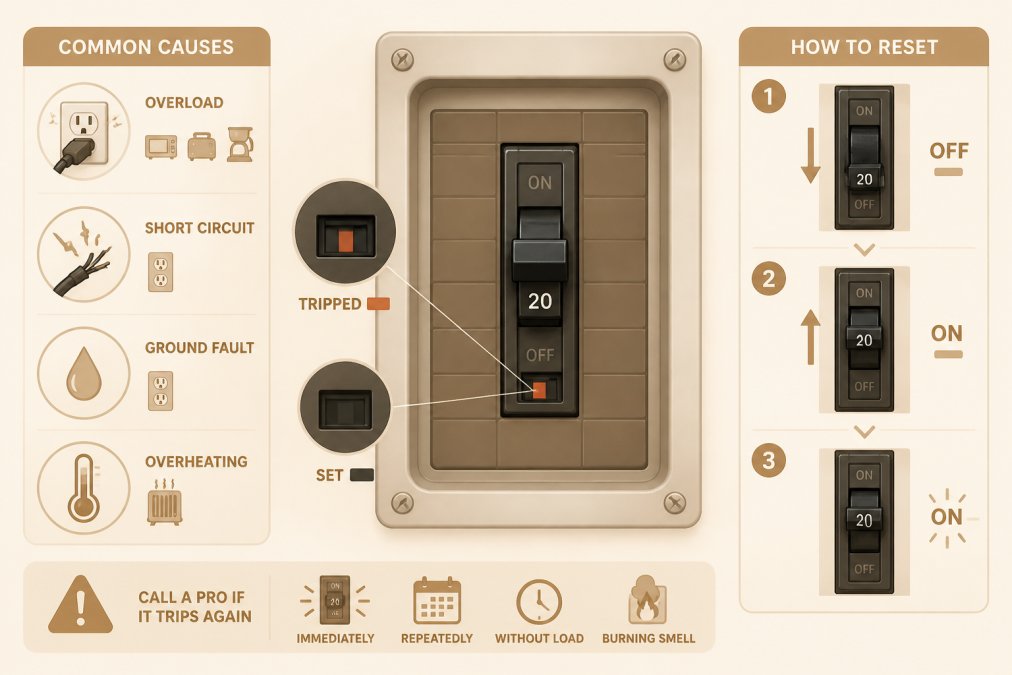
Open your breaker panel and look at the row of toggle switches. A tripped breaker will typically sit in a middle position between ON and OFF. On many panels, the toggle also shifts to a red or orange indicator window, which makes identification easier. On older panels lacking this indicator, a tripped breaker may feel slightly loose or give with less resistance when you press it.
Differences Between Tripped, Off, and On Positions
Understanding the three positions prevents a common mistake: trying to reset a breaker that was manually switched off.
- ON position: Toggle is fully toward the "ON" label, firm with no give
- OFF position: Toggle is fully toward the "OFF" label, deliberately switched
- TRIPPED position: Toggle sits in the middle, often with a visible red indicator window
A breaker in the OFF position was turned off intentionally and doesn't need resetting. A tripped breaker must be reset through a specific sequence.
Steps to Reset a Tripping Circuit Breaker Safely
Resetting a tripped breaker is straightforward when done in the right order. Skipping the appliance-unloading step is the single most common reason a breaker trips again immediately after reset.
What You'll Need Before You Start
- A flashlight or headlamp
- Non-contact voltage tester (optional but recommended)
- A dry surface to stand on
Step-by-Step Reset Process for Standard and AFCI/GFCI Breakers
Total Time: 10-20 minutes Difficulty: Beginner
-
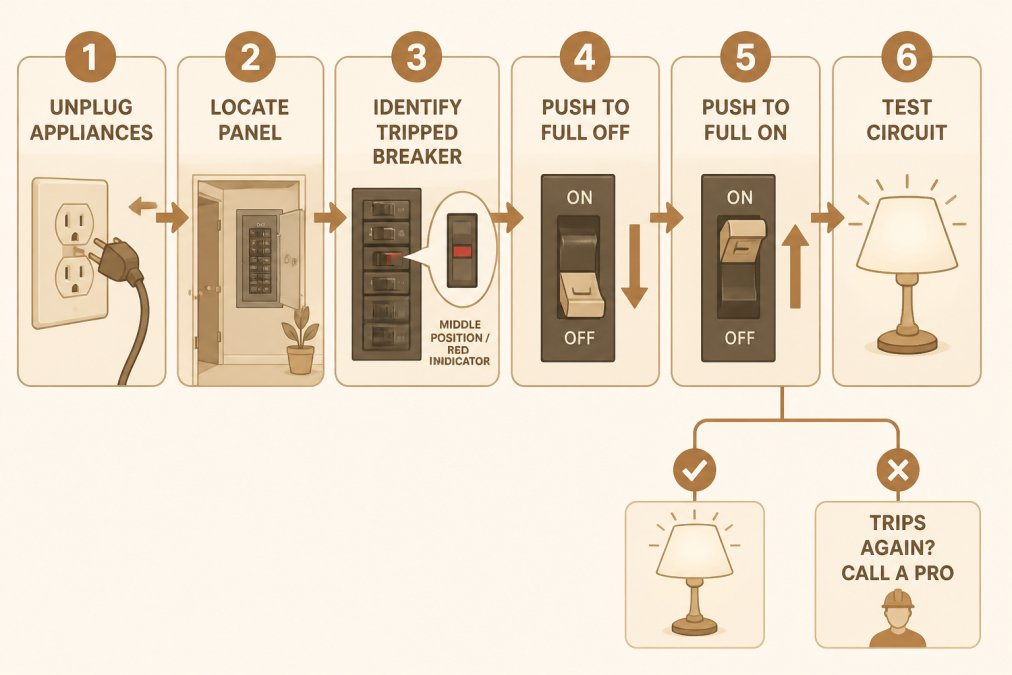
Unplug or turn off appliances on the affected circuit. Before touching the panel, remove the electrical load that caused the trip. Unplug hair dryers, space heaters, and kitchen appliances. This prevents an immediate re-trip.
-
Locate your breaker panel. Most residential panels are in garages, utility rooms, hallways, or exterior walls. Open the metal door carefully.
-
Identify the tripped breaker. Look for the middle-position toggle or the red indicator window. Note the circuit label if your panel is labeled.
-
Push the toggle firmly to the full OFF position. You cannot reset a breaker by pushing it directly to ON; the internal mechanism must be fully reset first. Push it all the way to OFF until you feel it click.
-
Push the toggle firmly to the full ON position. Apply steady, deliberate pressure. You should feel and hear a solid click as the breaker latches.
-
Test the circuit. Restore power to your appliances one at a time. If the breaker holds, the problem was likely a temporary overload. If it trips again immediately, stop and read the troubleshooting section below.
AFCI and GFCI breakers follow the same sequence with one addition: these breakers have a TEST button on the face of the breaker itself. After resetting to ON, press the TEST button to verify the breaker's internal fault-detection mechanism is functioning. If the breaker doesn't trip when you press TEST, the breaker itself may be faulty and should be replaced.
According to the National Fire Protection Association's electrical safety guidelines, arc fault circuit interrupter breakers are required in most living areas of new residential construction and are designed to detect dangerous arcing conditions that standard breakers miss.
Troubleshooting Overloaded Circuits: Finding the Real Cause
The reset process gets power back. This section explains why the breaker tripped in the first place, which is what actually matters.
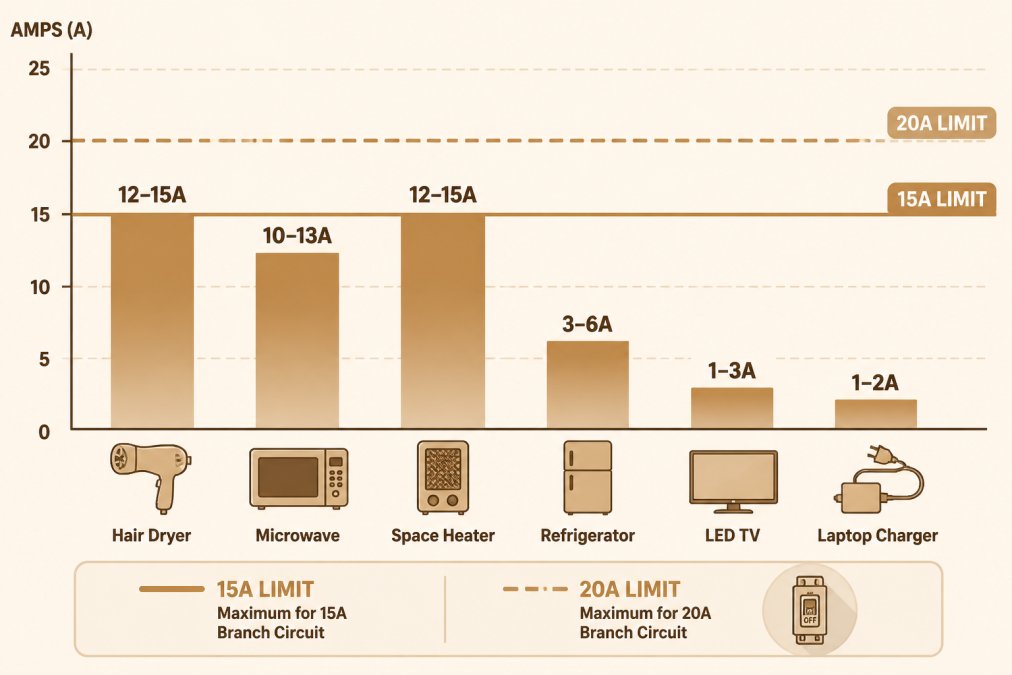
Every branch circuit in your home has an amperage rating, typically 15A or 20A for general living areas. When the combined electrical load of devices on that circuit exceeds the rated amperage, the breaker trips. The question is whether the overload is a one-time event or a recurring structural problem.
Nuisance Tripping vs. Hard Shorts: How to Tell the Difference
Nuisance tripping occurs when a circuit is legitimately overloaded, too many high-draw appliances running simultaneously on the same branch circuit. The breaker trips, you reduce the load, it resets fine, and it doesn't trip again under normal use.
Get your free electrical estimate →
A hard short is a direct connection between a hot wire and a neutral wire or ground, causing an immediate, massive surge of electrical current. A breaker that trips instantly the moment you restore power, before you've plugged anything back in, almost always indicates a hard short or ground fault in the wiring itself.
A ground fault occurs when the hot wire contacts a grounded surface, such as a wet outlet box or damaged wiring near a water source. GFCI outlets and GFCI breakers are specifically designed to detect ground faults at very low current levels, protecting against electrocution.
The practical test: reset the breaker with everything unplugged. If it holds, you have a nuisance trip or a device fault. If it trips immediately with nothing connected, you have a wiring fault that requires professional diagnosis.
Smart Home and IoT Devices: A Hidden Load Problem
Smart home devices, thermostats, video doorbells, hubs, lighting systems, security cameras, and IoT sensors, draw continuous power 24 hours a day. Individually, their consumption is low. Collectively, on a single branch circuit, they add up. A circuit that handled the original electrical load fine years ago may now be consistently near its amperage limit due to accumulated IoT devices.
The fix is usually load redistribution: move some devices to a different circuit, or have a dedicated circuit installed for your smart home hub and high-draw devices.
Signs of a Bad Circuit Breaker You Shouldn't Ignore
Not every tripping circuit breaker problem is about the load on the circuit. Sometimes the breaker itself has failed. Signs of a bad circuit breaker include:
- The breaker trips repeatedly with a normal load, well below the rated amperage, with no obvious cause
- The breaker feels hot to the touch, significant heat at the toggle is not normal
- You smell burning plastic or a faint burning odor near the panel, this is an urgent warning sign
- The breaker won't stay in the ON position, it trips back immediately or won't latch
- Visible scorch marks or discoloration around the breaker or on the panel bus bar
- The breaker is physically damaged, with a cracked housing, stiff toggle, or visible corrosion
A bad circuit breaker is not a DIY fix. The breaker must be replaced with an identical unit rated for the same amperage and compatible with your specific panel manufacturer.
Safety Precautions at the Breaker Panel
The breaker panel contains live electrical current at all times, including on the main breaker side. Even experienced homeowners make dangerous assumptions here.
Follow these precautions every time you work at the panel:
- Never touch the main breaker lugs or the bus bars. These remain energized even when the main breaker is off. Only a licensed electrician should work in that section of the panel.
- Keep the panel dry. Water and electrical panels are an immediate electrocution risk. If your panel is in a damp area or shows moisture intrusion, call a professional before opening it.
- Use one hand when possible. Keeping one hand in your pocket or behind your back when touching breakers reduces the risk of a current path through your chest.
- Stand to the side of the panel, not directly in front. In the unlikely event of an arc flash, this positioning reduces exposure.
- Never use a metal tool to flip a breaker. Use your fingers or a properly insulated tool.
The Occupational Safety and Health Administration's electrical safety standards classify electrical work as one of the most hazardous occupational activities. For homeowners, the relevant standard of care is to treat any panel work with deliberate caution and to stop immediately if anything looks, smells, or sounds abnormal.
When to Replace a Circuit Breaker vs. DIY Reset
| Situation | Recommended Action | Urgency |
|---|---|---|
| Single trip, normal load, holds after reset | DIY reset | Low, monitor |
| Trips repeatedly under normal load | Investigate cause, consider replacement | Medium |
| Trips instantly with no load connected | Professional diagnosis required | High |
| Breaker feels hot or smells burnt | Professional inspection immediately | Urgent |
| Visible scorch marks or corrosion | Do not use, call electrician | Urgent |
| AFCI/GFCI won't pass TEST cycle | Replace breaker | Medium-High |
| Panel is over 25 years old, frequent trips | Panel inspection or upgrade | Medium |
DIY breaker replacement is technically possible for experienced homeowners on a de-energized branch circuit. The problem is that the main breaker bus remains live throughout the process. One slip puts you in contact with 120V or 240V of electrical current. For most homeowners, the risk-to-reward ratio strongly favors calling a licensed electrician.
When to Call a Professional Electrician
Some tripping circuit breaker situations are clear signals to stop troubleshooting and call a professional.
Call immediately if:
- The breaker trips with nothing plugged in (hard short or wiring fault)
- You smell burning or see scorch marks anywhere near the panel
- Multiple breakers are tripping simultaneously or in sequence
- The main breaker trips, indicating a fault at the service entrance level
- Your panel is a recalled model (documented by the Consumer Product Safety Commission's product recall database)
- Lights flicker or dim when the breaker is supposedly holding, indicating a loose neutral wire or failing connection inside the panel
- Your home is older and has never had a panel inspection or upgrade
Don't call immediately, but schedule soon if:
- Your breaker trips regularly under what seems like a normal load
- You're adding high-draw appliances, EV chargers, hot tubs, or HVAC upgrades to existing circuits
- You want AFCI or GFCI protection added to older circuits that lack it
Recurring trips, burning smells, and breakers that won't hold are not problems to work around. They're your electrical system telling you something is wrong. Light Life Electric is a Florida certified, fully licensed and insured electrical contractor offering 24/7 emergency response for exactly these situations. Our team handles everything from circuit diagnosis and breaker replacement to full panel upgrades, managing permits and inspections from start to finish. Get your free electrical estimate and find out what's actually happening in your panel before a nuisance trip becomes a serious hazard.
Frequently Asked Questions
Q: Can a circuit breaker be reset after tripping?
A: Yes, most tripped breakers can be reset by pushing the toggle fully to the OFF position first, then firmly back to ON. However, if the breaker trips again immediately or repeatedly within a short period, that signals an underlying problem: an overloaded circuit, a short circuit, or a ground fault. Resetting without addressing the root cause is unsafe. If the breaker won't hold after resetting, stop using that circuit and have a licensed electrician inspect the panel.
Q: Should I be worried if my breaker keeps tripping?
A: A breaker that trips once after running too many appliances is usually a normal overload response. A breaker that trips repeatedly, trips without obvious cause, or trips immediately after reset is a warning sign. Recurring trips can indicate insulation damage, a wiring fault, a failing breaker, or a branch circuit that's undersized for current electrical load. These conditions create genuine electrical hazards, including arc faults and fire risk, so persistent tripping warrants a professional inspection rather than repeated resets.
Q: How many times can a breaker trip before it goes bad?
A: There's no fixed number. Breakers are rated for thousands of normal on/off cycles, but each hard trip, caused by a short circuit or severe overload, puts mechanical stress on the internal components. A breaker that has tripped multiple times from hard faults may no longer interrupt reliably at its rated amperage. Signs of a bad circuit breaker include visible scorch marks, a burning smell, a toggle that feels loose, or a breaker that won't stay in the ON position. These are reasons to replace, not reset.
Q: What is the difference between a tripped breaker and a blown fuse?
A: A tripped breaker is a reusable mechanical switch inside your circuit breaker panel, push it to OFF then ON to restore power. A blown fuse contains a metal strip that melts permanently when current exceeds its rating; the entire fuse must be replaced. Older homes may still have fuse boxes instead of breaker panels. Both devices protect branch circuits from overcurrent, but breakers offer the convenience of resetting without replacing hardware. If your home has a fuse box and fuses are blowing frequently, a panel upgrade is worth evaluating.