 listicle
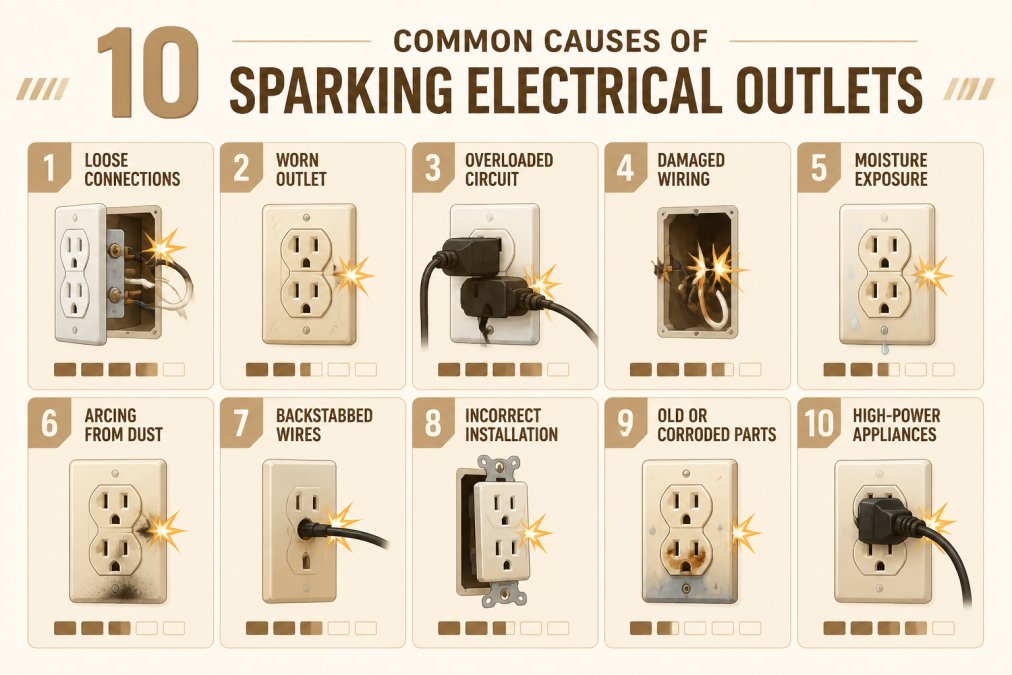
10 Common Causes of Sparking Electrical Outlets
Table of Contents
- 10 Common Causes of Sparking Electrical Outlets
- 1. Loose Wire Connections Behind the Outlet
- 2. Overloaded Circuits and High-Wattage Appliances
- 3. Short Circuits and Electrical Arcing
- 4. Frayed Wiring and Damaged Cords
- 5. Moisture Exposure and Water Intrusion
- 6. Worn-Out or Aging Outlets
- 7. Damaged Plugs and Prong Issues
- 8. Aluminum Wiring and Backstabbed Terminals
- 9. Voltage Spikes and Surge Damage
- 10. How to Fix a Tripping Circuit Breaker and Prevent Sparking Outlets
- When to Call a Professional
- Frequently Asked Questions
Last Updated: September 12, 2026
10 Common Causes of Sparking Electrical Outlets
A sparking outlet is one of the clearest warning signs of an electrical hazard. The 10 common causes of sparking electrical outlets range from loose wire connections and overloaded circuits to moisture, aging receptacles, and damaged plugs. At Light Life Electric, we know which are quick fixes and which mean cutting power immediately.
Below, we'll walk through each cause, how to spot it, and when the situation crosses from "keep an eye on it" to "call an electrician now." The U.S. Fire Administration's electrical fire safety guidance is blunt about the stakes: faulty wiring and related electrical failures remain a leading cause of residential fires, and a sparking outlet is often the first visible symptom.
1. Loose Wire Connections Behind the Outlet
A loose wire connection is the most common reason an outlet sparks. When the wire doesn't sit tight against the terminal screw or push-in contact, current jumps the gap, producing heat and a visible arc.
The connection loosens over time from vibration, heat cycling, or a rushed installation. Signs of faulty electrical wiring include a faint crackle, a warm faceplate, or a loose-feeling plug.
2. Overloaded Circuits and High-Wattage Appliances
An overloaded circuit happens when connected devices draw more amperage than the breaker and wiring can carry. Space heaters, microwaves, hair dryers, and air fryers pull heavy wattage, and stacking them on one circuit pushes the wiring past its limit, causing heat, degraded insulation, and eventually arcing. A breaker trip is your system doing its job, but repeated trips mean the load is too high for that circuit.
- Kitchen countertop circuits are the worst offenders
- Extension cords and power strips multiply the risk
- Older 15-amp circuits struggle with modern appliance loads
3. Short Circuits and Electrical Arcing
A short circuit occurs when a hot wire contacts a neutral wire or grounded metal, sending current along an unintended path. The surge produces a bright spark, a popping sound, and often a tripped breaker. Electrical arcing is the visible part of that event, current bridging a gap between worn contacts, loose terminals, or damaged insulation. What separates a nuisance arc from a dangerous one is rarely the size of the spark, it's the pattern.
Reading the spark: color, sound, and smell
| Cue | What it usually means | Risk level |
|---|---|---|
| Single blue-white snap when plugging in a device | Brief inrush arc at the contact point; common with motors and large capacitors | Low, monitor |
| Repeated blue-white sparks at the slot with no plug movement | Loose terminal or worn receptacle contacts arcing under load | High, stop using |
| Yellow or orange spark with a sizzling or frying sound | Sustained arcing fault; insulation is breaking down | Emergency, cut power |
| Green-tinted spark near a wet location | Moisture bridging live contacts, often with copper ionization | Emergency, cut power |
| Visible flame, popping, or a sharp acrid smell | Active electrical fire or imminent ignition | Evacuate and call 911 |
A faint crackle near the plate is not normal, nor is a faceplate that feels warm after a device runs for a few minutes. Both point to resistance heating behind the wall, which precedes most arc-fault fires.
Why your AFCI or GFCI breaker may be tripping
Modern code requires arc-fault circuit interrupter (AFCI) protection on most branch circuits and ground-fault circuit interrupter (GFCI) protection in wet locations, catching the failure modes above before they ignite surrounding material.
- AFCI monitors the circuit's waveform and trips when it detects a parallel or series arc signature. A sparking outlet on an AFCI circuit will often trip the breaker before you see the spark.
- GFCI monitors current balance between hot and neutral, tripping when current leaks to ground, the classic scenario when water reaches a live contact or a frayed cord touches a grounded surface.
- A breaker that trips the instant you reset it means the fault is still present. Repeated resets are how small faults become fires.
If an outlet sparks but the breaker does not trip, that is not reassurance, it may mean the circuit lacks AFCI protection, which is common in older homes. NFPA research on home electrical fires consistently links short circuits and arcing faults to a significant share of residential electrical fires, which is why arc-fault protection is now standard in many circuits.
4. Frayed Wiring and Damaged Cords
Frayed wiring exposes the conductor and lets current arc between strands or to nearby metal. Cord damage from furniture pinning cables, pets chewing, or repeated bending at the plug head is a frequent culprit. Once the jacket cracks, moisture and dust reach the conductor, and the outlet becomes a spark point. Replace any cord with exposed wire immediately rather than taping it.
5. Moisture Exposure and Water Intrusion
Moisture exposure is a leading cause of sparking in kitchens, bathrooms, laundry rooms, and outdoor receptacles. Water creates a conductive bridge between contacts that shouldn't connect.
Outlets near sinks, hose bibs, or leak-prone windows are highest risk. A GFCI outlet cuts power the moment it detects a ground fault, which is why code requires them in wet locations.
6. Worn-Out or Aging Outlets
Receptacles wear out. Internal contacts lose tension after thousands of insertions, and a loose grip means poor contact and arcing. An outlet 15 to 20 years old is a prime candidate.
You'll notice plugs that slide in too easily or fall out on their own, the same mechanism behind loose wire connections, just at the plug interface.
- Warm faceplates after normal use
- Discoloration around the slots
- Plugs that no longer stay seated
7. Damaged Plugs and Prong Issues
Prong damage on the plug itself can spark as readily as a faulty outlet. Bent, corroded, or partially broken prongs create poor contact and localized heating.
Inspect every cord before plugging it in. If a prong is loose, blackened, or bent, the device is the problem, and continuing to use it will damage the outlet too.
Get your free electrical estimate →
8. Aluminum Wiring and Backstabbed Terminals
Aluminum wiring was common in homes built during the 1960s and 1970s and behaves differently from copper. It expands and contracts more with heat, loosening connections over time and raising the risk of arcing.
Backstabbed terminals are the second half of this problem. Many outlets allow wires to be pushed into the back rather than wrapped around the terminal screws. That push-in connection has less contact area and loosens more easily, making it a known weak point. CPSC guidance on aluminum branch circuit wiring advises that aluminum branch circuits be evaluated and repaired by a qualified electrician rather than patched.
9. Voltage Spikes and Surge Damage
A voltage spike from a lightning strike, utility switching, or a large appliance cycling on can overwhelm an outlet and degrade its components. Repeated small spikes wear down insulation and contacts until the outlet arcs.
A quality surge protector protects the equipment plugged into it, not the wall wiring behind it. If an outlet sparks after a known surge, treat it as damaged.
| Cause | Warning Sign | Immediate Action | Who Should Fix It |
|---|---|---|---|
| Loose wire connection | Crackling, warm faceplate | Stop using the outlet | Electrician |
| Overloaded circuit | Repeated breaker trips | Redistribute the load | Electrician if it recurs |
| Short circuit / arcing | Pop, spark, tripped breaker | Cut power at the breaker | Electrician |
| Frayed wiring / cord | Visible exposed wire | Unplug and replace cord | Electrician for wall wiring |
| Moisture exposure | Sparking in wet areas | Turn off breaker | Electrician |
| Worn-out outlet | Plugs fall out | Replace receptacle | Electrician or capable DIYer |
| Damaged plug | Bent or blackened prongs | Replace the cord/device | DIY |
| Aluminum wiring | Warm outlets, flickering | Full evaluation | Electrician |
| Voltage spike | Spark after a surge | Inspect the outlet | Electrician |
| Smart device load | Overheating at receptacle | Check circuit capacity | Electrician |
10. How to Fix a Tripping Circuit Breaker and Prevent Sparking Outlets
Fixing a tripping circuit breaker starts with identifying why it tripped, not just resetting it. If it trips again immediately, stop and call a professional, repeated resets on a faulted circuit can turn a small problem into a fire.
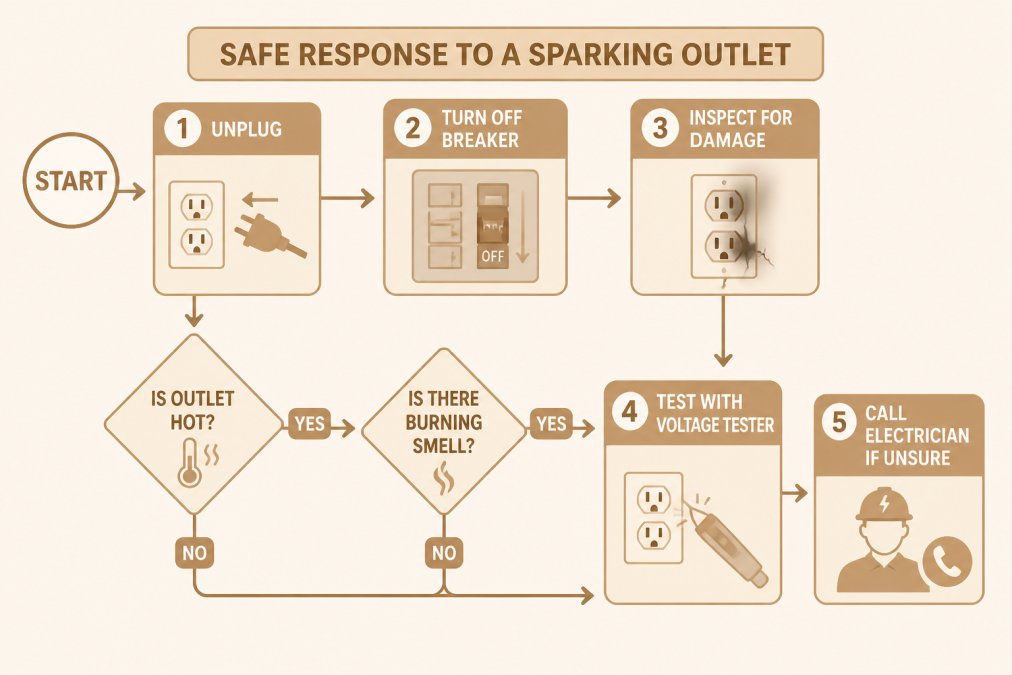
Here's the safe response sequence when an outlet sparks:
- Unplug the device from the outlet
- Turn off the breaker feeding that circuit
- Inspect the outlet and cord for visible damage
- Test the outlet with a voltage tester before touching it
- Call an electrician if you see burning, smell smoke, or can't identify the cause
Nuisance trip vs. fault trip
What most guides miss is the difference between a nuisance trip and a fault trip. A nuisance trip comes from too much load and clears when you redistribute it. A fault trip means current is going somewhere it shouldn't, that needs an electrician.
The smart-device load question
Smart plugs, speakers, always-on hubs, and high-draw IoT devices rarely spark on their own, but they change a circuit's load profile in ways older wiring was never designed for:
- Always-on draw adds up. A single smart plug draws very little, but a wall of them on one circuit keeps a steady baseline load that compounds with anything else plugged in.
- High-draw IoT devices are the real concern. Smart space heaters, Wi-Fi-connected air fryers, and smart window AC units pull the same wattage as their non-smart equivalents. The smart feature doesn't reduce the load, it just adds a schedule that can turn the device on when you're not watching.
- Cheap smart plugs can fail internally. A smart plug with a marginal relay or undersized contacts can arc inside its own housing, which looks like an outlet problem but is actually the plug. If an outlet only sparks when one specific smart plug is in it, the plug is the suspect.
- Tamper-resistant receptacles and smart plugs sometimes fight. The shutters in a TR receptacle can prevent a smart plug's prongs from seating fully, creating a poor contact point that heats up over time.
If you're stacking smart devices on an older 15-amp circuit, add up the wattage before you add another plug. The circuit doesn't care whether the load is "smart."
DIY vs. professional: a decision matrix
| Situation | Can a homeowner handle it? | Action |
|---|---|---|
| Spark only when plugging in a device, single snap, no smell | Yes | Inspect the cord and plug; replace if damaged |
| Sparking stops when a specific cord or device is removed | Yes | Retire the cord or device |
| Outlet sparks with nothing plugged in | No | Cut power at the breaker; call an electrician |
| Faceplate is warm, discolored, or smells acrid | No | Cut power; call an electrician |
| Breaker trips immediately on reset | No | Leave the breaker off; call an electrician |
| Visible flame, smoke, or burning smell | No | Evacuate; call 911, then an electrician |
| Aluminum wiring in the home | No | Full evaluation by a qualified electrician |
| Repeated nuisance trips from load | Yes, with caution | Redistribute the load; call if it recurs |
When to Call a Professional
Some sparking outlet causes are safe to handle yourself; some are not. Cord and plug damage is a DIY fix. Anything involving wiring, the breaker panel, or the receptacle's internal connections should go to a licensed electrician.
A burning smell, scorch marks, a hot faceplate, or a breaker that trips repeatedly are all signals to stop and call. Light Life Electric handles these calls across Southwest Florida with 24/7 emergency response. Our Florida certified electricians diagnose the fault, handle the repair or panel work, and confirm everything is code-compliant before we leave.
Frequently Asked Questions
Is it normal for an outlet to spark when plugging something in?
A tiny, blue spark when you plug in a device is usually normal, especially if the device draws power immediately. This small spark happens as the electrical current jumps to the plug. However, if the spark is large, yellow or white, or accompanied by a popping sound or burning smell, it indicates a serious problem like a loose connection or short circuit. In those cases, stop using the outlet and have a licensed electrician inspect it.
When should I be worried about a sparking outlet?
You should be worried if the spark is bright, loud, or repeated. Other warning signs include a burning smell, a buzzing or sizzling sound, a warm outlet cover, or a tripped circuit breaker. These symptoms point to electrical arcing, overloaded circuits, or faulty wiring, which can lead to an electrical fire. If you notice any of these signs, turn off power to the outlet at the breaker and call a professional.
What should I do immediately if an outlet sparks?
First, unplug any device from the outlet. Do not touch the outlet itself. Go to your electrical panel and turn off the circuit breaker that controls that outlet. If you cannot identify the correct breaker, turn off the main breaker. Then, inspect the outlet for visible damage like scorch marks or melted plastic. Do not reset the breaker until a qualified electrician has checked the outlet and wiring. If there is smoke or fire, evacuate and call 911.
Can a sparking outlet cause a house fire?
Yes. Sparking outlets are a leading cause of electrical fires in homes. When outlets spark due to loose connections, overloaded circuits, or frayed wiring, they create electrical arcing. This arcing generates intense heat that can ignite surrounding materials like insulation, wood framing, or curtains. Addressing sparking outlets promptly is critical for fire safety.
Do I need a licensed electrician to fix a sparking outlet?
If the sparking is caused by a loose connection, damaged wiring, or a faulty outlet, you should hire a licensed electrician. DIY repairs on electrical systems are risky and may violate local building codes. A licensed electrician can diagnose the root cause, ensure the repair meets National Electrical Code (NEC) standards, and prevent future hazards. For simple issues like a worn-out receptacle, a confident DIYer might replace it, but if you are unsure, professional help is always the safer choice.