 ultimate-guide
What Is the Benefit of Energy Efficient LED Lighting?
Table of Contents
- The Core Benefits of Energy Efficient LED Lighting
- How Much Energy Do LED Bulbs Save?
- LED Bulb Lifespan: Fewer Replacements, Lower Maintenance
- LED Color Temperature Guide: Matching Light to the Room
- LED Dimmer Compatibility: What You Need to Know
- Environmental and Safety Advantages of LED Lighting
- Limitations and Trade-Offs to Consider
- Conclusion
- Frequently Asked Questions
Last Updated: October 19, 2026
The Core Benefits of Energy Efficient LED Lighting
The benefit of energy efficient LED lighting comes down to one principle: light-emitting diode bulbs convert most of the electricity they draw into visible light rather than heat. At Light Life Electric, we install and retrofit these fixtures across homes and commercial properties.
Here is the honest version most guides skip. LED lighting is not automatically better just because the box says "LED." Cheap bulbs with poor drivers flicker, fail early, or produce harsh color. The benefit is real, but it depends on specification, not marketing.
Below, we break down what the savings actually look like, how to read a lumen and Kelvin rating, which dimmers work, and where LED technology still falls short.
How Much Energy Do LED Bulbs Save?
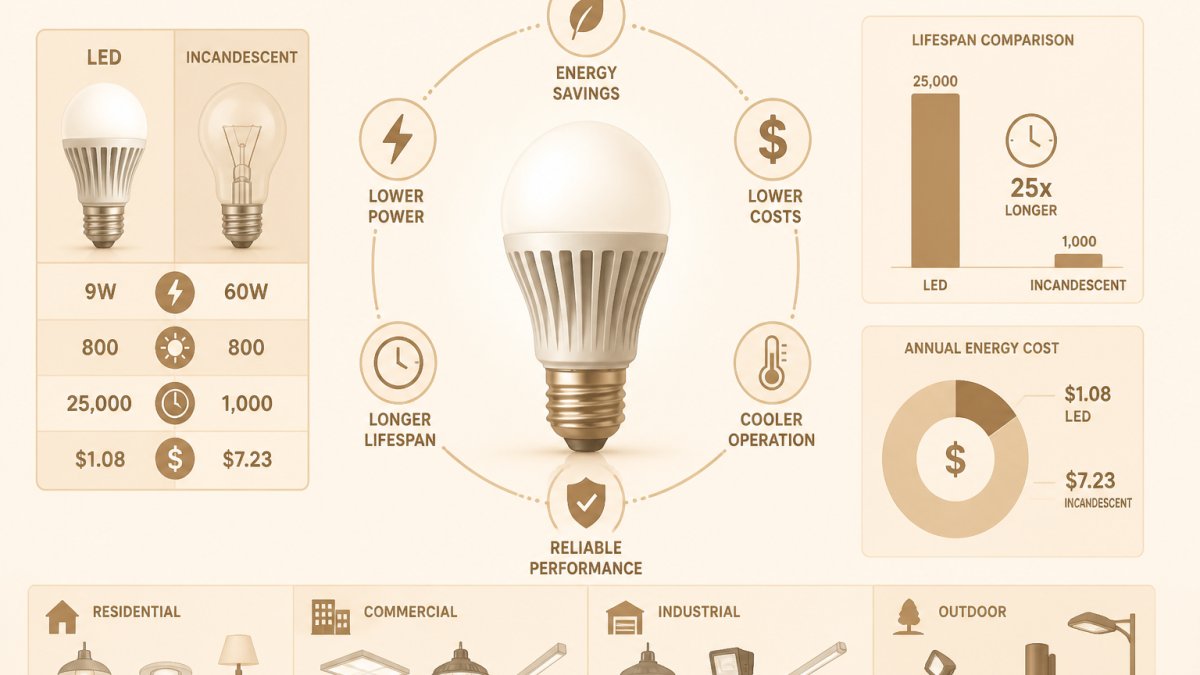
LED bulbs use roughly 75 to 80 percent less electricity than incandescent bulbs to produce the same brightness, measured in lumens. A typical 60-watt incandescent replacement draws about 8 to 10 watts as an LED.
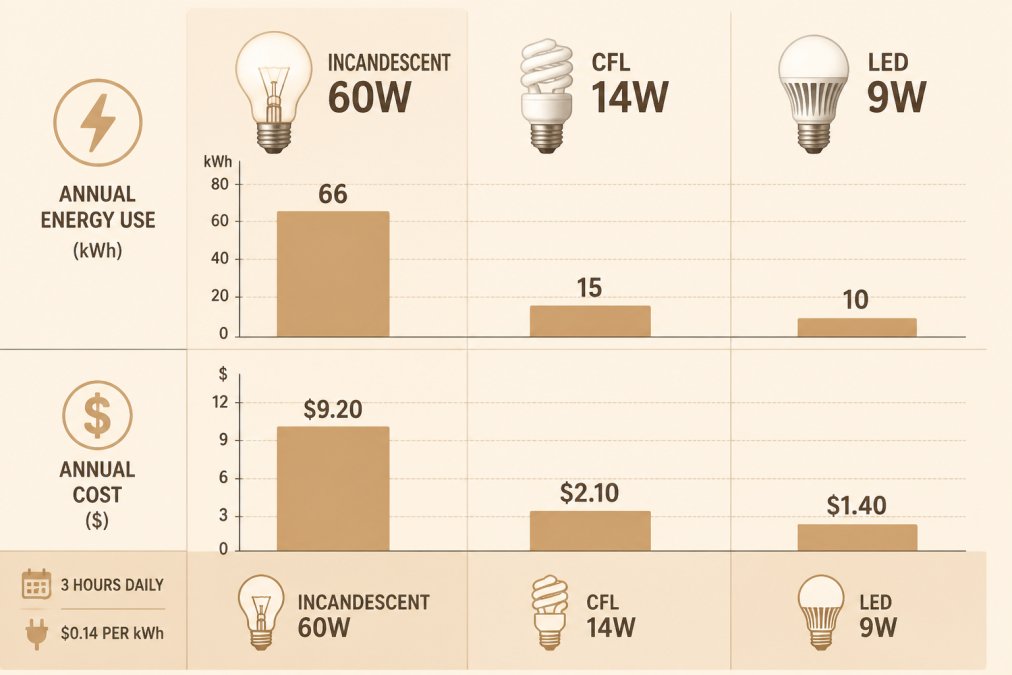
The math is straightforward once you fix the variables. Take a bulb run three hours a day at a residential rate near $0.14 per kWh:
| Bulb Type | Wattage | Annual Energy Use | Annual Cost | Lifespan |
|---|---|---|---|---|
| Incandescent | 60W | ~66 kWh | ~$9.20 | ~1,000 hours |
| CFL | 14W | ~15 kWh | ~$2.10 | ~8,000 hours |
| LED | 9W | ~10 kWh | ~$1.40 | ~25,000 hours |
Multiply that per-bulb gap across a whole house and the operating cost difference becomes meaningful. A common mistake is comparing bulbs by wattage alone. Wattage measures power draw, not brightness. Compare lumens.
A Worked Payback Example You Can Reproduce
Here is the calculation most guides skip. Suppose you replace a 60W incandescent that costs about $1.25 with a 9W LED that costs about $4.00. Run it three hours a day at $0.14 per kWh.
- Annual electricity savings: (66 kWh − 10 kWh) × $0.14 = about $7.84 per year.
- Avoided replacement cost: the incandescent lasts about 1,000 hours, or roughly 11 months at three hours a day, so you would buy about one replacement per year at $1.25. The LED is rated for 25,000 hours, or more than two decades at this duty cycle.
- Net first-year savings: about $7.84 in electricity plus roughly $1.25 in avoided replacement, minus the $2.75 upfront premium = about $6.34.
- Payback period: the $2.75 premium is recovered in roughly four to five months of operation.
That is a single bulb. Scale it: twenty bulbs in high-use areas produce roughly $150 or more in first-year electricity savings alone, and the payback shortens further because the upfront premium is spread across more units.
Use this formula for your own numbers:
Payback period (months) = (LED price − incandescent price) ÷ [(monthly energy savings + monthly replacement savings)]
To fill it in, you need four inputs: the wattage of each bulb, your hours of daily use, your electricity rate from your utility bill (divide the total bill by kWh used for a blended rate), and the purchase prices.
Whole-home retrofits move faster than single-bulb swaps because the savings stack while the labor is shared. That is also why high-use areas, kitchens, living rooms, offices, retail floors, and exterior lighting that runs nightly, can deliver significant payback, while closets and storage rooms may see slower returns.
LED Bulb Lifespan: Fewer Replacements, Lower Maintenance
A quality LED bulb is rated for roughly 25,000 hours, compared with about 1,000 hours for incandescent and 8,000 for CFL. At three hours of daily use, that is over two decades of service from a single bulb. Even at heavy commercial duty, the replacement frequency drops sharply.
The maintenance savings matter more than the bulb price in commercial settings. Replacing a bulb in a high ceiling, a parking structure, or a tenant common area costs labor and disruption, not just the part. When you cut replacement frequency by a factor of ten or more, the labor line item shrinks with it.
Durability is the other half of this story. LEDs have no filament to break, so they tolerate vibration far better than incandescent bulbs. That makes them the practical choice for ceiling fans, garage door openers, and any fixture that shakes.
LED Color Temperature Guide: Matching Light to the Room
Color temperature, measured in Kelvin, describes how warm or cool a light appears. Choosing the right Kelvin rating for each room does more for how a space feels than almost any other lighting decision.
- 2700K: warm white, closest to traditional incandescent. Best for living rooms, bedrooms, and dining areas.
- 3000K: soft white, slightly crisper. A good default for kitchens, hallways, and general residential use.
- 3500K-4000K: cool white. Common in offices, retail, and workspaces where alertness matters.
- 5000K-6500K: daylight. Task lighting, garages, and utility areas; harsh as ambient light in living spaces.
Reading the Label: Lumens, Watts, CRI, and Certifications
Kelvin is only one of several specifications that decide whether a bulb performs. Compare these side by side before you buy:
- Lumens: the measure of brightness. A 60W incandescent replacement should produce roughly 800 lumens. Match lumens to the task, not wattage to the old bulb.
- Lumens per watt (lm/W): the efficiency score. A quality LED typically lands around 80 to 100 lm/W or higher; budget bulbs often fall below that. Higher lm/W means more light for the same electricity.
- CRI (color rendering index): how accurately the light shows color, on a 0-100 scale. Look for 90+ in residential spaces and retail; 80+ is acceptable in utility areas. A bulb that hits the right Kelvin but a low CRI will make interiors look flat and washed out.
- Dimmer compatibility: check the manufacturer's published dimmer compatibility list and confirm the dimmer is rated for LED loads. A bulb can be perfect on paper and still flicker on the wrong dimmer.
- Efficiency certifications: look for the ENERGY STAR label, which verifies minimum efficiency, color quality, and lifetime claims through a third-party testing program. For fixtures and lamps, also check for DesignLights Consortium (DLC) listing, which many commercial rebate programs require. These certifications are the clearest signal that the specifications on the box have been independently verified.
Matching Light to the Room
A practical selection sequence: pick the Kelvin for the room's function, pick the lumens for the task, then confirm CRI and dimmer compatibility, then verify the certification. That order prevents the common failure of buying a bulb that looks right in the package but underperforms in the fixture.
For residential spaces, 2700K-3000K at 90+ CRI is a reliable default. For commercial and workplace settings, 3500K-4000K with documented lm/W and DLC listing supports both visual comfort and any available utility rebate. For garages and utility areas, 5000K daylight is appropriate as task light but should not spill into living zones.
Get your free electrical estimate →
LED Dimmer Compatibility: What You Need to Know
Not every LED bulb dims smoothly on every dimmer. LEDs draw far less power than the dimmers designed for incandescent loads, and older dimmers often can't regulate that low draw, which causes flicker, buzzing, or a limited dimming range.
Check three things before you buy:
- Dimmer compatibility list: Reputable LED makers publish tested dimmer models. Match your dimmer to the list.
- LED-rated dimmer: Look for dimmers explicitly rated for LED loads, not just incandescent.
- Minimum load: Some dimmers need a minimum wattage to function; a single LED may fall below it.
If you're retrofitting a whole room, replacing the dimmer alongside the bulbs is usually the cleaner path. A dimmer that worked flawlessly with incandescent bulbs may behave poorly with LEDs, and no amount of bulb-swapping fixes a mismatched dimmer.
Environmental and Safety Advantages of LED Lighting
LED lighting reduces electricity demand, and in most grids lower demand means lower carbon emissions from power generation. Because LEDs also contain no mercury, unlike fluorescent tubes and CFLs, they avoid a hazardous-material disposal problem at end of life.
The whole-life picture is more nuanced than "eco-friendly" marketing suggests. LEDs carry a higher manufacturing footprint per bulb, but their long service life and low energy draw typically offset that over the product's life.
Safety is the quieter benefit. LEDs run cooler than incandescent bulbs, which reduces burn risk near fabrics and lowers heat load on the space. In commercial kitchens and HVAC-heavy buildings, that reduced heat output also eases the cooling load.
Limitations and Trade-Offs to Consider
LED lighting is not the right answer for every fixture, and pretending otherwise does readers a disservice. Here is where it falls short.
Upfront cost. LEDs cost more per bulb than incandescent. The premium is real, and the payback depends on usage hours.
Driver failure. The LED chip itself often outlasts the driver that powers it. When a quality LED fails early, it's usually the driver, not the diode.
Heat sensitivity. As noted, enclosed fixtures shorten LED life unless the bulb is rated for them.
Compatibility friction. Older dimmers, some smart switches, and certain fixture designs need adjustment before LEDs perform well.
Color inconsistency. Budget LEDs can vary in tint from bulb to bulb within the same box.
Conclusion
The benefit of energy efficient LED lighting is genuine, but it rewards buyers who specify carefully. Match lumens to the task, Kelvin to the room, CRI to the space's purpose, and dimmers to the bulbs. Done right, the savings compound for years.
That specification work is where a licensed electrician earns their keep. Light Life Electric is a family-owned, Florida certified electrical contractor, fully licensed, bonded, and insured, and we handle LED retrofits and lighting design from permit to final inspection.
Get your free electrical estimate and let us show you what a properly specified LED retrofit looks like in your home or commercial property.
Frequently Asked Questions
What are the main benefits of energy-efficient LED lighting?
LED lighting uses up to 75% less energy than incandescent bulbs and lasts 15 to 25 times longer. That means lower electricity bills, fewer replacements, and less maintenance. LEDs also produce less heat, which reduces cooling costs in warmer months. For homeowners and property managers, the combination of energy savings and reduced maintenance adds up to significant long-term savings.
How much energy do LED bulbs save compared with incandescent bulbs?
A typical LED bulb uses about 10 watts to produce the same brightness as a 60-watt incandescent bulb. Over a year of three hours daily use, that saves roughly 55 kWh per bulb. The exact savings per bulb annually will depend on your local electricity rate. Multiply that across a whole home or commercial space, and the savings grow quickly.
Do LED lights lower electricity bills?
Yes. Because LEDs convert more electricity into light and less into heat, they draw less power for the same brightness. The U.S. Department of Energy estimates that widespread LED use could cut lighting energy consumption by nearly half. For a typical household, lighting accounts for about 10% of electricity use, so switching to LEDs can meaningfully reduce monthly bills.
Can LED bulbs work with dimmer switches?
Not all LEDs are dimmable. Check the packaging for a dimmable rating. Even dimmable LEDs may need a compatible dimmer switch designed for LED loads. Older dimmers made for incandescent bulbs can cause flickering or buzzing. If you're unsure, a licensed electrician can test your dimmer's compatibility or recommend a replacement that matches your LED fixtures.