 how-to
What Happens When a Commercial Electrical Panel Overloads
Table of Contents
- What Happens When a Commercial Electrical Panel Overloads
- Signs of an Overloaded Electrical Panel in Commercial Facilities
- When Your Commercial Circuit Breaker Keeps Tripping
- Electrical Panel Capacity and Load Calculation Basics
- What to Do Immediately When You Suspect an Overload
- How to Distinguish a Circuit Overload From a Panel Capacity Problem
- When a Commercial Electrical Panel Upgrade Makes Sense
- Conclusion
- Frequently Asked Questions
Last Updated: October 6, 2026
What Happens When a Commercial Electrical Panel Overloads
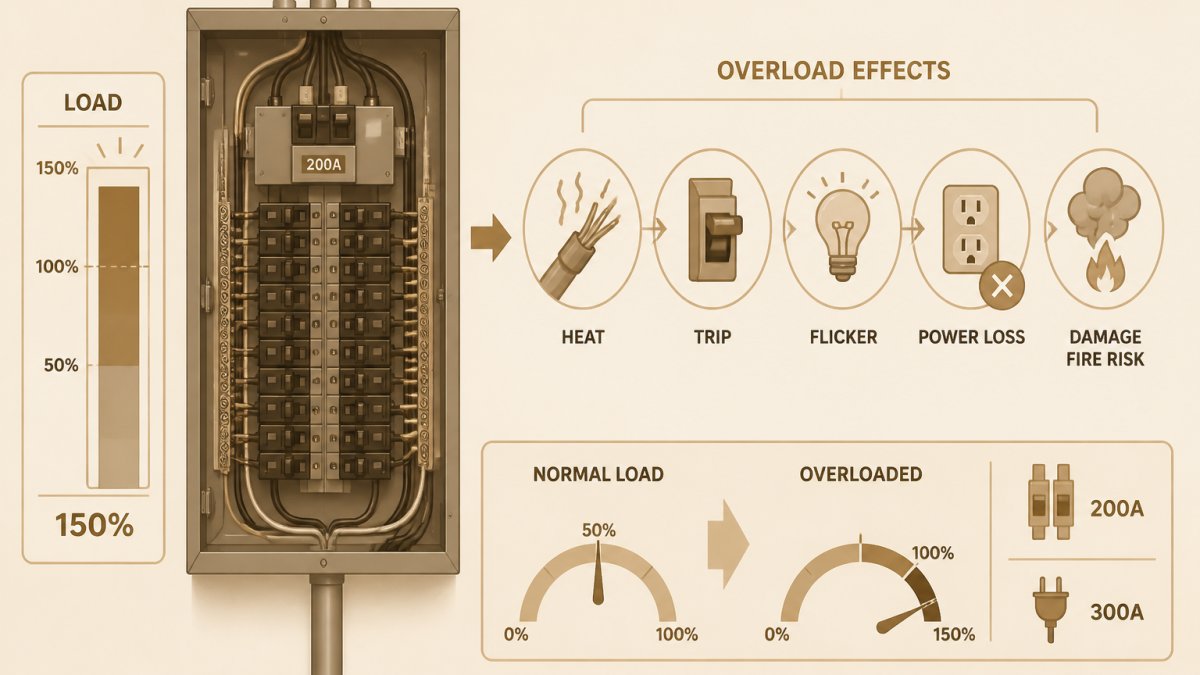
When a commercial electrical panel overloads, the breaker trips to cut power before wiring overheats and starts a fire.
Most overloads build slowly, a circuit here, a warm outlet there.
Inside the panel, demand exceeds what the circuit can carry, heat rises in the wiring and connections, and the breaker trips.
Below: every warning sign, what to do the moment you suspect an overload, and how to tell a circuit problem from a full panel capacity failure.
Signs of an Overloaded Electrical Panel in Commercial Facilities
A commercial electrical panel rarely fails without warning, but the early signs are easy to dismiss in a busy facility. Catching them is the difference between a repair and a shutdown.
Watch for these signals across your building:
- Breakers that trip again and again, even with normal equipment running
- Lights that flicker or dim when motors, HVAC, or kitchen gear kicks on
- A buzzing hum from the panel or outlets
Flickering Lights, Buzzing, and Burning Odors
Flickering lights and a buzzing panel are the earliest warnings a commercial electrical system gives you: current is struggling to flow.
When lights dim every time a large motor starts, the circuit is straining under a load it can't handle.
A burning odor is the most urgent signal. If you smell hot plastic or a fishy, acrid scent near the panel, shut off power to that area and call a licensed electrician.
Warm Outlets, Discolored Components, and Arcing
Heat is the clearest proof of an overloaded circuit: warm outlets, discolored breaker faces, and scorched wiring all mean too much current, resistance, and heat.
Arcing is the dangerous end of that spectrum, sparks, a sharp pop, or a flash inside the panel. It happens when current jumps a gap and can ignite nearby material.
When Your Commercial Circuit Breaker Keeps Tripping
A commercial circuit breaker that keeps tripping is doing its job, not failing, it's protecting your wiring from a load it can't carry.
Either the circuit is genuinely overloaded, or the breaker is weak and tripping early. Both need attention, but they call for different fixes.
Here's how to read the pattern:
- Trips during peak use: the circuit is overloaded. Too much equipment runs at once.
- Trips immediately on reset: a short circuit or ground fault, not a simple overload.
- Trips randomly, even with light load: a failing breaker or a loose connection.
That last distinction matters most, because it changes everything about the fix.
Electrical Panel Capacity and Load Calculation Basics
Electrical panel capacity is the total current a panel can safely carry, measured in amps.
Load calculation finds what your building actually needs: it adds up every load, lighting, outlets, motors, HVAC, kitchen equipment, then accounts for how often those loads run at once.
The key terms:
- Ampacity: the maximum current a wire or device can carry safely.
- Demand load: the realistic peak, not the sum of every device at full power.
- Continuous load: equipment running three hours or more, like commercial lighting.
Get these wrong and you get an overload. Get them right and you know where your capacity stands.
The 80% Rule and Demand Load Explained
The 80% rule says a circuit should carry no more than 80% of its breaker rating for continuous loads.
Breakers and wiring generate heat under load, and that heat builds over time.
Demand load is the other half: you don't add every device at full rating because they don't all run at once.
What to Do Immediately When You Suspect an Overload
If you suspect an overload, reduce the load and shut down the affected circuit first, then call a licensed electrician. Do not keep resetting breakers and hoping the problem clears.
In a commercial facility, protect people first, then the equipment and inventory that keep the business running.
Step 1: Protect people first
If you see sparks, arcing, smoke, or flames at the panel, treat it as an electrical fire, not an overload. Evacuate, call 911, and do not open the panel or spray water on it.
If there is no fire but you smell burning insulation or see discolored components, clear the area and keep the panel closed, the next event can be an arc flash.
Step 2: Shed load in the right order
When the panel is hot, buzzing, or repeatedly tripping but there is no fire, reduce demand first. Shed loads in this order:
- Non-critical comfort and convenience loads, decorative lighting, signage, breakroom equipment, space heaters.
- Deferrable process loads, equipment that can pause without ruining product or data, such as certain production lines, compressors, or HVAC stages.
- Protect critical loads, refrigeration, servers, medical or lab equipment, security systems, and anything whose failure causes spoilage, data loss, or safety risk. If these are on the affected circuit, they need to be moved or backed up, not simply switched off.
That last point is where commercial overloads differ from residential ones. A homeowner can flip a breaker and wait. A facility manager must decide which loads can survive a shutdown and which cannot.
Step 3: Leave the breaker off if there were warning signs
If the breaker tripped after any heat, buzzing, burning smell, or visible damage, leave it off. Do not reset it to "see if it holds", repeated resets on a damaged circuit can re-energize arcing and start a fire.
Step 4: Call a licensed electrician and document the event
Call a licensed electrician for a diagnostic inspection. While you wait, document:
- The time of the trip
- Which breaker or breakers tripped
- What equipment was running
That record helps an electrician find the pattern fast and supports insurance and liability documentation if the issue escalates.
Get your free electrical estimate →
Step 5: Plan for the next event before it happens
A suspected overload signals that your facility's electrical demand has outgrown its supply. Once the hazard is cleared, use the event to trigger a load study, a panel inspection, and a maintenance plan, facilities that treat every trip as a one-off repair tend to repeat the same emergency on a larger scale.
At Light Life Electric, our 24/7 emergency response exists for exactly this situation. A suspected overload at 2 a.m. is not something to sleep on.
How to Distinguish a Circuit Overload From a Panel Capacity Problem
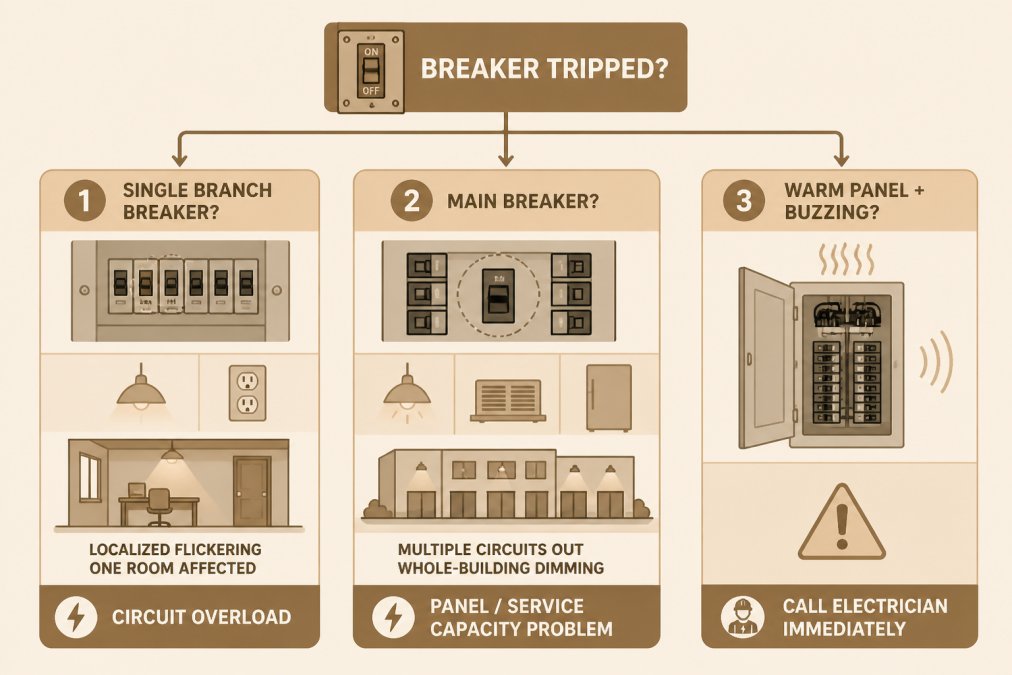
A branch circuit overload affects one circuit; a panel or service capacity problem affects the whole building. The symptoms tell you which one you're facing, but the causes require different diagnostics and fixes.
The three layers of an electrical supply
To sort out what is happening, think about a commercial electrical system in three layers:
- Branch circuit, the wiring and breaker feeding a specific set of outlets or equipment. Rated in amps (often 15A, 20A, 30A, or larger).
- Panel, the distribution point that holds the branch breakers. Rated by its busbar and main breaker, commonly 100A, 200A, 400A, or higher in commercial settings.
- Service, the utility feed, meter, and main disconnect that supply the panel. Rated in amps and often limited by the utility transformer serving the building.
An overload can occur at any layer; the symptoms and fix depend on which one is at its limit.
Branch circuit overload
A branch circuit overload happens when equipment on one circuit draws more current than the breaker and wiring are rated to carry. The breaker trips, the circuit goes dead, and the rest of the building keeps running.
Common commercial causes:
- Multiple high-draw appliances or tools on one circuit
- A motor or compressor with a high inrush current starting on a circuit already near its limit
- Extension cords and power strips daisy-chained to add outlets
The fix is usually local: redistribute loads, run a dedicated circuit, or replace undersized wiring. It does not require a service upgrade.
Panel capacity problem
A panel capacity problem happens when total demand exceeds what the panel and its main breaker can safely supply. The main breaker may trip, or branch breakers may trip in patterns that match no single piece of equipment.
Signs that point to the panel rather than a branch circuit:
- The main breaker trips under normal building load
- Multiple branch breakers trip around the same time
- Lights dim across the whole building when large equipment starts
The fix is not load shuffling but a panel upgrade, a service upgrade, or both, sized to the building's actual demand.
Service capacity problem
A service capacity problem is the layer above the panel: the utility feed, meter, and main disconnect may be rated for less than the building now demands, even if the panel itself is adequate.
Symptoms overlap with a panel problem, but the diagnostic path is different. An electrician may need to coordinate with the utility to confirm the transformer and service drop can support the load.
What an electrician actually measures
When an electrician evaluates a suspected capacity problem, the process typically includes:
- Load calculation, adding up connected loads, applying demand factors, and separating continuous from non-continuous loads.
- Ampacity check, confirming that breakers, wiring, and terminations are rated for the loads they serve.
- Phase balance check, measuring current on each phase to see whether one leg is carrying more than its share.
These measurements separate a guess from a diagnosis: a symptom table points you in the right direction, but only testing confirms which layer is at its limit.
Use this comparison to sort it out:
| Symptom | Circuit Overload | Panel / Service Capacity Problem |
|---|---|---|
| Breaker affected | One branch breaker | Main breaker or several at once |
| Lights | Flicker in one area | Dim across the whole building |
| Scope | Single room or equipment | Multiple circuits, entire facility |
| Frequency | During specific equipment use | Random, building-wide, worsening |
| Fix | Redistribute load, repair circuit | Panel or service upgrade |
If one breaker trips when a specific machine runs, that's a circuit overload, often fixed by moving equipment to another circuit or reducing what runs at once.
If the main breaker trips, or multiple circuits fail together, you have a capacity problem. No amount of load shuffling fixes that.
The main breaker tripping is the clearest sign of a capacity problem. It means the whole service is at its limit, not just one circuit. That's a job for a licensed electrician and likely a panel upgrade.
When a Commercial Electrical Panel Upgrade Makes Sense
A commercial electrical panel upgrade makes sense when your building's demand has outgrown what the panel and service can safely supply.
Signs it's time to upgrade:
- The main breaker trips under normal building load
- You've added equipment over the years without a capacity check
- The panel is old, crowded, or shows heat damage
An upgrade means a larger panel, a higher-amperage service, or both.
The payoff is real: a properly sized panel ends the tripping, protects your equipment, and removes a serious fire risk, the difference between reliable operations and constant interruptions.
At Light Life Electric, we handle the entire process, from permits to final inspection.
Commercial property owners and managers whose buildings have outgrown their current electrical service, or who need documented, code-compliant work for insurance and inspections.
Conclusion
An overloaded commercial electrical panel is a safety problem, not an inconvenience. The signs are there early, tripping breakers, flickering lights, buzzing, heat, and that burning smell you should never ignore.
When the diagnosis points to a capacity problem, guessing costs more than fixing it right.
Get your free electrical estimate and put a stop to the tripping before it becomes a fire.
Frequently Asked Questions
What happens if a commercial electrical panel is overloaded?
When a commercial electrical panel overloads, the main breaker or individual branch circuit breakers trip to cut power and prevent damage. If breakers fail to trip, wiring and electrical connections can overheat, insulation can degrade, and arcing may occur, creating a serious fire hazard. Equipment on affected circuits loses power, which can interrupt operations, damage sensitive machinery, and lead to costly downtime. Persistent overloads accelerate wear on the entire electrical system and may eventually require a full panel upgrade or service upgrade to restore safe capacity.
What are the warning signs of an overloaded commercial electrical panel?
Common signs of an overloaded electrical panel include frequent breaker trips, flickering or dimming lights, buzzing sounds from the panel, warm or discolored outlets, and a burning odor near electrical components. In commercial settings, you may also notice equipment shutting off unexpectedly, lights dimming when HVAC systems kick on, or multiple circuits failing at once. Any of these signs warrant an electrical inspection by a licensed electrician, because ignoring them increases fire risk and the chance of expensive equipment damage.
What should you do if a commercial circuit breaker keeps tripping?
If a commercial circuit breaker keeps tripping, stop resetting it repeatedly. First, unplug or turn off equipment on that branch circuit to reduce the electrical load. If the breaker holds after reducing load, the circuit was likely overloaded and you should redistribute equipment across circuits. If it trips again with minimal load, there may be a short circuit, ground fault, or failing breaker that requires professional diagnosis. A licensed electrician can perform an electrical inspection, check amperage with a clamp meter, and determine whether the issue is a circuit overload or a panel capacity problem.
Can an overloaded electrical panel cause a fire?
Yes. An overloaded electrical panel is a genuine fire hazard. When current exceeds the ampacity of wiring and components, heat builds up in conductors, breakers, and electrical connections. Over time, this overheating degrades insulation and can ignite nearby combustible materials. Arcing and sparks from loose connections or failing breakers are another ignition source. The main breaker and branch circuit breakers are designed to trip before damage occurs, but if they are undersized, worn, or bypassed, that protection fails. Regular preventive maintenance and load calculations help reduce this risk.