 blog
blog
Top 10 Outdoor Landscape Lighting Ideas for Your Yard
Table of Contents
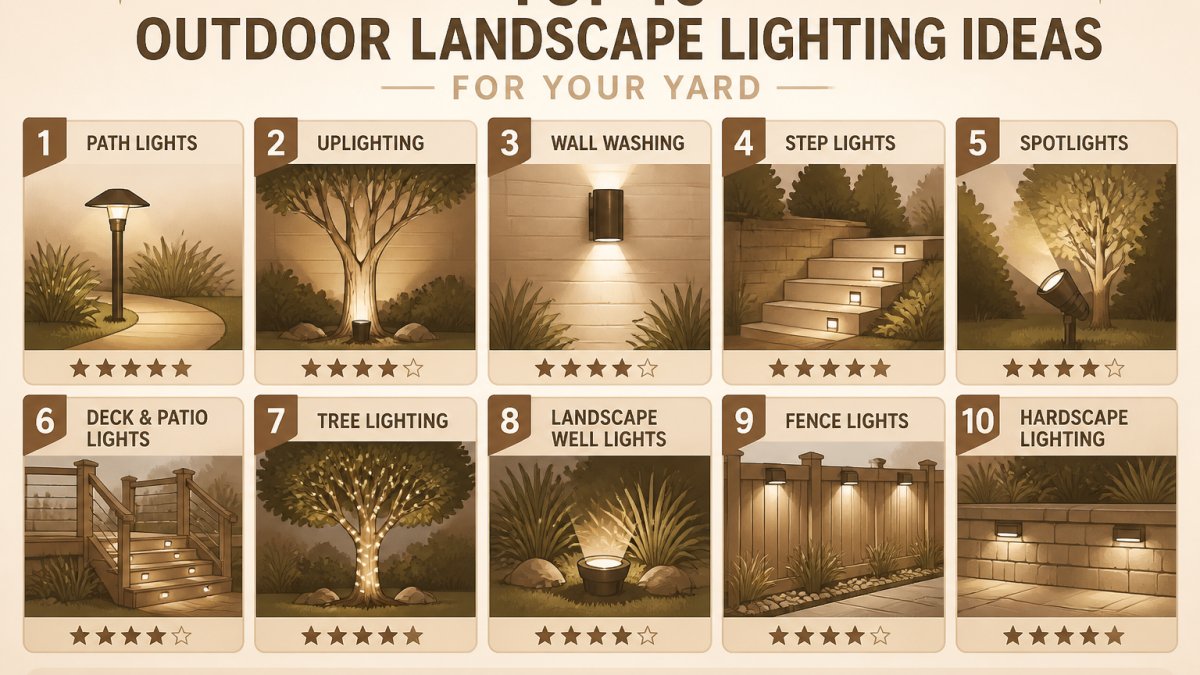
- Path and Walkway Lighting Ideas That Guide Without Glare
- Front Door and Entryway Lighting for a Confident First Impression
- Outdoor Garden Lighting Ideas for Flower Beds and Foliage
- Tree Uplighting and Shrub Lighting That Adds Depth After Dark
- Spotlights, Accent Lighting, and Step Lights for Hardscape and Stairs
- Deck, Patio, and String Light Ideas for Outdoor Living
- Low-Voltage Landscape Lighting: Layout, Spacing, and Costs
- LED Landscape Lighting, Color Temperature, and Dark-Sky Choices
- Frequently Asked Questions
Last Updated: October 17, 2026
Path and Walkway Lighting Ideas That Guide Without Glare
Path and walkway lighting places low fixtures along a route so people see where they are stepping without being blinded. Light Life Electric recommends starting every walkway plan with one rule: light the ground, not the eyes.
Path lights work best spaced 6 to 10 feet apart along one side of a walk, staggered rather than mirrored, at a 12- to 18-inch stake height.
- Straight walk: 8 to 10 feet apart, one side
- Curved walk: 6 to 8 feet apart through the bend
- Steps at the end: add a step light per riser
Front Door and Entryway Lighting for a Confident First Impression
Front door and entryway lighting frames the entry: wall lanterns, sconces, a porch light, and sometimes a post light at the drive.
Mount wall lanterns at roughly two-thirds the door's height, one on each side if centered, or a single larger fixture offset on a narrow entry. Keep fixtures at least 6 inches clear of the door trim so light washes the face, not the frame.
Outdoor Garden Lighting Ideas for Flower Beds and Foliage
Outdoor garden lighting ideas work on a simple principle: light the texture, not the bloom. A beam raking across foliage from a low, concealed fixture picks up leaf shape and depth that flat overhead light destroys.
Keep the fixture hidden behind mulch, a rock, or a shrub so the source never enters view. Downlighting from a tree branch gives a soft moonlit wash.
- Low ground lights: wash across the bed surface
- In-ground uplights: graze up through foliage
- Concealed fixtures: hide behind mulch or stone
Tree Uplighting and Shrub Lighting That Adds Depth After Dark
Tree uplighting and shrub lighting gives a yard depth after dark, pulling tall elements forward and pushing the background back. Place an uplight 2 to 3 feet from the trunk and aim up into the canopy.
For shrubs, a single low uplight at the base lights the whole form. Keep the beam narrow on tall trees and wider on low shrubs.
Spotlights, Accent Lighting, and Step Lights for Hardscape and Stairs
Spotlights and accent lighting direct attention to a wall, a specimen plant, or an architectural feature, while step lights make stairs safe. Step lights mount in the riser or side wall and throw a low pool of light onto each tread.
Adjustable accent spotlights let you aim at a stone wall, a fountain, or hardscape. Use a narrow beam for a tight highlight and a wider beam for a wash.
- Step lights: riser or side-wall mount, low output
- Adjustable spotlights: narrow beam for highlights
- Wall wash: wide beam across hardscape
Deck, Patio, and String Light Ideas for Outdoor Living
Deck and patio lighting is about usable evening space, not decoration. Recessed deck lights set into the boards or fascia light the surface and step-down without glare.
String lights and hanging lights turn a patio or pergola into a room. Hang string lights on a catenary between posts or trees, keeping the lowest point at least 7 feet above the floor.
Low-Voltage Landscape Lighting: Layout, Spacing, and Costs
Low-voltage landscape lighting runs fixtures on 12 to 15 volts from a transformer plugged into a standard outlet, rather than line voltage at each fixture. It is the standard choice for residential yards because it is safe to install, easy to expand, and efficient. The trade-off: low-voltage systems are sensitive to cable length and load, so layout and transformer sizing matter as much as the fixtures.
Start with a layout plan by yard type
A layout starts at the transformer, runs a main cable along the primary path, and branches to fixtures. The right plan depends on yard shape, not fixture count. Three patterns cover most homes:
- Small front yard (roughly 1,500 to 3,000 sq ft): one transformer zone, a single run along the walk from the drive to the door, 4 to 8 path lights, 2 entry lanterns, and 2 to 4 uplights on the main tree or facade. Keep the run under about 100 feet so voltage drop stays manageable.
- Deep lot (long drive or a walk that runs 100 feet or more): split into two or more zones at the transformer. Put the entry and front walk on one zone and the drive or rear path on another. Long single runs dim the far fixtures; multiple zones keep every fixture at consistent brightness and let you switch areas independently.
- Mixed-use backyard (patio, beds, and trees): three layers, a perimeter run for bed and shrub uplights, a separate run for patio and deck fixtures, and a dedicated circuit for any water feature or fire-pit area. Keep the patio zone on a dimmer or smart controller so the entertaining area can go warm and low while the perimeter stays on a schedule.
Spacing, beam angles, and brightness
Fixture spacing follows the job, and beam angle controls what the fixture actually lights:
- Path lights: 6 to 10 feet apart, one side of the walk, 12- to 18-inch stake height. A 60- to 90-degree beam gives a soft pool; a narrower beam creates scallops that read as stripes.
- Uplights: 2 to 3 feet from the trunk, aimed up into the canopy. A 15- to 30-degree narrow beam for tall trees, 30- to 60-degree for low shrubs.
- Step lights: one fixture per two to three risers on a wide stair, one per riser on a narrow run, low output (often under 100 lumens) so the tread is readable without glare.
Brightness is where most DIY layouts go wrong: overlighting the path and underlighting the trees. Path fixtures at 50 to 150 lumens are usually enough; uplights on a large tree often need 200 to 500 lumens depending on canopy height. More fixtures at lower output read better than fewer bright ones.
Transformer sizing and voltage drop
Add up the wattage of every fixture on a run, then size the transformer with headroom, load it to no more than about 80 percent of rated capacity so it runs cool and leaves room to add fixtures.
Get your free electrical estimate →
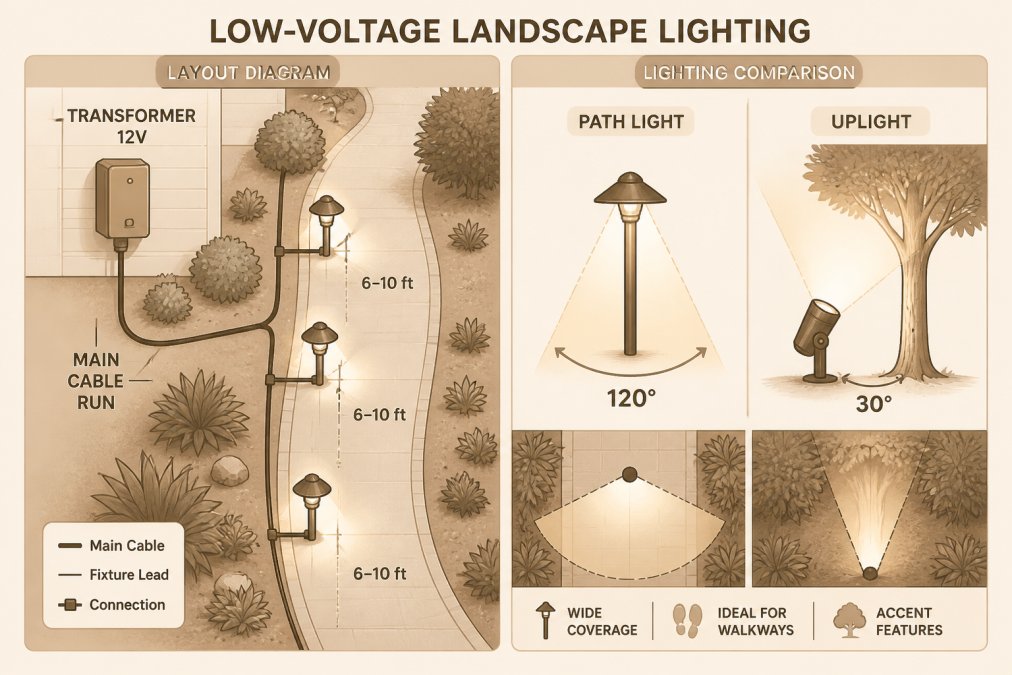
Power and control options compared
- Low-voltage wired: 12 to 15 volts from a transformer, safe to install, easy to expand, best for most residential yards. Requires a transformer and cable trenching or burial.
- Line-voltage wired: 120 volts at each fixture, used for larger or commercial jobs and some entry and post lights. Requires a licensed electrician, conduit, and permits in most jurisdictions.
- Solar: no wiring or transformer, easiest to place, but output depends on sun exposure and battery life; best for accent and path fixtures in sunny spots, not for tree uplighting or year-round reliability.
What it costs
Cost depends on fixture count, transformer size, cable length, and whether the yard needs new wiring or trenching. Pricing for residential low-voltage installations depends on fixture count, transformer size, cable length, and whether the yard needs new wiring or trenching. Larger or complex jobs may run higher. A rough breakdown:
- Fixtures: often $40 to $150 each for quality residential fixtures; premium solid brass runs higher.
- Transformer: roughly $150 to $600 depending on wattage and zone count.
- Cable and connectors: a modest line item, but trenching or burial adds labor.
Operating cost is low: LED fixtures draw a fraction of halogen's power. Light Life Electric provides a written estimate that separates fixtures, transformer, labor, and any permit or inspection work after a walk-through.
LED Landscape Lighting, Color Temperature, and Dark-Sky Choices
LED landscape lighting has largely replaced halogen because LEDs last far longer, use a fraction of the power, and hold their color. The choice that matters most is color temperature: warm white around 2700K to 3000K suits homes and gardens, while cooler temperatures read clinical outdoors. But color rendering and glare control also decide whether the yard looks natural or harsh.
Warm versus cool: what each does to plants and architecture
- 2700K warm white: the default for paths, entries, gardens, and most residential facades. It flatters brick, stone, and wood, and it reads as soft rather than institutional. Warm light also attracts fewer insects than cool white, which matters on a patio or near a door.
- 3000K neutral white: a slightly crisper option for hardscape, accent spotlights, and modern architecture. It keeps foliage from looking yellow while still avoiding the blue cast of cooler temperatures.
- 4000K and above: best avoided in residential yards. Cool white washes out plant color, makes stone look gray, and reads as security lighting rather than landscape lighting. Reserve it for utility areas if you use it at all.
A common pattern is to keep the whole yard within one or two steps of color temperature. Mixing 2700K path lights with 4000K uplights on the same tree creates a visible color clash that no amount of aiming fixes.
Color rendering: why CRI matters outdoors
Color rendering describes how accurately a light shows the true color of what it hits. A high-CRI LED (80 or higher, 90+ for specimen plants and stone) shows foliage and stone in truer color, so plants look natural rather than gray or muddy. Low-CRI LEDs can make a healthy garden look tired after dark. When comparing fixtures, ask for the CRI rating, not just the color temperature, two 2700K fixtures can render color very differently.
Dark-sky practices and glare control
Dark-sky practice puts light where it is needed and nowhere else. The practical steps:
-
Shield every fixture. A hood or shield hides the bulb from view so you see the lit surface, not the source. Unshielded fixtures are the number-one cause of glare in residential yards.
-
Aim beams down. Uplights should be aimed into the canopy, not across the property line. Path lights should point down and slightly inward toward the walk.
-
Use timers and controls. A photocell or astronomical timer turns the system on at dusk and off at a set hour, so the yard is not lit all night for no reason. Dimming after a set hour reduces light spill and saves energy.
-
Warm 2700K: paths, entries, gardens
-
Neutral 3000K: hardscape and accents
-
High CRI (80+, 90+ for specimen plants): truer foliage and stone color
Smart lighting controls let you set scenes and schedules, dim after a set hour, and switch zones from a phone. Pair that with a licensed electrician for the transformer, wiring, and any permit work, and the system stays safe and code-compliant. Light Life Electric handles the full job, from permits to final inspection, and offers 24/7 emergency response.
Frequently Asked Questions
Where should landscape lights be placed?
Place path lights 8-10 feet apart along walkways, offset from the edge so the fixture head stays out of the walking line. Put uplights 2-3 feet from tree trunks and aim them into the canopy, and keep entryway fixtures at eye level or higher beside the door. Garden and flower-bed lighting works best tucked into foliage so the source stays hidden and only the glow shows. The goal is to light the surface or plant, not the bulb.
Are LED lights a good choice for landscape lighting?
Yes. LED landscape lighting uses a fraction of the power of halogen while lasting far longer, which cuts both electricity bills and replacement labor. LEDs also run cooler, so fixtures and wiring stay safer in tight garden beds. Choose warm-white LEDs in the 2700K-3000K range for most homes, and pick fixtures with a high color-rendering rating so plants and stone look natural rather than gray or blue.
How far apart should landscape lights be placed along a walkway?
Space path lights about 8-10 feet apart for an even pool of light with no dark gaps. On long walkways, tighten spacing slightly on curves and corners where footing matters most. Keep beam angles narrow (around 30-40 degrees) so each fixture lights its own patch instead of spilling into a neighbor's view. If you want a softer look, widen spacing to 12 feet and accept small shadows between pools.
Can landscape lighting improve outdoor safety?
It can. Well-placed step lights on stairs, path lights along walkways, and motion-activated fixtures near entries reduce trips and falls after dark and make it harder for someone to approach unseen. Keep glare low by shielding fixtures and aiming them downward, since a bright bulb in the eyes is worse than no light at all. Pair lighting with a timer or smart control so it runs consistently every night.