 blog
blog
Alternatives to Traditional Recessed Lighting
Table of Contents
- Why Homeowners Are Moving Away From Traditional Recessed Lighting
- Quick Comparison: Recessed Lighting Alternatives by Room and Ceiling Height
- Flush Mount Lighting: A Clean Swap for Hallways and Bedrooms
- Track Lighting for Living Rooms and Open Floor Plans
- Lighting Ideas for Low Ceilings: Pendants, Sconces, and Canless Options
- Layered Lighting Design: How to Combine Fixtures Without Overdoing It
- Installation, Retrofit Constraints, and What It All Costs
- Frequently Asked Questions
Last Updated: October 16, 2026
Why Homeowners Are Moving Away From Traditional Recessed Lighting
Recessed lighting is the practice of embedding light fixtures into a ceiling cavity so the housing sits nearly flush with the drywall, leaving only a trim ring visible. It became the default choice for new construction because it disappears into the ceiling and spreads light evenly across a room. But more homeowners are asking us at Light Life Electric about alternatives to traditional recessed lighting before they commit to cutting holes in a ceiling.
The reason is practical, not aesthetic. A recessed can is a fixed hole in a fixed spot. Move the sofa, add a reading chair, or reconfigure a kitchen, and the light stays where the drywall says it stays. Retrofitting means patching, repainting, and often running new cable. Homeowners who plan to stay in a home for years increasingly want overhead light they can adapt without a remodel.
There's also the ceiling-height problem. In homes with eight-foot ceilings, a standard recessed can with a deep housing can feel like it's crowding the room, and the light source sits close enough to the occupant that glare becomes noticeable. The fix isn't always "more recessed lights." Often it's a different fixture entirely.
Below, we break down the real alternatives, what each one costs in installation complexity, and how to choose by room and ceiling height.
Quick Comparison: Recessed Lighting Alternatives by Room and Ceiling Height
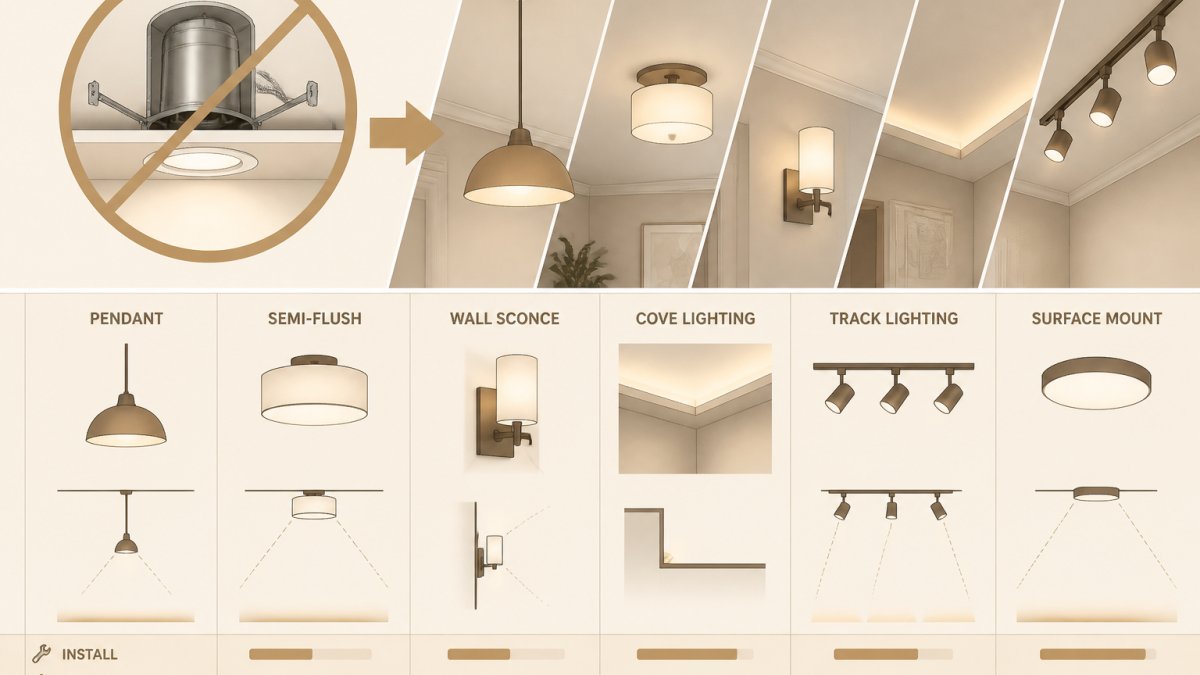
The best alternative depends on three things: ceiling height, room function, and whether you can run new wiring. A flush mount suits a hallway with a low ceiling and no room for a pendant drop. Track lighting suits an open floor plan where furniture moves. Pendants suit a kitchen island with a ceiling high enough to hang them.
| Alternative | Best Room | Ceiling Height | Light Output | Install Complexity | Cost Tier |
|---|---|---|---|---|---|
| Flush mount | Hallways, bedrooms, closets | 8 ft and up | Moderate, ambient | Low | $ |
| Semi-flush mount | Bedrooms, dining, entries | 8-9 ft | Moderate-high | Low | $ |
| Track lighting | Living rooms, open plans | 8 ft and up | High, adjustable | Moderate | $$ |
| Pendant lights | Kitchen islands, dining | 9 ft and up | Focused, task | Moderate | $$ |
| Wall sconces | Hallways, bathrooms, stairs | Any | Low, accent | Low-moderate | $ |
| Canless LED | Anywhere recessed was used | 8 ft and up | High, directional | Moderate | $$ |
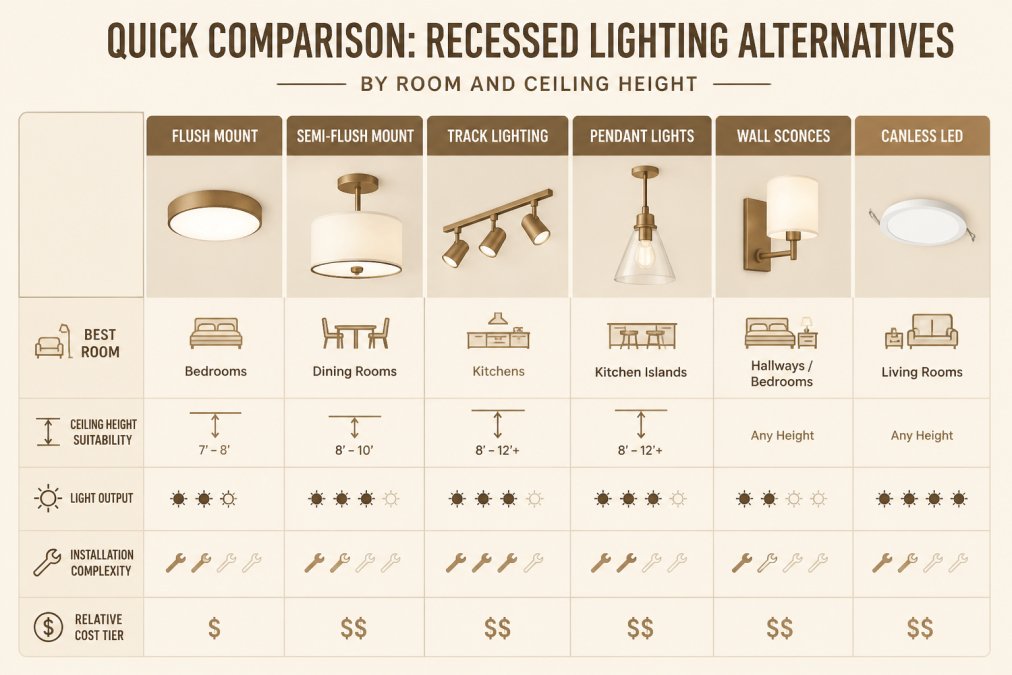
The table is a starting point, not a rule. A semi-flush mount can work in a living room if the room is small. Track lighting can work in a bedroom if you want directional reading light. The point is to match the fixture to how the room is actually used.
Flush Mount Lighting: A Clean Swap for Hallways and Bedrooms
Flush mount lighting is a ceiling fixture that mounts directly against the ceiling with no gap, while a semi-flush mount leaves a short stem or bowl between the ceiling and the fixture body. Both replace a recessed can without requiring a new ceiling cut, and both work in rooms where a hanging fixture would feel intrusive.
For hallways, closets, and bedrooms with standard eight-foot ceilings, a flush mount is often the simplest swap. The existing ceiling box that fed the recessed can can usually be reused. That keeps the job to a fixture change rather than a wiring project.
Semi-flush mounts give you a bit more visual presence. They work well over a dining table or in an entry where you want the fixture to read as a design element, not just a light source. The trade-off is that a semi-flush mount hangs lower, so it's a poor fit for a room where people walk directly beneath it.
One honest limitation: flush mounts spread light in a broad, even wash. They don't create the focused pools of light that recessed cans can. If you want a bright, even hallway, that's fine. If you want to highlight artwork on a wall, you'll need a second layer of light.
Track Lighting for Living Rooms and Open Floor Plans
Track lighting is a system of fixtures mounted on a continuous rail, letting you aim, add, or remove individual heads without touching the ceiling again. For open floor plans, that flexibility is the whole point. A living room that doubles as a home office and a dining space needs light that can shift with the furniture.
The installation story is where track lighting separates itself from a simple fixture swap. A track system needs a power feed, and the track itself has to be mounted securely to ceiling joists or a proper backing. In a home with an existing ceiling box, a short track can often be fed from that box. A long track spanning a great room usually means new wiring and a plan for where the feed enters.
What most guides miss is the beam angle. Track heads with a narrow beam create dramatic pools of light. Heads with a wide beam wash a whole wall. Buying the right track is only half the job; picking the right beam angle for each head is what makes the room feel intentional rather than spotty.
Lighting Ideas for Low Ceilings: Pendants, Sconces, and Canless Options
Low ceilings don't rule out good lighting. They rule out fixtures that hang low. The trick is to move light to the ceiling plane or to the walls instead of dropping it into the room.
Pendant lights are often the first idea people have, and they're also the most misunderstood. A pendant needs clearance. Over a kitchen island, the bottom of the fixture typically sits well above the counter so it doesn't block sightlines or bump heads. In a room with a low ceiling, that clearance is hard to achieve. Pendants work best over islands and dining tables where nobody walks underneath, and they work poorly in traffic paths.
Get your free electrical estimate →
Wall sconces solve the low-ceiling problem differently. They put light on the wall at eye level, which lifts the perceived height of a room and adds ambient light without touching the ceiling. Sconces are excellent in hallways, stairwells, bathrooms, and beside a bed.
Canless LED lights are the closest thing to a recessed can without the can. Instead of a housing that sits above the drywall, a canless fixture is a thin, self-contained unit that clips into a cut hole. They're popular in remodels precisely because they need less depth above the ceiling, which matters in homes where ductwork or joists leave little room.
Layered Lighting Design: How to Combine Fixtures Without Overdoing It
Layered lighting design is the practice of combining three types of light in one room: ambient light for overall brightness, task light for focused work, and accent light for visual interest. Most rooms that feel "off" aren't underlit. They're lit with only one layer.
Here's how the layers typically break down:
- Ambient: flush mount, semi-flush mount, or canless LED for general brightness
- Task: under-cabinet lighting in a kitchen, a pendant over an island, a sconce beside a mirror
- Accent: track heads aimed at art, sconces washing a wall, a pendant used as a focal point
The mistake we see most often is treating these as competing options. They're not. A kitchen with only recessed cans has ambient light and nothing else. Add under-cabinet lighting for the countertop, and the room becomes usable for actual cooking. Add a pendant over the island, and the room gets a focal point.
Dimming ties the layers together. Dimmable lights let you shift a room from bright task mode to soft evening mode without changing a single fixture. If you're planning a lighting layout, plan the dimming zones at the same time.
Installation, Retrofit Constraints, and What It All Costs
Installation complexity is the factor most homeowners underestimate. A fixture swap that reuses an existing ceiling box is a straightforward job. A new circuit, a new switch leg, or a run of cable through a finished ceiling is a different project entirely.
Retrofit constraints usually come down to three things: what's above the ceiling, where the power comes from, and whether the wall is open. Insulation, ductwork, and joists all limit where a new fixture can go. A canless LED needs less clearance than a traditional recessed housing, which is one reason it's a common choice in remodels.
On cost, we won't quote a number here, because the honest answer is that it depends on the scope. A single fixture swap and a whole-room lighting redesign are not the same job, and any contractor who quotes a flat price before seeing the ceiling is guessing. What we can tell you is how the cost drivers break down:
- Fixture cost: varies widely by style and finish
- Labor: higher for new wiring, lower for a direct swap
- Drywall and paint: needed if holes are cut or patched
- Permits and inspection: required for new circuits in most jurisdictions
If you want a real number, the only reliable path is an on-site estimate. Light Life Electric handles the entire process, from permits to final inspection, so you're not coordinating between a lighting vendor and a separate electrician.
Frequently Asked Questions
What are the best alternatives to recessed lighting for low ceilings?
For ceilings under 8 feet, flush mount and semi-flush mount fixtures sit close to the ceiling and avoid the cramped look pendants can create. Wall sconces add ambient lighting without eating headroom, and canless LED lights install with minimal depth. Track lighting mounted tight to the ceiling also works well because you can aim each head where you need light without lowering the fixture.
Can track lighting replace recessed lights in an open floor plan?
Yes, track lighting works well in open floor plans because you can run a single track across a large area and aim individual heads at different zones, such as a kitchen island, dining table, and reading chair. It gives you the directional control recessed cans provide but with easier adjustability. The trade-off is visible hardware on the ceiling, so plan the track layout before installation.
Are flush mount lights a good alternative to recessed lighting?
Flush mount lighting is one of the simplest swaps, especially in hallways, bedrooms, and closets. These fixtures mount directly against the ceiling, so they work in rooms where you do not want to cut into drywall or run new wiring for multiple cans. They provide even ambient light from a single point. For larger rooms, pair a flush mount with wall sconces or under-cabinet lighting to fill in shadows.
How much does it cost to replace recessed lighting with an alternative fixture?
Cost depends on the fixture type, how many you need, and whether new wiring or a junction box is required. A simple flush mount swap may only need the existing electrical box, while track lighting or pendants often require new runs and possibly a dimmer. Pricing depends on quantity, ceiling access, and labor. Contact Light Life Electric for a free estimate based on your specific layout.