 how-to
Recessed Lighting Installation Time: How Long It Takes
Table of Contents
- How Long Does Recessed Lighting Installation Take? Real Timelines
- Task-by-Task Timeline for a Typical Room
- Recessed Lighting Layout for a Room: Time Spent Planning
- Recessed Lighting Retrofit Time vs. New Construction
- Replacing Recessed Can Lights: How Long It Takes
- Recessed Lighting Before or After Drywall: Timing Your Install
- DIY vs. Hiring an Electrician: Time and Cost Differences
- What Slows Down Installation and How to Prevent Delays
- Frequently Asked Questions
Last Updated: October 8, 2026
How Long Does Recessed Lighting Installation Take? Real Timelines
Recessed lighting installation typically takes 4 to 8 hours for a single room with six lights, assuming the ceiling is open or attic access is available. That is the hands-on labor time, and it is the number most homeowners actually want.
At Light Life Electric, we have walked hundreds of Southwest Florida homes through this exact project, and the gap between what people expect and what the calendar shows is almost always about one thing: project lead time versus labor time.
Below, we break down real timelines by project size and conditions. We will also show you what slows a job down, so you can plan around it instead of discovering it mid-project.
Quick Answer by Project Size
Recessed lighting installation time scales with the number of lights and how hard it is to reach the wiring. Here is the short version:
| Project Size | Typical Labor Time | Best For |
|---|---|---|
| 1-2 lights (single spot fix) | 1-2 hours | Hallway or closet |
| 4 lights (small room) | 3-5 hours | Bathroom or entryway |
| 6 lights (standard bedroom) | 4-8 hours | Bedroom or office |
| 8-12 lights (open living area) | 1-2 days | Living room or kitchen |
Most single-room jobs land in the 4-to-8-hour window. Larger open-concept spaces with vaulted ceilings push into a second day, mostly because of ladder work and cable runs.
Installation Time vs. Project Lead Time
Installation time is the hours a crew spends on site. Project lead time is everything else: permits, scheduling, material pickup, and inspection.
That second number is where most timelines fall apart. The U.S. Department of Energy guidance on lighting upgrades notes that proper planning and layout work are essential before any fixture goes in, and that upfront work is part of the calendar.
So when you ask how long recessed lighting installation takes, decide which answer you need. If you are scheduling around a painter or drywall crew, you need lead time. If you are budgeting labor, you need the on-site hours.
Task-by-Task Timeline for a Typical Room
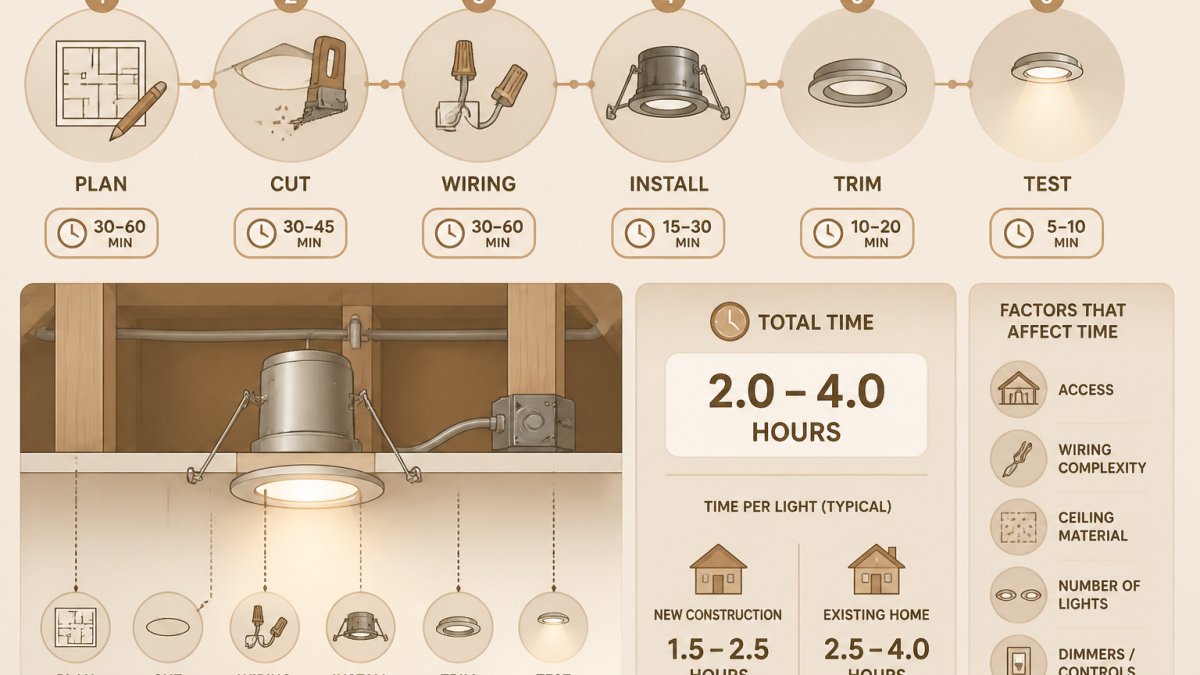
For a standard 6-light bedroom with attic access, here is how the hours break down. This assumes the ceiling is finished and the wiring will be new.
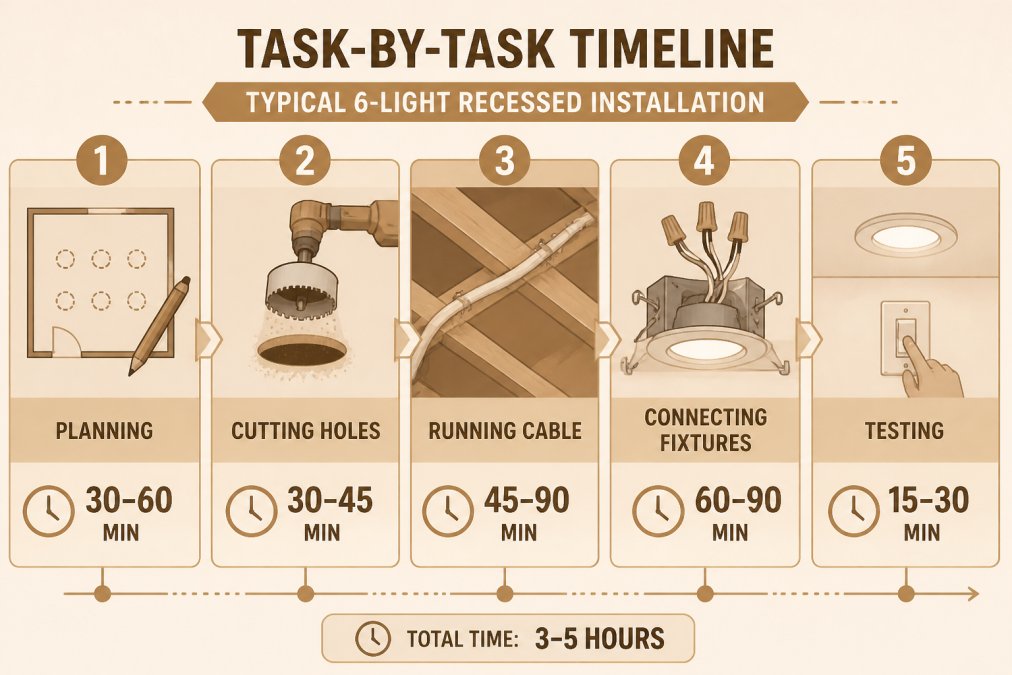
| Task | Typical Time | What Drives the Range |
|---|---|---|
| Pre-job walkthrough and layout | 30-60 min | Room size, joist direction, fixture spacing |
| Marking and drilling pilot holes | 10-15 min | Number of lights, ceiling material |
| Cutting ceiling openings | 30-45 min | 5-8 min per 6-inch can with a hole saw |
| Running cable switch-to-first-light | 20-40 min | Wall access, insulation, fire blocking |
| Daisy-chaining between lights | 25-50 min | Attic clearance, joist crossings |
| Stripping and joining wires at each fixture | 40-60 min | 6-10 min per fixture |
| Mounting housings and trims | 30-45 min | 5-8 min per fixture |
| Sealing gaps and air-sealing | 10-20 min | Attic-side access |
| Testing lights, dimmer, and switch | 15-30 min | Troubleshooting if a connection is loose |
| Cleanup and debris removal | 10-20 min | Drywall dust, packaging |
Add those up and you land in the 4-to-8-hour window for a typical 6-light room. The single biggest swing factor is cable routing: a straight run through an open attic takes minutes, while fishing through a finished ceiling with insulation and fire blocking can triple that step alone.
Planning and Layout (30-60 minutes)
Layout comes first, and it matters more than people think. A good layout keeps light even across the room and avoids shadows in corners.
This step includes:
- Measuring room dimensions and marking light positions
- Checking joist direction so fixtures land between them
- Confirming attic or crawlspace access above
- Verifying the circuit can handle the added load
Skipping this step is the most common mistake we see. A misplaced light means patching drywall and starting over, which can add hours to the job.
Cutting, Wiring, and Installation (1.5-3 hours)
Once the layout is set, the physical work moves fast. Cutting the ceiling openings for a 6-inch can takes 5 to 8 minutes each with the right hole saw.
The wiring is where the clock really moves. Running cable from the switch to the first light, then daisy-chaining to the rest, takes 45 to 90 minutes depending on how much insulation or bracing is in the way.
Then comes the connection work:
- Pulling cable through each opening
- Stripping and joining wires at each fixture
- Mounting the housing and trim
- Sealing gaps to keep attic air out
The NFPA 70 National Electrical Code sets the rules for box fill, cable support, and grounding, and those rules are what keep this step from being a quick splice job.
Testing, Troubleshooting, and Cleanup (25-50 minutes)
This is the step most DIY timelines forget. After the last trim is seated, you still need to:
- Energize the circuit and confirm every fixture lights
- Test the dimmer across its full range for flicker or buzz
- Check that no breaker trips under load
- Vacuum drywall dust and remove packaging
If a single fixture does not light, budget 10-20 minutes to trace it, usually a loose wire nut or a reversed connection at the switch. Catching it before cleanup is far cheaper than a return trip.
Recessed Lighting Layout for a Room: Time Spent Planning
Recessed lighting layout for a room is the step that decides whether 4 hours or 8 hours is realistic. A clean layout means straight cable runs and even spacing. A rushed layout means rework.
Here is the rule of thumb we use: space lights roughly half the ceiling height apart.
For a 12-by-14-foot bedroom, that usually works out to 4 to 6 lights in two rows. That layout takes 30 to 60 minutes to plan and mark.
What most guides miss is that layout time is not wasted time. Every minute spent here saves three later.
Recessed Lighting Retrofit Time vs. New Construction
Recessed lighting retrofit time runs longer than new construction, and the reason is simple: you are working around a finished ceiling instead of an open one.
Get your free electrical estimate →
In new construction, the ceiling is open. A crew can run cable, mount housings, and connect everything in a straight line. A 6-light room can be roughed in during a single morning.
In a retrofit, every step fights the structure:
- Fishing cable through finished walls
- Working around insulation and fire blocking
- Patching small access holes afterward
- Matching existing trim and finish
Expect a retrofit to take 30 to 50 percent longer than the same job in open framing. A 4-hour new-construction job can easily become 6 hours in a finished home.
Replacing Recessed Can Lights: How Long It Takes
Replacing recessed can lights is the fastest version of this project.
A simple trim swap takes 10 to 20 minutes per light. An LED retrofit kit, which replaces the bulb and trim in one piece, takes 15 to 30 minutes per light.
For a room with 6 existing cans, that is 1.5 to 3 hours total. No new cable, no new switch, no drywall work.
The catch is the wiring behind the old can. Older homes sometimes have brittle insulation or missing ground connections. If the wiring fails inspection, the "quick swap" becomes a rewiring job.
Recessed Lighting Before or After Drywall: Timing Your Install
Recessed lighting before or after drywall is the scheduling question that trips up most renovations. The answer depends on whether you are building new or remodeling.
New Construction: Before Drywall
Install rough-in housings before drywall goes up. This is the cheapest and fastest option because the framing is exposed.
At this stage, the electrician runs all cable, mounts the housings, and leaves the wiring ready for trim. The trim goes in after drywall and paint. Total rough-in time for a 6-light room: 2 to 4 hours.
Remodels: After Drywall
In a remodel, you install after drywall, which means cutting openings and fishing cable. This adds time and dust.
Plan for 4 to 8 hours for the same 6-light room, plus patching and paint touch-up. If you are already opening walls for other work, do the lighting then. It saves a second round of mess.
DIY vs. Hiring an Electrician: Time and Cost Differences
DIY saves labor cost but usually adds time. An experienced electrician works faster, knows the code, and does not have to learn on the job.
Here is the honest comparison:
| Factor | DIY | Licensed Electrician |
|---|---|---|
| Time for 6 lights | 8-16 hours | 4-8 hours |
| Code knowledge | Must research | Built in |
| Permit handling | You file it | Handled for you |
| Inspection risk | Higher rework chance | Passes first time |
| Safety risk | Real shock and fire risk | Managed |
Cost depends on your area, the number of lights, and whether new circuits are needed. We do not publish flat rates because every home is different. For a current estimate, check your state's licensing board for contractor verification before hiring anyone, and get a written quote that lists labor and materials separately.
What Slows Down Installation and How to Prevent Delays
Delays come from a short list of predictable problems. Knowing them ahead of time is how you keep a one-day job to one day.
The biggest time-killers:
- No attic access. Fishing cable blind can double labor time.
- Insulation and fire blocking. These block cable runs and require careful routing.
- Old wiring. Aluminum or ungrounded circuits need upgrades before new lights go in.
- Wrong fixture choice. A can that does not fit the joist bay means a return trip.
- Permit and inspection waits. These add days to lead time, not labor time.
Prevention is straightforward. Confirm attic access, check the circuit, and pick fixtures that match your ceiling depth before the crew arrives.
Recessed lighting is one of the highest-impact upgrades you can make to a room, but the timeline only holds together when the planning is done right.
Light Life Electric handles the whole job, from permits to final inspection, so your project stays on schedule and within budget. Our Florida certified electricians are licensed, bonded, and insured, and we offer 24/7 emergency response when something goes wrong after hours.
Frequently Asked Questions
How long does it take to install recessed lighting in one room?
For a standard room with 4 to 6 lights and existing wiring, expect 2 to 4 hours of hands-on installation time. That includes cutting holes, running cable, and connecting fixtures. If you are adding a new circuit or working in a finished ceiling with no attic access, it can stretch to 6 to 8 hours.
Do you install recessed lighting before or after drywall?
For new construction, rough-in wiring goes in before drywall so you can drill through joists and run cable easily. The actual fixtures go in after drywall and painting to avoid damage. In a remodel, you work after drywall is up, which takes longer because you have to fish cable through closed walls and patch holes.
How long does it take to replace recessed can lights?
Replacing existing can lights with LED retrofit kits is fast: 15 to 30 minutes per light. A room with 6 cans takes 1.5 to 3 hours. You remove the old trim and bulb, screw in the retrofit adapter, and connect the plug. No new wiring or ceiling cutting is needed, so this is a straightforward DIY job.
How many recessed lights can an electrician install in a day?
A licensed electrician can typically install 10 to 15 recessed lights in a day when wiring is already in place. If they are running new cable, cutting ceiling openings, and tying into the panel, expect 6 to 10 lights. Layout complexity, attic access, and ceiling height all affect the daily count.