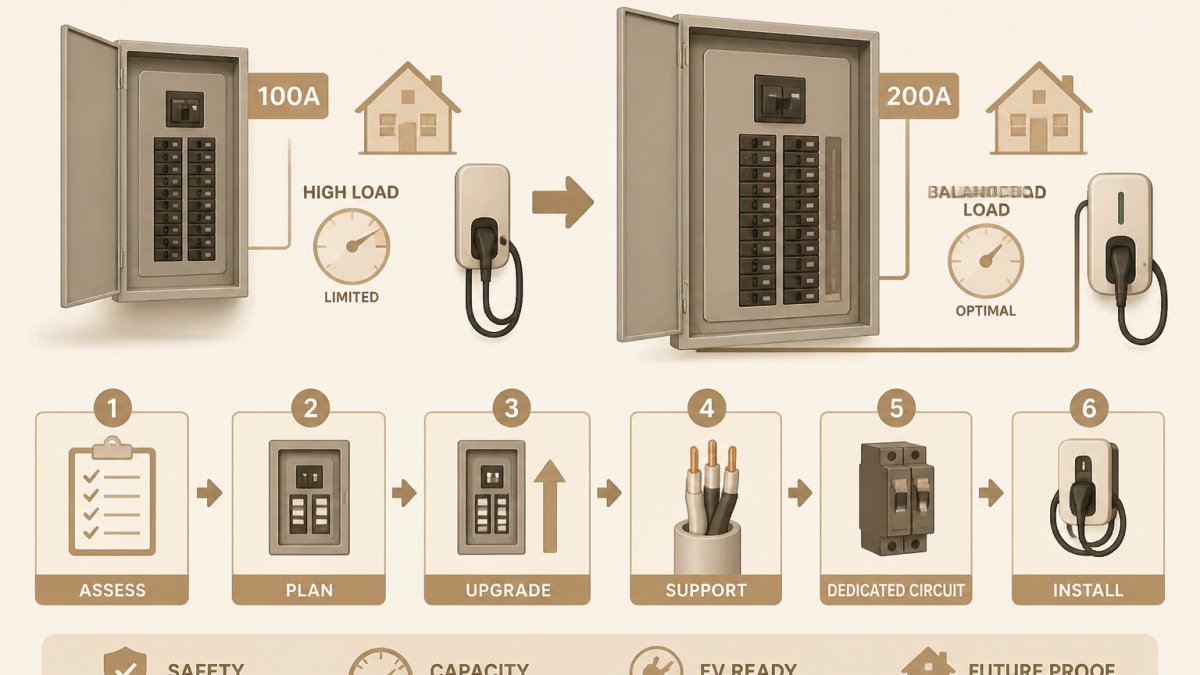
 how-to
How to Upgrade Electrical Panel for EV Charger
Table of Contents
- Introduction to Electrical Panel Upgrades for EV Chargers
- Step 1: Assess Your Current Electrical Panel Capacity
- EV Charger Electrical Load Calculation Explained
- Step 2: Determine If Your Panel Needs an Upgrade
- Electrical Panel Upgrade for EV Charger Cost: What to Expect
- EV Charger Installation Without Panel Upgrade: Alternatives to Consider
- Electrical Panel Upgrade Permit and Inspection: Navigating the Process
- Conclusion: Making the Right Choice for Your EV Charger Installation
- Frequently Asked Questions
Last Updated: October 5, 2026
Introduction to Electrical Panel Upgrades for EV Chargers
Adding a Level 2 charger usually pulls far more power than any single appliance in your home. That is why learning how to upgrade electrical panel for EV charger projects starts with one question: can your service panel handle the extra load? We walk Southwest Florida homeowners through this decision every week, and the answer is rarely as scary as people fear. Below, we break down the full process, from load calculations to permits, so you know exactly what to expect before anyone touches your breaker panel.
An electrical panel upgrade is the replacement of your main service panel, and sometimes your entire electrical service, to provide more capacity, newer safety features, and room for new circuits.
Three things decide whether you need one:
- Your available capacity after a load calculation
- The number of open breaker spaces in your panel
- The amperage your chosen charger draws
Most modern homes can support a charger with a smaller fix. Some genuinely need a full service upgrade. The sections below show you how to tell the difference, what drives cost, and how the permit and inspection process works.
Step 1: Assess Your Current Electrical Panel Capacity
Start by finding your main electrical service panel, often called the breaker panel or service panel. Open the door and look for the main breaker at the top or bottom. The number stamped on it is your service amperage, usually 100 amps or 200 amps.
Next, count two things:
- Breaker spaces: How many slots are open?
- Existing circuits: What is already running, and how heavy are those loads?
Older homes often have a 100-amp service with every slot filled. Newer homes usually have 200 amps with room to spare. The label inside the panel door lists the panel's rating and the breaker types it accepts, including whether tandem breakers are allowed.
Do not guess at this step. A licensed electrician can read the panel label, check the wire gauge on the main feed, and confirm what your service can actually carry. That inspection takes minutes and prevents expensive mistakes later.
EV Charger Electrical Load Calculation Explained
An EV charger electrical load calculation compares your home's total connected load against your service capacity. The result tells you how much room you have for a new dedicated circuit.
Here is how the numbers typically stack up for a 2,000-square-foot home with 200-amp service:
| Load | Typical Draw | Notes |
|---|---|---|
| Base household load | 2,000W | Lights, outlets, small appliances |
| Central AC | 3,500W | Runs heavily in summer |
| Electric range | 5,000W | Only when cooking |
| Electric water heater | 4,500W | Continuous standby |
| Level 2 EV charger | 7,200W | 30-amp continuous draw |
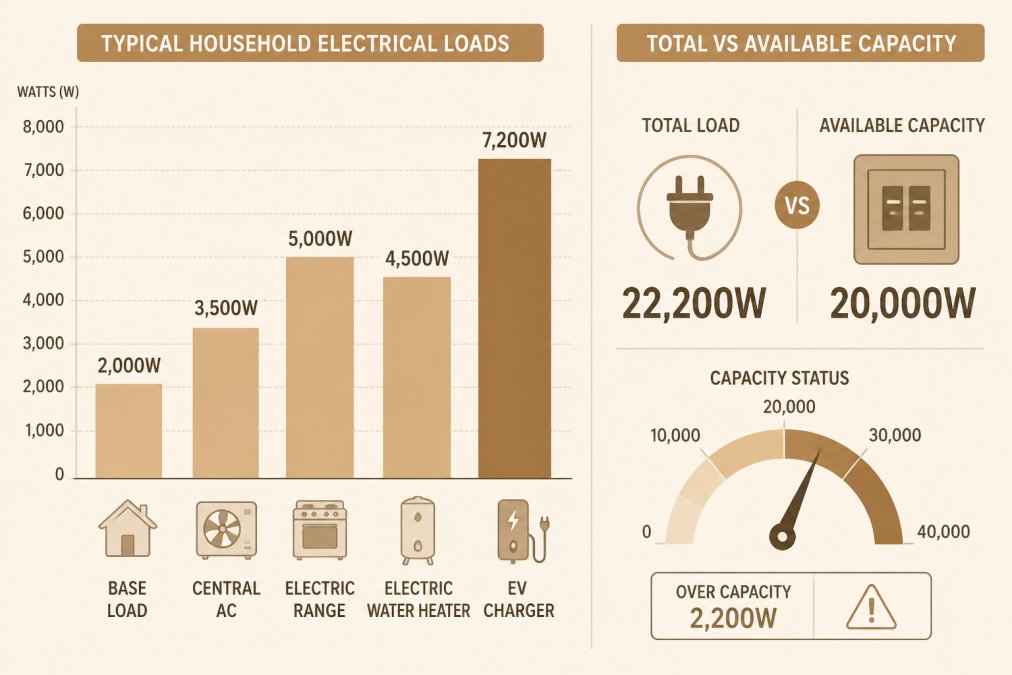
A Level 2 charger is a continuous load, meaning it runs at full draw for hours. The electrical code requires continuous loads to be sized at 125% of their rating. So a charger drawing 40 amps needs a 50-amp circuit with a double-pole breaker.
The math is simple. Add your major loads, apply the code rules, and compare the total to your service amperage. If the total lands under capacity, you may only need a new circuit, not a new panel.
Worked Example: 200-Amp Service with 100 Amps Available
Suppose your home has 200-amp service and your existing calculated load is 100 amps. You want to add a 48-amp Level 2 charger. The charger's continuous load requires a 60-amp circuit (48 amps × 125% = 60 amps). Your new total load would be 100 + 60 = 160 amps, which is under 200 amps. In this case, you likely only need a new dedicated circuit, not a panel upgrade.
Worked Example: 100-Amp Service with 80 Amps Available
Now suppose your home has 100-amp service and your existing calculated load is 80 amps. Adding a 32-amp charger (which requires a 40-amp circuit) would bring the total to 120 amps, exceeding your 100-amp capacity. Here, you would need either a load management device, a lower-amperage charger, or a full service upgrade to 200 amps.
Why Breaker Space Alone Is Not Enough
Many homeowners assume that if they have two open breaker slots, they can add a charger. But open slots only mean the panel has physical room for a breaker; they say nothing about whether the service can handle the additional load. A 100-amp panel with two open slots may still be at capacity. Always perform a load calculation before assuming a new circuit will work.
When to Call a Licensed Electrician
Load calculations involve nuanced code rules, demand factors, and safety margins. A licensed electrician can perform an official calculation, often using software or worksheets, and confirm whether your service can support the charger. This step is not optional if you want to avoid overloading your system or failing an inspection.
Step 2: Determine If Your Panel Needs an Upgrade
Your panel needs an upgrade if the load calculation exceeds your service capacity, if no breaker spaces remain, or if the panel is an older model with known safety issues. Any one of those three signals points to replacement.
Here is a quick decision guide:
| Situation | Likely Fix |
|---|---|
| Open spaces, capacity available | Add a dedicated circuit |
| Panel full, capacity available | Add a subpanel |
| Capacity exceeded | Service upgrade to 200 amps |
| Older panel, known issues | Full panel upgrade |
A 100-amp service with heavy electric appliances often cannot carry a charger plus everything else. A 200-amp service usually can. Homes with gas heat and gas ranges have far more room than all-electric homes.
Get your free electrical estimate →
One more factor matters: future capacity. If you plan to add a heat pump, a hot tub, or a second EV, size the upgrade for that now. Doing it twice costs far more than doing it once.
Electrical Panel Upgrade for EV Charger Cost: What to Expect
The electrical panel upgrade for EV charger cost depends on several variables, so we quote every job after seeing the panel, the wire run, and the charger location. However, you can use the following ranges as a planning guide. These are typical for many homes, but your actual cost may vary based on local labor rates, permit fees, and site conditions.
Itemized Cost Breakdown
| Item | Typical Cost Range | Notes |
|---|---|---|
| 200-amp panel upgrade (labor + materials) | $1,500 - $3,000 | Includes new panel, breakers, and labor |
| Service upgrade to 200 amps (if needed) | $2,000 - $4,000 | Includes new meter base, mast, and utility coordination |
| Dedicated 240V circuit for EV charger | $500 - $1,500 | Depends on wire run length and conduit needs |
| Permit and inspection fees | $150 - $500 | Varies by jurisdiction |
| Utility disconnect/reconnect fees | $100 - $500 | Some utilities charge for service changes |
| Load management device (if used) | $500 - $1,200 | Includes installation |
| Level 2 charger (hardware only) | $400 - $800 | Not including installation |
Factors That Change the Total
- Service size: A 200-amp upgrade costs more than a simple subpanel addition.
- Wire run length: A charger in a detached garage needs more conduit and heavier wire gauge, which can add $500 or more.
- Panel condition: Rust, undersized feeders, or a missing grounding electrode conductor add work.
- Permit and inspection fees: Set by your local building department.
- Utility coordination: Some upgrades require the utility to disconnect and reconnect service, which may add cost and delay.
How to Get an Accurate Quote
Request a written estimate that itemizes labor, materials, permits, and any utility fees. A reputable electrician will break down the costs so you can see exactly what you are paying for. Avoid contractors who give only a lump-sum verbal quote.
Cost-Saving Alternatives
If a full panel upgrade is out of budget, consider a load management device or a lower-amperage charger. These can often be installed for under $1,500 and may allow you to charge safely without upgrading your service. However, they may not be suitable for all homes, so consult a licensed electrician.
EV Charger Installation Without Panel Upgrade: Alternatives to Consider
EV charger installation without panel upgrade work is possible in many homes, and it is often the smarter first move. You avoid the cost and downtime of a full service change while still getting fast charging.
The main alternatives are:
- Load management devices: A smart charger or load controller monitors total draw and pauses charging when the home nears capacity
- Lower charging amperage: A 32-amp or 40-amp charger draws less than a 48-amp unit and may fit your existing capacity
- Subpanel addition: Frees up space and organizes new circuits without replacing the main panel
- Tandem breakers: Double up two circuits in one slot where the panel allows it
Load management is the option most homeowners overlook. It lets a 100-amp home run a Level 2 charger safely, because the system throttles charging during peak household demand.
If none of these fit, a full upgrade is the honest answer.
Electrical Panel Upgrade Permit and Inspection: Navigating the Process
An electrical panel upgrade permit and inspection is required in nearly every jurisdiction, and skipping it creates real problems. Unpermitted work can fail at resale, void insurance claims, and force you to tear out finished walls.
The process usually runs like this:
- Your electrician pulls the permit from the local building department
- The utility schedules a service disconnect if the meter must move
- The crew installs the new panel and brings it up to current electrical code
- The inspector checks grounding, bonding, breaker sizing, and labeling
- The utility reconnects power and the inspector signs off
Utility coordination is the step that surprises people. Disconnects and reconnects are scheduled around utility availability, not yours, so plan for a day without power. The U.S. Department of Energy's guide to home electrical safety explains why grounding and bonding matter so much in this work.
We handle the entire process, from permit to final inspection.
Conclusion: Making the Right Choice for Your EV Charger Installation
The right path comes down to your load calculation, your open breaker spaces, and your plans for the next few years. Some homes need a full service upgrade. Many just need a dedicated circuit or a load management device. A qualified electrician can tell you which one you are in a single visit.
Light Life Electric is a family-owned, Florida certified electrical contractor. We handle panel upgrades, dedicated circuits, and EV charger installations from permit to final inspection, and we back our work with 24/7 emergency response. Get your free electrical estimate and know exactly where your home stands before you buy a charger.
Frequently Asked Questions
Do I need to upgrade my electrical panel to install an EV charger?
Not always. A licensed electrician must perform a load calculation to determine if your existing panel has enough capacity. If you have a 200-amp service with spare breaker spaces and low household demand, you may not need an upgrade. However, older 100-amp panels or those already near capacity typically require an upgrade to safely support a Level 2 charger.
How do I know if my electrical panel can handle an EV charger?
Check your panel's amperage rating and available breaker spaces. A 200-amp panel with at least two open slots is a good sign, but a professional load calculation is the only way to confirm. If your panel is a 100-amp service, uses fuses, or is a recalled brand, an upgrade is likely necessary. A licensed electrician can assess your specific situation.
What size electrical panel do I need for a Level 2 EV charger?
Most Level 2 chargers require a 40- to 50-amp dedicated circuit. A 200-amp panel is generally recommended to accommodate the charger alongside other household loads. If you have a 100-amp panel, you may need to upgrade to 200 amps or consider a load management device to avoid overloading your system.
How much does an electrical panel upgrade for an EV charger cost?
The cost varies based on your current panel, needed amperage, labor, permits, and whether utility coordination is required. Pricing depends on the specifics of your home and local rates. For an accurate estimate, contact a licensed electrician like Light Life Electric for a free assessment and quote.