 how-to
Minimize Disruption During System Failure Repair
Table of Contents
- Why Minimized Disruption During Service Depends on Pre-Failure Planning
- Preventative Electrical Maintenance Strategies That Prevent System Failure
- How to Prepare for an Emergency Electrician Visit
- Emergency Electrical Repair Timeline: What to Expect
- Stakeholder Communication and Emergency Templates During an Outage
- Staff Training, Inventory Management, and Spare Parts Readiness
- How Minimized Disruption During Service Translates to Long-Term Savings
- Frequently Asked Questions
Last Updated: August 28, 2026
Why Minimized Disruption During Service Depends on Pre-Failure Planning
Most electrical failures build quietly, a panel running hotter than it should, a circuit breaker tripping more often, a voltage fluctuation nobody logged. By the time the lights go out, the window for easy, low-impact repair has closed.
At Light Life Electric, we've seen this pattern repeat across Southwest Florida: properties that experience the least disruption during emergency repairs are never lucky. They planned before anything broke. Minimized disruption during service starts weeks or months before a technician arrives on site.
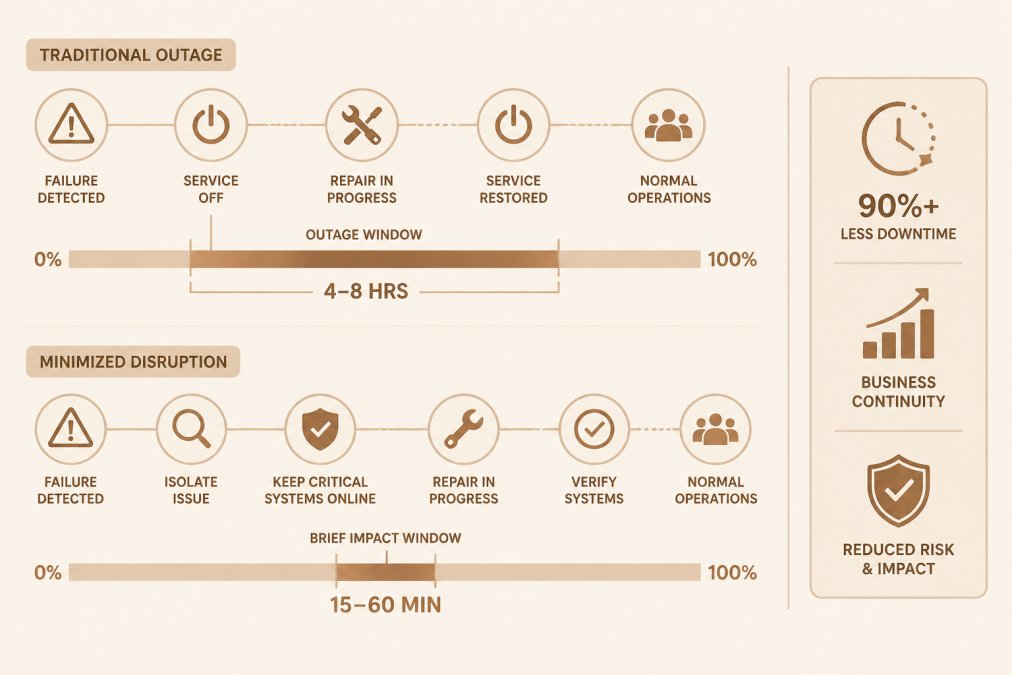
The core principle is straightforward: system reliability is engineered, not reactive. Every layer of preparation you add before a failure directly compresses the repair timeline, reduces collateral damage, and keeps essential operations running while the fix happens.
Redundancy and Failover Systems That Keep You Running
Redundancy maintains backup systems that activate automatically when a primary system fails. For electrical infrastructure, this typically means uninterruptible power supply systems, automatic transfer switches, and backup generators that provide seamless failover without manual intervention.
A well-designed automatic transfer switch detects a primary power interruption and switches to a backup source within milliseconds, protecting sensitive equipment and maintaining business continuity. For residential and light commercial properties, a UPS system protects critical loads, security systems, medical equipment, refrigeration, during the gap between power loss and generator startup. For larger facilities, load balancing across multiple circuits prevents a single point of failure from cascading into a full outage.
Cost-Benefit Analysis of Redundancy Before You Need It
The cost-benefit question on redundancy is one most property owners avoid until after their first major outage. That's the wrong order.
Redundancy infrastructure carries upfront cost, but that cost must be measured against the true expense of an unplanned outage: lost productivity, spoiled inventory, equipment damage from power surges, and emergency service rates higher than scheduled maintenance. Many facility managers find that a single extended outage costs more than the redundancy system that would have prevented it.
| Consideration | Questions to Ask | Impact on Decision |
|---|---|---|
| Critical load value | What equipment or operations cannot stop? | Higher criticality = stronger case for full redundancy |
| Outage frequency | How often has this system failed in the past? | Higher frequency = faster payback on investment |
| Recovery time objective | How long can you tolerate downtime? | Shorter tolerance = need for automatic failover |
| Mean time between failures | What does your maintenance history show? | Longer MTBF may reduce urgency |
| Emergency service premium | What do unplanned repairs cost vs. scheduled? | Wide gap = redundancy pays off faster |
Not every circuit needs full redundancy. The discipline is identifying which systems do, then protecting those specifically.
Preventative Electrical Maintenance Strategies That Prevent System Failure
Reactive maintenance is the most expensive way to run an electrical system. The work itself often costs no more than a scheduled repair, but unplanned timing multiplies every associated cost.
Preventive maintenance catches degradation before it becomes failure, extending mean time between failures and reducing emergency interventions.
Automated Monitoring and Alerting
Automated monitoring systems provide continuous visibility into electrical infrastructure without requiring manual inspection. Systems like those offered by other providers collect real-time data from power chain components, voltage levels, battery health, breaker status, and load distribution, generating automated alerts when readings drift outside normal thresholds.
A voltage fluctuation caught at 2 AM by an automated alert becomes a scheduled repair call the next morning. Undetected, the same fluctuation becomes an emergency at 9 AM when the panel fails. For commercial properties with multiple circuits, remote monitoring also reduces the need for routine on-site inspections, lowering operational costs while improving reliability.
Predictive Maintenance and Scheduled Inspections
Predictive maintenance uses real-time analytics and historical data to forecast when a component is likely to fail before obvious symptoms appear. Thermal imaging during scheduled inspections can identify hot spots in panels and wiring that precede failure by weeks.
Scheduled preventive maintenance typically includes thermal imaging of panels and connection points, torque checks on breaker connections, insulation resistance testing on older wiring, load analysis to identify circuits approaching capacity, and review of any system modifications.
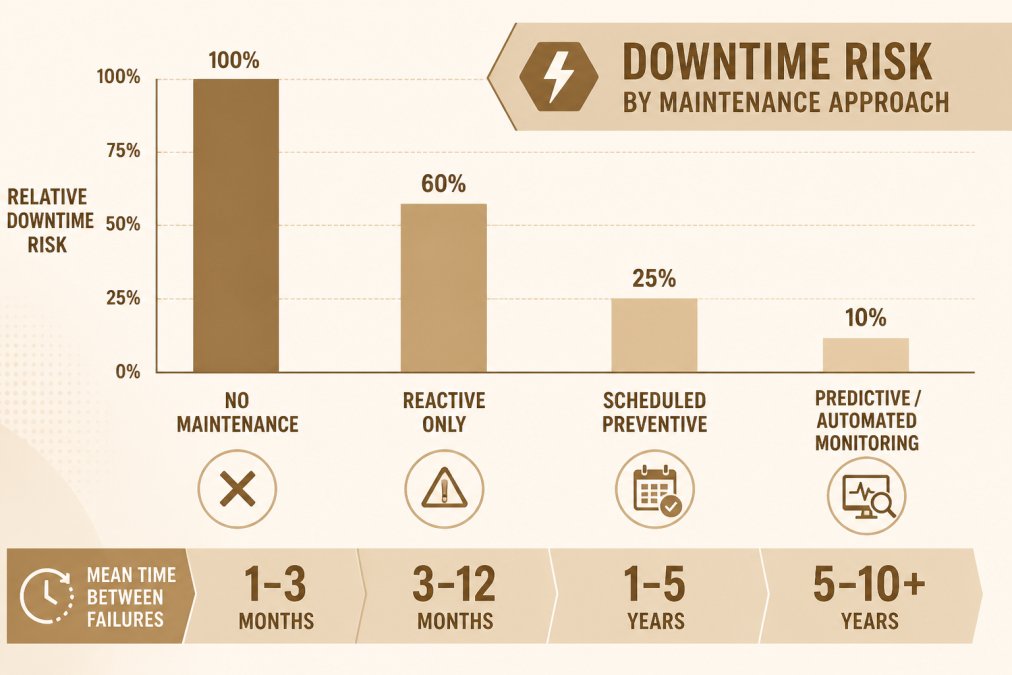
According to the U.S. Department of Energy's guidance on industrial energy efficiency, predictive maintenance programs typically identify problems early enough to schedule repairs during planned downtime windows, the single most effective way to avoid emergency service scenarios.
How to Prepare for an Emergency Electrician Visit
Preparation before the crew arrives directly affects how quickly the repair can begin and how much collateral damage accumulates.
Prioritizing Essential Circuits During a Power System Failure
The first decision during any power system failure is triage: which circuits are life-safety or business-critical, and which can remain offline during repair?
A clear circuit priority list, documented before any emergency, lets you make that call in seconds. Most electrical panels have circuits that can be isolated without affecting essential operations, HVAC, refrigeration, security, lighting in egress paths. Knowing in advance which breakers correspond to which loads means you can isolate non-essential circuits immediately, reducing the electrical load the repair team must work around. Creating a labeled circuit directory is a 30-minute task that pays dividends in every future service call.
Human-in-the-Loop Error Mitigation: What You Can Do Before the Crew Arrives
Practical pre-arrival steps that reduce repair complexity:
- Document what happened. Note the time of failure, any sounds, smells, or visible signs, and which circuits were affected. This information dramatically speeds up diagnosis.
- Do not repeatedly reset tripped breakers. A breaker that won't reset is protecting the circuit from a fault. Forcing it back on can damage wiring or equipment.
- Isolate the affected area. Verify that adjacent circuits are stable before assuming the problem is contained.
- Secure the area around the panel. Clear access before the crew arrives; this alone can save 10-15 minutes.
- Have your circuit directory and recent electrical work records ready. A technician who knows what was modified six months ago diagnoses faster.
Emergency Electrical Repair Timeline: What to Expect
The emergency electrical repair timeline from first call to restored power follows a predictable sequence, though duration varies with fault complexity.
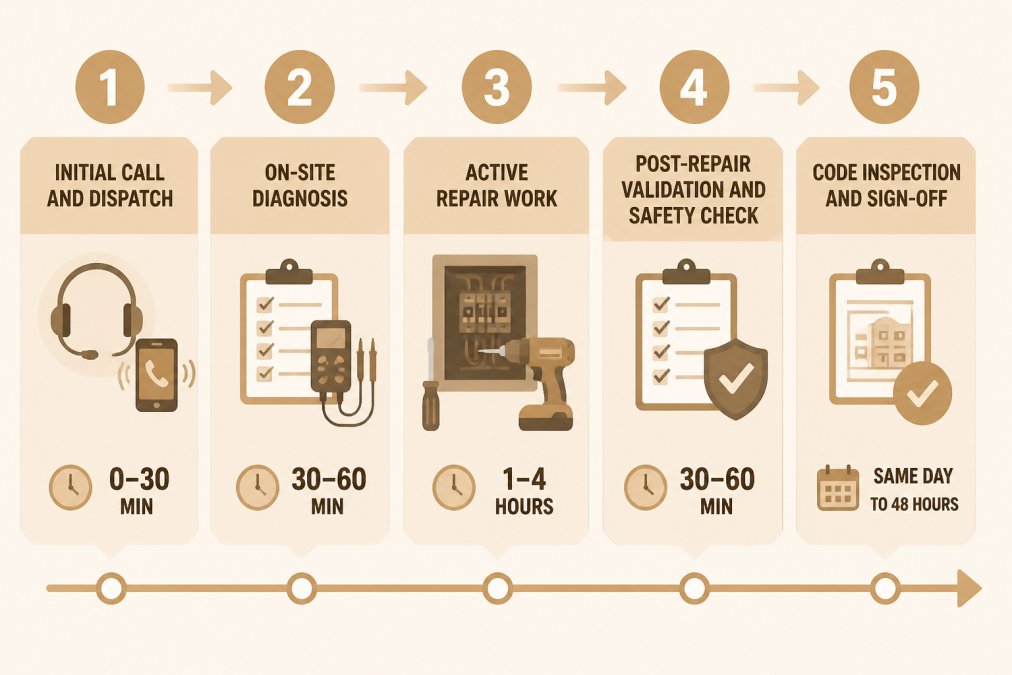
Phase 1: Initial call and dispatch (0-30 minutes). The call triggers dispatch, routing the nearest available certified technician.
Phase 2: On-site diagnosis (30-60 minutes). The technician assesses the fault, reviews your circuit directory and documentation, and identifies the root cause. Preparation shortens this phase significantly.
Phase 3: Active repair work (1-4 hours). Duration depends on fault type. A failed breaker replacement runs 30-45 minutes. Tracing and repairing a wiring fault in a finished wall takes longer.
Phase 4: Post-repair validation and safety check (30-60 minutes). See the next section; this phase is non-negotiable.
Phase 5: Code inspection and sign-off (same day to 48 hours). Depending on scope and local permit requirements, a final inspection may be required.
Get your free electrical estimate →
Post-Repair Validation Protocols That Confirm the Fix Held
Post-repair validation is the step most rushed jobs skip. It's also the step that catches 80% of comeback calls before they happen.
A proper validation protocol includes:
- Load testing under normal operating conditions. Restore circuits one at a time and verify each holds under its typical load.
- Thermal scan of the repaired area. A quick thermal imaging check after 15-20 minutes of operation confirms no new hot spots have developed.
- Voltage and continuity verification. Confirm voltage readings match expected values and test continuity on any disturbed conductors.
- Breaker function test. Verify that tripped breakers reset cleanly and that GFCI and AFCI devices respond correctly.
- Documentation of findings. Record what was found, what was repaired, and post-repair readings.
Stakeholder Communication and Emergency Templates During an Outage
Communication during an outage is where many otherwise well-prepared facilities fall apart. Effective stakeholder communication follows three rules: communicate early, communicate specifically, and communicate on a schedule.
Emergency communication template, initial notification:
"[Time], We are currently experiencing an electrical system issue affecting [specific area/circuits]. Our licensed electrical contractor is on site and actively diagnosing the fault. Estimated restoration time will be provided by [specific time]. Essential systems [list them] remain operational. Please avoid [specific action]. Updates will follow every 30 minutes."
Emergency communication template, resolution notification:
"[Time], Electrical service has been restored to [area]. The fault has been repaired and the system has passed post-repair validation. Normal operations may resume. A full incident report will be available within [timeframe]."
Specific updates with a next-communication timestamp generate fewer follow-up calls and erode less confidence than vague messages.
According to FEMA's guidance on business continuity communication, organizations that establish pre-written communication templates before an incident report significantly faster stakeholder notification times.
Staff Training, Inventory Management, and Spare Parts Readiness
The fastest emergency electrical repair is the one where the technician has the right parts on site and building staff knows exactly what to do while waiting.
Staff training for electrical emergencies requires three things: knowing how to document a failure, knowing what not to do, and knowing who to call in what order. A one-page emergency protocol posted near the electrical panel covers all three.
Spare parts inventory is worth discussing with your electrical contractor during scheduled maintenance. Common items that extend repair timelines when unavailable include replacement breakers matching your panel manufacturer and amperage ratings, GFCI and AFCI outlet replacements, conduit fittings, and wire connectors in standard sizes.
Properties that maintain ongoing relationships with a licensed electrical contractor benefit from technicians who already know the property's infrastructure, its quirks, and its history. That familiarity compresses diagnosis time on every service call. Asset management records, including a log of every modification, repair, and inspection, are the foundation of this relationship.
As noted in NFPA 70B: Recommended Practice for Electrical Equipment Maintenance, regular maintenance documentation and staff familiarity with electrical systems are foundational elements of infrastructure resilience.
How Minimized Disruption During Service Translates to Long-Term Savings
The business case for prioritizing minimized disruption during service is straightforward once you account for all costs an unplanned outage generates.
Direct costs are obvious: emergency service rates, equipment replacement, spoiled inventory. Indirect costs accumulate faster: lost productivity, staff overtime, tenant dissatisfaction affecting lease renewals, and reputational damage.
Properties that invest in preventive maintenance, redundancy infrastructure, staff training, and documented protocols consistently report shorter outage windows, lower emergency service frequency, and better outcomes when failures occur. The investment in preparation pays back through reduced emergency calls, lower average repair costs, and faster restoration times.
A property with documented maintenance history, trained staff, a circuit directory, and an ongoing relationship with a certified electrical contractor doesn't just recover faster from failures, it experiences fewer of them. Uptime optimization is the aggregate result of every preparation decision made before the lights go out.
For commercial properties managing multiple tenants and circuits, the case for an ongoing maintenance contract with a licensed electrical contractor is particularly strong. The per-incident cost of reactive service almost always exceeds the annualized cost of a scheduled maintenance agreement.
According to the National Electrical Contractors Association's resources on electrical system maintenance, properties with structured maintenance programs demonstrate measurably better infrastructure resilience and lower lifetime ownership costs than those relying on reactive repair alone.
Electrical system failures are disruptive by nature, but how disruptive they become is largely within your control. Light Life Electric provides 24/7 emergency electrical response alongside scheduled maintenance, panel upgrades, and code-compliant installations, all handled by Florida certified electricians who manage the entire process from permits to final inspection. Whether you need an emergency repair resolved tonight or a maintenance plan that prevents the next one, get your free electrical estimate from Light Life Electric and put the preparation in place before you need it.
Frequently Asked Questions
Q: What is the most effective way to minimize downtime during electrical repairs?
A: The most effective approach combines redundancy with fast incident response. Install backup systems such as a UPS or automatic transfer switch so critical circuits stay live while repairs happen. Pair that with automated monitoring that alerts your electrician before a minor fault becomes a full outage. When a licensed, 24/7-available contractor is already familiar with your system, diagnosis is faster and the recovery time objective shrinks from hours to minutes.
Q: How long should I expect an emergency electrical repair to take?
A: Most residential emergency electrical repairs resolve within two to four hours from the time a licensed electrician arrives on site. Simple faults like a tripped breaker or a failed outlet circuit are often fixed in under an hour. Panel-level failures, storm damage, or wiring faults inside walls take longer. A thorough post-repair validation and safety check adds 30 to 60 minutes but confirms the system is stable before power is fully restored.
Q: How can homeowners prepare for emergency electrical system failures?
A: Keep a written list of your main panel location, the circuits serving critical loads like medical equipment or refrigeration, and your electrician's 24/7 contact number. Know how to safely isolate a tripping breaker without resetting it repeatedly. Clear the area around your panel so the technician can work immediately on arrival. If you have a generator or UPS, test it monthly. These steps cut the emergency electrical repair timeline and reduce risk of further system failure.
Q: What are the benefits of proactive maintenance in preventing system failure?
A: Preventative electrical maintenance strategies catch deteriorating connections, overloaded circuits, and aging components before they cause a service interruption. Scheduled inspections improve system reliability, extend the mean time between failures, and keep your installation code-compliant under NEC standards. For commercial properties, documented maintenance also supports service level agreement compliance and reduces liability exposure. The cost of a routine inspection is a fraction of emergency repair plus lost operational time.