Safety First: Know Your Limits Before Troubleshooting
To troubleshoot commercial electrical panel safely requires caution, electricity at 208V, 277V, or 480V can cause cardiac arrest or severe burns. Understand what you can safely handle and what demands a licensed electrician.
Visual inspection and basic voltage testing with a multimeter are safe for most people. Opening the panel, touching breaker handles, or working with exposed wires is not. Light Life Electric offers 24/7 emergency response throughout Southwest Florida for repairs requiring professional certification.
Scorch marks, burn discoloration, or black streaks on the panel or breaker handles
A burning smell coming from the panel or walls near it
Sparks visible inside the panel when breakers trip
Buzzing, humming, or crackling sounds from the panel
Loose or corroded wiring connections inside or outside the panel
Signs of water damage, rust, or corrosion on metal components
Heat radiating from the panel (the metal should be cool to the touch)
Key TakeawayA burning smell or visible scorching is an emergency. Evacuate the area and call a licensed electrician right away. Do not attempt any troubleshooting.
Why Your Commercial Circuit Breaker Keeps Tripping
A breaker trips to protect your system by cutting power when it detects a dangerous condition. Understanding why helps you know whether the problem is simple or serious.
Overloaded circuits and power demand
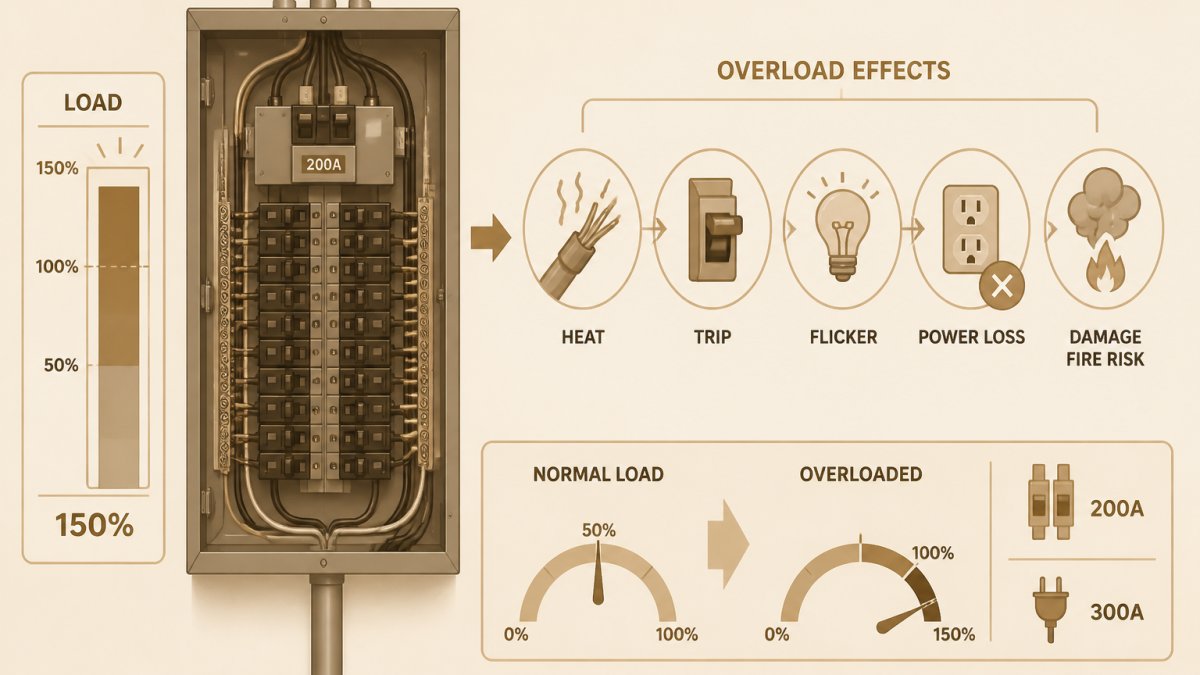
An overloaded circuit occurs when total current exceeds the breaker's rating (typically 15A, 20A, 30A, or higher).
Common causes: running too many high-power devices simultaneously, adding equipment without upgrading capacity, or temporary loads exceeding design limits.
For temporary overload, spread the load across circuits. For permanent overload, a licensed electrician can add circuits or upgrade breakers.
Short circuits and ground faults
A short circuit occurs when a hot wire touches a neutral wire or ground, creating low resistance and current surge that trips the breaker instantly.
A ground fault occurs when a hot wire contacts a grounded surface or person. GFCI breakers detect this and trip before injury occurs.
Both indicate damaged wiring, loose connections, or faulty equipment and require professional diagnosis.
Loose or damaged wiring connections
Signs: breaker trips only when specific equipment runs, trips after idle periods, visible corrosion on terminals, or burning smell near breaker positions.
Pro TipDocument which breaker trips and when. Note the time, what equipment was running, and how long it took to trip. This information helps an electrician diagnose the root cause faster.
Essential Electrical Panel Troubleshooting Steps
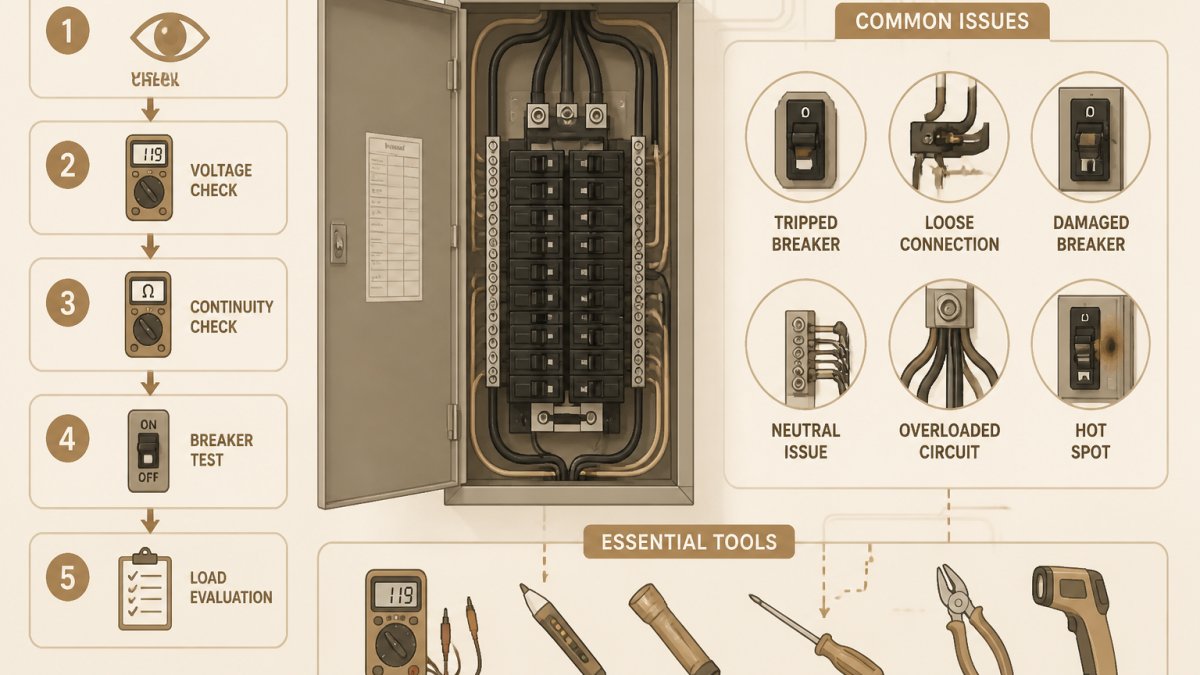
A systematic approach to troubleshoot commercial electrical panel reduces guesswork and keeps you safe. Follow these steps in order and stop immediately if you encounter any warning signs.
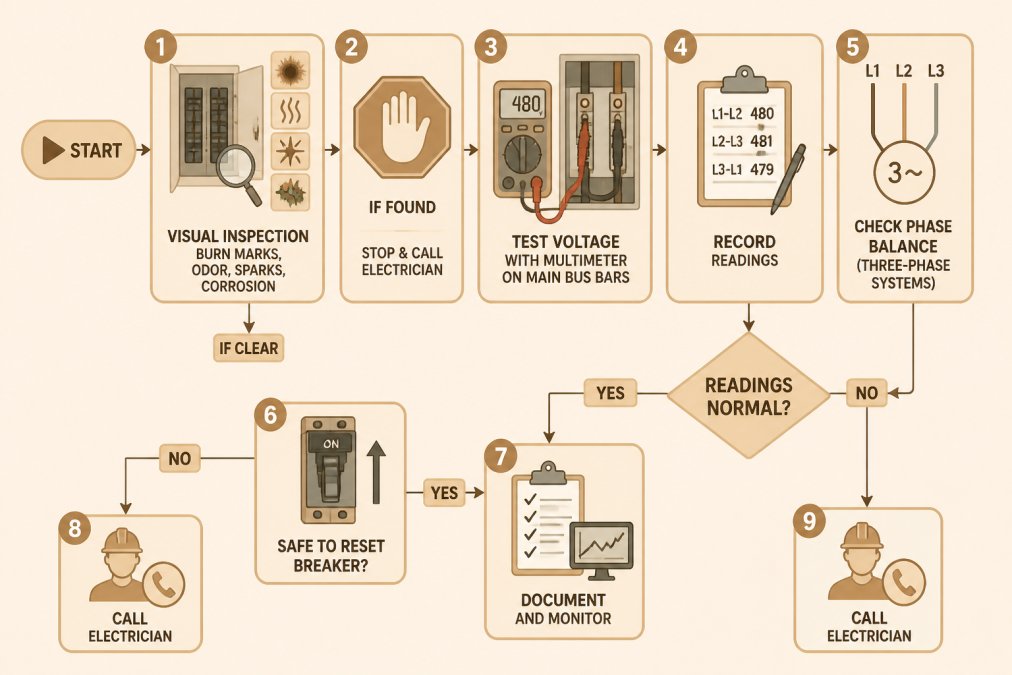
Flowchart showing decision tree: Start → Visual inspection for burn marks, odor, sparks, corrosion → If found, stop and call electrician → If clear, test voltage with multimeter on main bus bars → Record readings → Check phase balance (three-phase systems) → Readings normal? Yes → Safe to reset breaker? ### Step 1: Visually inspect the panel and connections Open the panel door only if the panel is in a safe, dry location with no warning signs present. Look for loose breaker handles, discolored or corroded terminals, debris, visible wire damage, water stains, or burn marks. Take photos of any unusual findings to help a licensed electrician diagnose the problem. **Decision point:** If you observe burn marks, corrosion, moisture, or other warning signs, stop and call a licensed electrician. Do not proceed to voltage testing. ### Step 2: Test voltage with a multimeter A multimeter measures voltage and reveals whether power is at the correct level. Abnormal voltage indicates a utility-side problem, loose connection, or failing main breaker. Set the multimeter to AC voltage mode. Measure voltage between the main bus bars and ground. For three-phase systems, measure each phase separately. Readings within 10% of expected voltage indicate normal supply. Significantly lower or higher readings indicate a utility-side problem, loose connection, or transformer fault. **Decision point:** If voltage is abnormal, do not reset any breakers. Call a licensed electrician. ### Step 3: Check for phase imbalance in three-phase systems Commercial buildings often use three-phase power. Load should be balanced across all three phases; imbalance causes overheating, premature trips, and equipment damage. Measure voltage on each phase to ground. The three readings should be within 5% of each other. If all three phases are within 5%, the system is balanced. If one phase reads significantly higher or lower, or reads zero, call a licensed electrician. **Decision point:** Significant phase imbalance (more than 5% variance) requires professional correction. Do not attempt to rebalance circuits yourself. Call a licensed electrician. ### Step 4: Reset breakers and document the sequence Locate the tripped breaker, flip it fully to OFF, wait 30 seconds, then flip it back to ON. Document the date, time, breaker number, circuit name, equipment running, and whether it stayed on or tripped again. **Decision point:** If the breaker stays on, monitor the circuit for the next week. If it trips again, investigate further. If the breaker trips immediately upon reset, isolate the circuit by leaving the breaker OFF and call a licensed electrician, this indicates a short circuit or ground fault. :::tip Create a simple log or spreadsheet to track breaker trips: date, time, breaker number, circuit name, equipment running, and outcome (stayed on or tripped again). This documentation helps an electrician identify patterns and diagnose recurring faults much faster than a verbal description. ::: ## How to Troubleshoot a Tripped Breaker Safely A breaker that trips once may be a fluke; repeated trips signal a serious problem. Gather information to help an electrician diagnose the fault faster. ### Single trip: Monitor and document Reset the breaker once. If it stays on, monitor for one week. If it does not trip again, the fault was likely temporary. If it trips a second time within a week, the circuit has a recurring fault. Proceed to root-cause investigation. ### Repeated trips: Investigate the root cause Repeated trips indicate one of four problems: overload, short circuit, ground fault, or a failing breaker. Identifying which one helps an electrician prioritize the repair and may prevent equipment damage. #### Is it an overload? **Signs of overload:** breaker trips only when specific equipment runs, trips after a few minutes of operation, or trips during peak usage times. Note which equipment is running when the breaker trips. Check device nameplates for wattage and add them up. If the total exceeds the breaker's rating, try running equipment one at a time or move some to a different circuit. If you confirm an overload, call a licensed electrician to add a circuit or upgrade the breaker. #### Is it a short circuit or ground fault? **Signs:** breaker trips immediately upon reset, trips when lightly loaded or idle, burning smell or sparks near breaker or outlet, visibly damaged outlet or fixture, or breaker trips when plugging in a specific device. Unplug devices one at a time and try resetting. If it stays on after unplugging a specific device, that device is faulty. Isolate the circuit by leaving the breaker OFF. Call a licensed electrician for diagnosis. If you smell burning or see sparks, evacuate and call emergency services. #### Is the breaker failing? A breaker can fail mechanically, losing its ability to trip reliably or becoming stuck in the tripped position. **Signs of a failing breaker:** - The breaker trips repeatedly even after you've confirmed the circuit is not overloaded and no short circuit exists - The breaker handle feels loose, stiff, or difficult to move - The breaker trips at a lower load than it should (e.g., a 20A breaker trips when only 10A is drawn) - The breaker will not stay in the ON position; it immediately returns to the middle or OFF position - The breaker is visibly discolored, corroded, or damaged Confirm the circuit is not overloaded and no short circuit is present. Check the breaker's age, if the panel is over 20 years old, breakers may be reaching end of life. If the breaker trips immediately upon reset, it is likely failing. **Next step:** Call a licensed electrician to replace the breaker. A failing breaker is a fire hazard and should not be left in service. ### Safe escalation: When to stop investigating Stop after two reset attempts and call a licensed electrician if the breaker trips immediately upon reset, you smell burning or see sparks, you find water damage, you cannot identify the cause, the problem involves three-phase power, or you are unsure whether it is safe to proceed. ### Documentation checklist for your electrician Before calling, compile this information to speed diagnosis: - **Circuit number and breaker size:** (e.g., "Breaker 12, 20A") - **Circuit name or load:** (e.g., "Conference room outlets" or "HVAC unit 2") - **Trip frequency:** (e.g., "Tripped twice in one week" or "Trips every time the copier runs") - **Timing and conditions:** (e.g., "Trips after 10 minutes of operation" or "Trips only during morning startup") - **Equipment running:** (e.g., "Large space heater and microwave" or "HVAC compressor") - **Visual or auditory signs:** (e.g., "Burning smell near outlet 4" or "Breaker handle feels loose") - **Actions taken:** (e.g., "Unplugged the heater and breaker stayed on" or "Breaker trips immediately even with no load") - **Photos:** (e.g., of scorch marks, water damage, or the breaker handle position) This information allows an electrician to arrive prepared with the right tools and parts, reducing diagnostic time and service cost. ## Commercial Electrical Panel Maintenance to Prevent Future Issues Preventive maintenance reduces emergency calls and extends panel life. Annually, visually inspect the panel, test voltage on main bus bars, check breaker handles, and verify circuit labels. Every 3-5 years, hire a licensed electrician for thermal imaging, connection tightening, and GFCI testing. When upgrading equipment, calculate new power demand and add circuits if needed rather than overloading existing ones. Light Life Electric provides ongoing maintenance contracts for commercial properties throughout [Southwest Florida(https://blog.lightlifeelectric.com/24-7-emergency-electrical-contractors-southwest-florida).
When to Stop Troubleshooting and Call a Licensed Electrician
Know when to hand off the work. Attempting repairs beyond your skill level risks injury, equipment damage, and code violations.
Light Life Electric's team of Florida certified electricians handles everything from diagnostics to repairs. We offer 24/7 emergency response and can usually schedule routine maintenance within a few days.
Troubleshooting a commercial electrical panel requires knowing what you can safely diagnose and when professional help is essential. Visual inspection and basic voltage testing are within reach for most people.
Frequently Asked Questions
What should I check when a commercial circuit breaker trips?
First, visually inspect the panel for signs of burning, melting, or loose connections. Check what equipment was running when the breaker tripped, this identifies the circuit load. Use a multimeter to test voltage at the breaker terminals (if safe to do so). Document which breaker tripped and how often. If the same breaker trips repeatedly, stop resetting it and contact a licensed electrician immediately, as repeated trips indicate an underlying electrical fault that requires professional diagnosis.
How can I tell if my electrical panel is failing?
Common signs of a failing panel include frequent breaker trips, flickering or dimming lights across multiple circuits, buzzing or crackling sounds from the panel, a burning smell near the electrical panel, visible corrosion or rust on panel components, warm spots on the panel housing, and tripped breakers that won't reset. Three-phase commercial systems may show phase imbalance, where voltage differs significantly between phases. Any of these warning signs requires immediate inspection by a licensed electrician to prevent equipment downtime or safety hazards.
Is it safe to reset a commercial circuit breaker myself?
Resetting a breaker once is generally safe if you follow proper procedure: turn the breaker switch fully to OFF, then back to ON. Do not force it. However, if the breaker trips immediately after reset, or if it trips repeatedly, stop resetting and call a licensed electrician. Never bypass a breaker or leave it in a partially tripped position. Repeated trips indicate a short circuit, ground fault, or overload that requires professional diagnosis. Commercial panels carry higher voltage and power than residential systems, so escalate any persistent issue to avoid equipment damage or electrical hazards.
How often should I perform maintenance on a commercial electrical panel?
Schedule professional electrical panel maintenance annually for most commercial properties, or every six months in high-demand environments (data centers, manufacturing, heavy HVAC use). Between professional visits, visually inspect the panel monthly for loose connections, corrosion, or unusual sounds. Keep the area around the panel clear of debris and moisture. Document all breaker trips and reset events. A licensed electrician can identify aging components, loose power connections, and phase imbalance during routine maintenance, preventing unexpected power interruptions and extending panel life.
 how-to