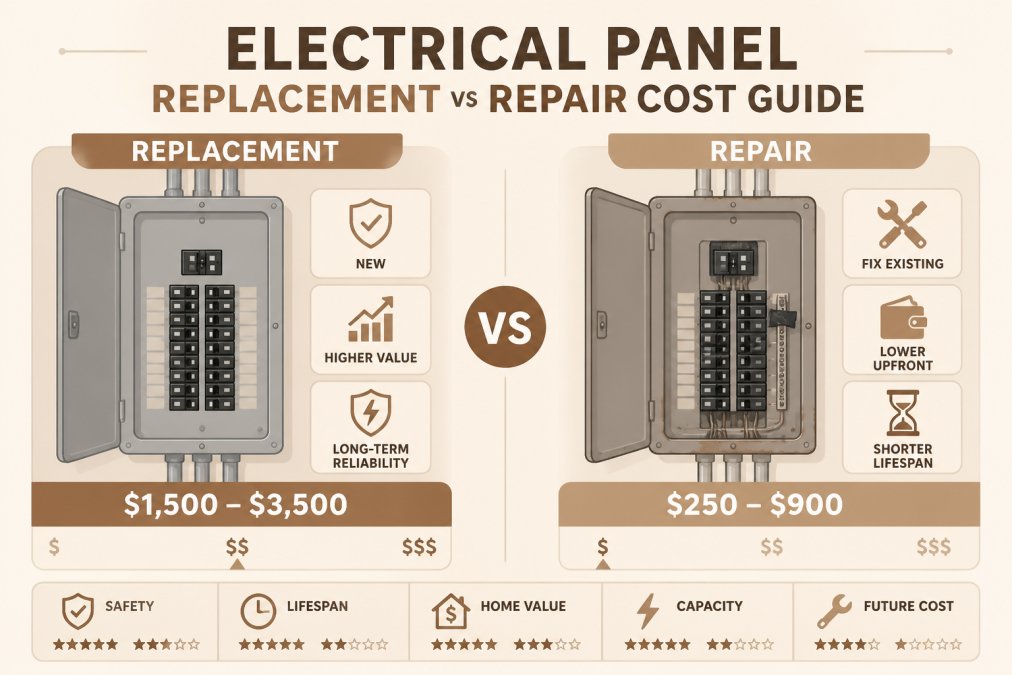
 comparison
Electrical Panel Replacement vs Repair Cost Guide
Table of Contents
- Electrical Panel Replacement vs Repair Cost: A Side-by-Side Comparison
- Signs Your Electrical Panel Needs Replacing
- Electrical Panel Upgrade Cost: What Drives the Price Up or Down
- How Long Does an Electrical Panel Last?
- Insurance and Smart Panel Considerations
- DIY vs. Professional Panel Work: Risks and Realities
- How to Decide: A Decision Framework for Repair vs Replacement
- Conclusion
- Frequently Asked Questions
Last Updated: September 11, 2026
Electrical Panel Replacement vs Repair Cost: A Side-by-Side Comparison
The electrical panel replacement vs repair cost question comes down to three variables: the extent of the damage, the age and capacity of your existing panel, and whether local code allows a partial fix. A repair might mean swapping a single breaker or tightening a loose neutral; a full replacement means new hardware, a permit, an inspection, and a licensed electrician on site for most of a day. Neither is automatically cheaper once you factor in repeat visits and code compliance.
This guide from Light Life Electric breaks down both paths, the cost drivers behind each, and the safety and insurance angles most homeowners overlook.
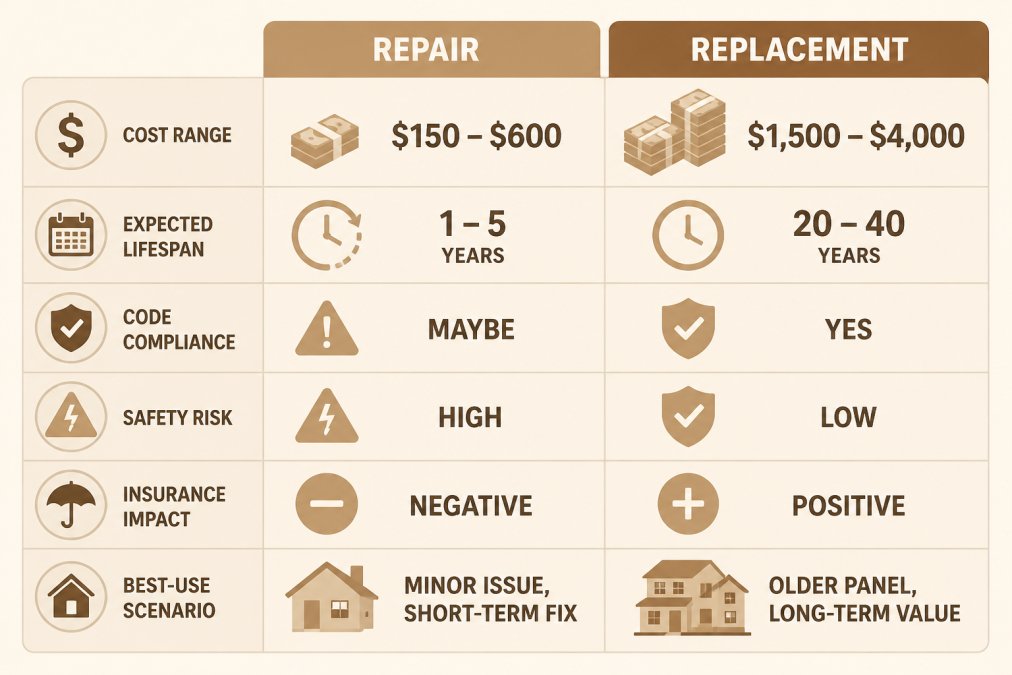
Quick Comparison Table: Repair vs Replacement
| Factor | Repair | Replacement |
|---|---|---|
| Typical trigger | One failed breaker or loose connection | Age, capacity limits, or safety hazard |
| Scope of work | Single component swap | Full service panel and main breaker |
| Permit needed | Sometimes, for circuit changes | Almost always |
| Lifespan after work | Remaining life of existing panel | Full new service life |
| Code compliance | Only the repaired portion | Whole panel meets current code |
| Best for | Isolated, recent faults | Aging or overloaded systems |
Signs Your Electrical Panel Needs Replacing
The clearest signs an electrical panel needs replacing are a burning smell near the panel, scorch marks, warm breaker faces, repeated tripping that returns after reset, and rust or corrosion inside the enclosure. Any one points to a problem a breaker swap will not fix.
Age matters too. Most panels last roughly 25 to 40 years, and older units often lack modern safety devices like arc-fault circuit interrupters (AFCI) and ground-fault circuit interrupters (GFCI) (osha.gov). Flickering lights across multiple rooms, a main breaker that trips under normal load, and no spare slots for new circuits all suggest the system is at capacity.
When Repair Still Makes Sense
A repair is the right call when the fault is isolated, recent, and the panel itself is in good condition. A single tripping breaker on a circuit you just added, a loose lug, or a failed breaker on a panel under 15 years old with spare capacity are all repair scenarios. The key test: if the hardware is sound and the problem is one component, fix the component.
If the panel is old, undersized, or shows heat damage, a repair is a temporary patch on a system that will keep generating calls.
Electrical Panel Upgrade Cost: What Drives the Price Up or Down
Electrical panel upgrade cost depends on amperage, labor hours, permit fees, and whether the service entrance cable or meter base also needs work. Moving from 100-amp to 200-amp service, adding a sub-panel, or relocating the panel to meet clearance rules all push the total higher.
The biggest swing factor is amperage upgrade. A like-for-like swap takes less time than a capacity increase, which may require a new service entrance cable, utility transformer coordination, and a load calculation. Homes adding EV chargers, heat pumps, or a workshop often need that jump, which is where a repair stops being an option.
How Amperage Tier Drives the Price
Most residential panels fall into three amperage tiers, and each tier carries a different labor and hardware profile:
| Tier | Typical use case | What changes vs. a like-for-like swap |
|---|---|---|
| 100-amp | Small homes, gas appliances, no EV | Baseline replacement; often the existing service entrance cable is reused |
| 150-amp | Mid-size homes adding one large load | New main breaker, sometimes a new service entrance cable |
| 200-amp | Homes with EV charging, heat pumps, electric ranges, or solar | New service entrance cable, meter base evaluation, utility coordination, load calculation |
| 320/400-amp | Large homes, dual EV chargers, outbuildings | Possible transformer upgrade with the utility; longest lead time |
The jump from 100-amp to 200-amp costs meaningfully more than a same-amperage swap, not because the panel is expensive, but because the service entrance conductors, meter socket, and utility coordination all change. If the existing service entrance cable is undersized for the new amperage, it must be replaced, often the largest line item after labor.
Line Items That Show Up on a Real Estimate
A thorough estimate separates these categories:
- Panel and main breaker hardware, the enclosure, bus bar, main breaker, and branch breakers.
- Labor, typically the largest line item; scales with access difficulty (finished drywall, tight closets, attic runs) and whether the service entrance cable is replaced.
- Permit and inspection fees, set by the local jurisdiction, not the electrician, and almost always required for a panel replacement.
- Service entrance cable and meter base, often replaced during an amperage upgrade; a failed meter base inspection can add a same-day change order.
- Grounding and bonding upgrades, required by the National Electrical Code (NEC) when the existing grounding electrode system does not meet current requirements.
- Utility disconnect and reconnect, some utilities charge for the truck roll to pull and reset the meter.
- Drywall and finish repair, patching after the old panel comes out, which is rarely included in an electrician's quote.
What Pushes the Price Up or Down
Up: amperage increase, service entrance cable or meter base replacement, panel relocation, grounding upgrades, tight or finished access, utility transformer coordination, and heat damage requiring branch-circuit tracing.
Down: same-amperage swap, accessible panel location (garage or utility room wall), existing service entrance cable already sized for the new panel, and a jurisdiction with straightforward permit processing.
National Fire Protection Association overview of NFPA 70, the National Electrical Code
Why Repair Rarely Beats Replacement Once You Are Upgrading
If your reason for calling an electrician is a capacity problem, adding an EV charger, heat pump, or workshop, a repair cannot solve it. Breakers do not create capacity. The only path is a larger service, meaning replacement plus the service entrance work that comes with it. Here the repair-vs-replacement cost comparison stops being close.
How Long Does an Electrical Panel Last?
A typical electrical panel lasts 25 to 40 years, though heat, moisture, and repeated overloads shorten that window. Panels in humid coastal climates corrode faster, and units tripped repeatedly under heavy load age quicker than ones running well under capacity.
Once a panel passes 25 years, treat every fault as a signal to evaluate the whole system rather than the individual part. The question shifts from "can this be fixed" to "is it worth fixing." For a panel near the end of its service life, repair money is often better put toward replacement.
Get your free electrical estimate →
Insurance and Smart Panel Considerations
This is the section most repair-vs-replacement articles skip, and it is where the decision can get expensive. Home insurers increasingly ask about panel age and brand during underwriting and claims review, and certain panel types are treated differently.
Panel Brands Insurers Flag
Two panel families come up repeatedly in underwriting and home inspection reports:
- Federal Pacific Electric (FPE) Stab-Lok panels, made roughly from the 1950s into the 1980s. These have a documented history of breakers that fail to trip under overload, and many insurers surcharge, require inspection, or decline coverage on a home with one.
- Zinsco panels (and later GTE-Sylvania successors), also associated with breakers that fail to trip and bus bar corrosion. Same underwriting pattern as FPE.
If your panel is one of these, the repair-vs-replacement question is largely settled: a repair does not change the brand, and the brand is what the insurer prices. A code-compliant replacement with a permit and final inspection gives you a paper trail that supports future claims and can move you back into standard underwriting.
How Replacement Affects Premiums and Coverage
A panel replacement does not automatically lower your premium, but it can change your eligibility:
- Eligibility, moving off a recalled panel can move you from a surplus-lines or non-standard carrier back to a standard carrier.
- Inspection conditions, some carriers issue a policy with a condition that the panel be replaced within a set window; missing that window can lead to non-renewal.
- Claim defensibility, a permitted, inspected replacement creates a record that the hazard was addressed, which matters if a future electrical claim is questioned.
- Documentation, keep the permit, the final inspection sign-off, and the electrician's invoice. These are the documents an adjuster will ask for.
Smart Panels: Cost-Benefit vs. a Standard Breaker Box
A smart electrical panel adds circuit-level monitoring, remote breaker control, and integration with solar, battery storage, and home energy management systems. The trade-off versus a standard breaker box:
| Factor | Standard panel | Smart panel |
|---|---|---|
| Upfront hardware cost | Lower | Higher; the panel itself is the premium line item |
| Monitoring | None | Circuit-level usage, anomaly alerts |
| Remote control | None | App-based breaker control on supported circuits |
| Solar / battery integration | Requires separate hardware | Often built in |
| Serviceability | Any licensed electrician | Manufacturer ecosystem and app may be required for full features |
| Best fit | Budget-driven replacement, simple loads | Homes adding solar, battery, EV charging, or with complex load management needs |
The cost-benefit case for a smart panel is strongest when you are already replacing and know you are adding solar, battery backup, or multiple large loads soon. If you are replacing purely to restore safe, code-compliant service with no near-term energy upgrades planned, a standard panel is usually the better value. Choosing a smart panel later means paying for a second replacement, so decide once, at replacement time.
DIY vs. Professional Panel Work: Risks and Realities
Panel work is not a DIY task, for legal as much as practical reasons. Most jurisdictions require a licensed electrician and a permit for panel replacement, and an unpermitted job can fail a home inspection, void insurance coverage, and create liability if a fire occurs later. The work involves the service entrance, main breaker, and grounding, all carrying live-line and arc-flash risk.
The cost gap between DIY and professional is smaller than it looks once you price the permit, inspection, correct hardware, and risk. A licensed electrician also performs the load calculation, pulls the permit, and stands behind the work through final inspection, the part that keeps the job compliant and insurable.
U.S. Consumer Product Safety Commission guidance on electrical fire safety
How to Decide: A Decision Framework for Repair vs Replacement
Use this framework to sort your situation before you call anyone:
- Is the fault isolated to one breaker or circuit? If yes, repair is likely viable.
- Is the panel under 15 years old with spare capacity? If yes, repair is likely viable.
- Is there any burning smell, scorch mark, or warm breaker face? If yes, treat as replacement.
- Is the panel 25 years or older? If yes, evaluate for replacement.
- Does the main breaker trip under normal load, or are there no spare slots? If yes, replacement.
- Are you adding EV charging, solar, or major appliances? If yes, plan for an amperage upgrade.
- Does your insurer or a home inspection flag the panel? If yes, replacement with permit.
If more than one replacement trigger applies, stop pricing repairs. The electrical panel replacement vs repair cost comparison tips toward replacement the moment safety, age, and capacity problems stack up.
Conclusion
Deciding whether to repair or replace your panel is a safety decision first and a budget decision second, and the wrong call can leave a known hazard in place. Light Life Electric handles the entire process, from load calculation and permit to final inspection, as a Florida certified electrical contractor that is licensed, bonded, and insured. We offer 24/7 emergency electrical response and code-compliant installations, and we work to keep projects on schedule and within budget. Get your free electrical estimate from Light Life Electric and replace uncertainty with a panel you can trust.
Frequently Asked Questions
Will homeowners insurance cover electrical panel replacement?
Most homeowners insurance policies do not cover panel replacement due to normal wear and tear or outdated equipment. However, if a fire or storm damages the panel, your policy may cover the repair or replacement. Some insurers also offer discounts for upgrading to a modern panel with AFCI and GFCI protection. Check your policy and ask your agent whether an upgrade could lower your premium.
How much does an electrician charge to replace an electrical panel?
The total electrical panel cost depends on amperage, labor rates in your area, permit fees, and whether the service entrance cable or meter socket also needs work. Pricing varies widely by project scope. Light Life Electric provides free estimates so you know the full cost before work begins.
Can I upgrade my electrical panel without rewiring my house?
Yes, in many cases. A panel upgrade replaces the main breaker box and breakers without touching the branch wiring inside walls. However, if your home has outdated wiring like aluminum or knob-and-tube, the electrician may recommend rewiring to meet current National Electrical Code (NEC) requirements. A licensed electrician can perform an electrical load calculation and inspect the service entrance cable to confirm what is needed.
What are the signs that an electrical panel needs to be replaced?
Key signs include flickering lights, a burning smell near the panel, breakers that trip repeatedly, rust or corrosion inside the panel, and a panel that is more than 25 to 30 years old. If your panel is a known hazardous brand or you see scorch marks, replacement is safer than repair. A home safety inspection from a licensed electrician can confirm whether repair or replacement is the right call.
Is it worth repairing an old electrical panel?
Repair makes sense when the panel is structurally sound, parts are available, and the issue is isolated, such as a single failed breaker. If the panel is outdated, undersized for your electrical load, or has known safety defects, replacement is the better investment. Weigh the repair cost against the remaining lifespan of the panel; if it is near the end of its service life, put that money toward an upgrade.