 how-to
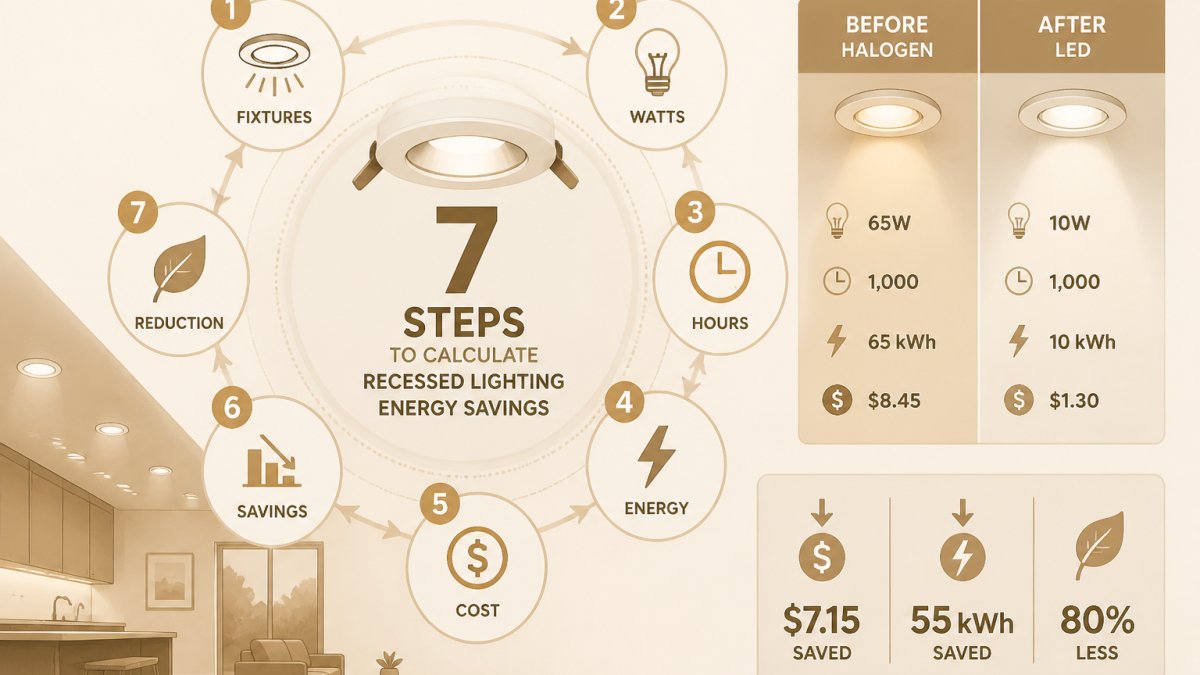
7 Steps to Calculate Recessed Lighting Energy Savings
Last Updated: October 27, 2026
Quick Summary
To calculate recessed lighting energy savings, count your fixtures and confirm each bulb's wattage, then use annual kWh = (watts × hours per day × 365) ÷ 1,000 and multiply by your utility rate. Subtract the LED's annual cost from the incandescent cost to see the savings per fixture, then multiply by fixture count.
- Match brightness by lumens first, then compare watts to see what each option costs to run.
- Most homes pay 10 to 20 cents per kWh, so pull your actual rate from a recent bill.
- A 65W incandescent running 4 hours a day costs about $13.29 per year at a 14-cent rate.
- Savings scale with fixture count: a 20-fixture home saves roughly $229 a year.
- Payback period in years equals upfront cost divided by annual savings.
Table of Contents
- Step 1: Count Your Recessed Fixtures and Confirm Wattage
- Recessed Light Wattage and Lumens: The Two Numbers That Drive the Math
- How to Calculate Lighting Electricity Cost in Kilowatt-Hours
- Use a Recessed Lighting Energy Cost Calculator to Check Your Work
- Worked Examples: Recessed Lighting Energy Savings for Three Households
- Factor In Dimming, Controls, and Real Operating Hours
- Run an LED Lighting Payback Period Calculator Before You Buy
- Get a Free Electrical Estimate for Your LED Retrofit
- Frequently Asked Questions
Step 1: Count Your Recessed Fixtures and Confirm Wattage
You can't calculate recessed lighting energy savings without two facts: fixture count and watts per fixture. Start with a notepad and a ladder.
Count every recessed can, including rarely used ones, then check each bulb. Wattage is stamped on the base or printed on the glass.
- Old incandescent: commonly 60W or 75W
- Halogen flood: often 50W to 90W
- CFL: usually 13W to 26W
Record count and wattage per room.
Once you have both numbers, you're ready for the math.
Recessed Light Wattage and Lumens: The Two Numbers That Drive the Math
Wattage is how much power a bulb pulls. Lumens is how much light it puts out.
An old 65W incandescent puts out roughly 700 lumens. A modern LED that produces the same 700 lumens draws about 9W.
That gap is where the savings live. For the broader case, see what is the benefit of energy efficient LED lighting.
A quick reference for matching brightness:
- 450 lumens: about 40W incandescent, or 5W to 7W LED
- 800 lumens: about 60W incandescent, or 9W to 12W LED
- 1,100 lumens: about 75W incandescent, or 13W to 15W LED
Match lumens first. Then the wattage comparison tells you the savings.
How to Calculate Lighting Electricity Cost in Kilowatt-Hours
Learn how to calculate lighting electricity cost once and you can reuse the formula for every room.
Annual kWh = (watts × hours per day × 365) ÷ 1,000
Annual cost = Annual kWh × your utility rate
The 1,000 converts watts to kilowatts, the unit your utility bills in.
Work it through for one fixture: a 65W incandescent running 4 hours a day.
- 65 × 4 × 365 = 94,900 watt-hours
- 94,900 ÷ 1,000 = 94.9 kWh per year
- 94.9 × $0.14 = about $13.29 per year, per fixture
Watch out: skipping the utility rate step and guessing at it throws off every downstream number.
Use a Recessed Lighting Energy Cost Calculator to Check Your Work
A recessed lighting energy cost calculator automates the formula: enter fixture count, wattage, daily hours, and your rate to get annual kWh and cost.
These tools are a sanity check, not a substitute for your own numbers.
Many calculators use a simplified fixture-count method based on room area and brightness targets. A lighting layout calculation from SEUS Lighting's recessed lighting guide uses room area, required foot-candles, and lumens per fixture to estimate how many cans a room needs: (room area × foot-candles needed) ÷ lumens per fixture.
What most calculators miss is the gap between nameplate wattage and real draw: a dimmed LED pulls less, a bad driver pulls more.
Worked Examples: Recessed Lighting Energy Savings for Three Households
Here are three scenarios at a 14-cent utility rate and 4 hours of daily use, showing how the math plays out at different scales.
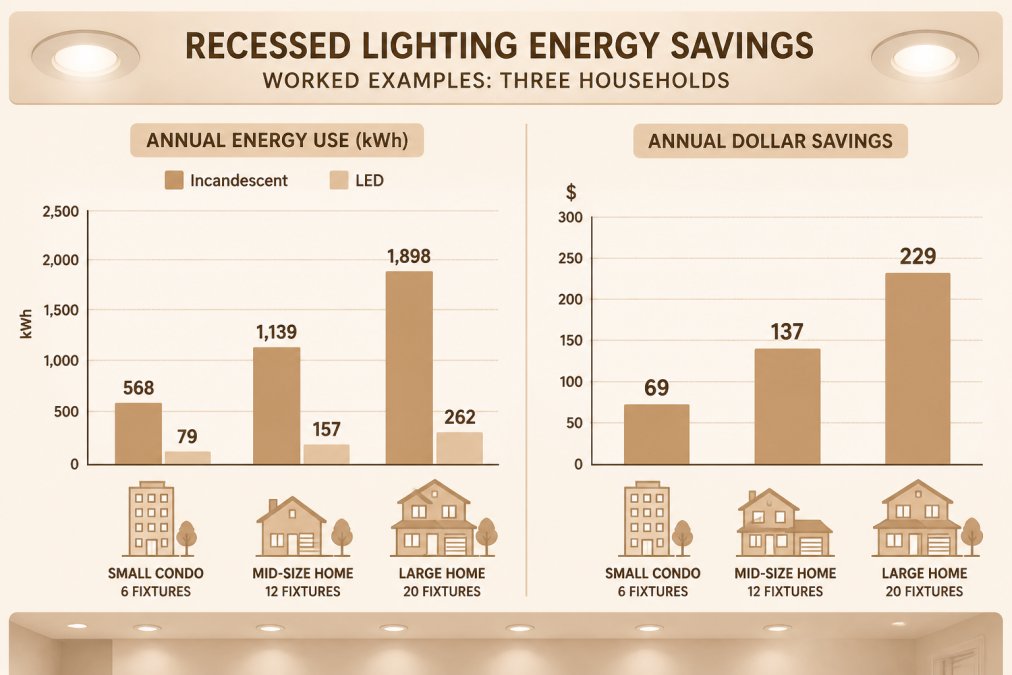
Small condo, 6 fixtures, 65W incandescent to 9W LED
Get your free electrical estimate →
- Incandescent: 6 × 65 × 4 × 365 ÷ 1,000 = 569 kWh, about $80 a year
- LED: 6 × 9 × 4 × 365 ÷ 1,000 = 79 kWh, about $11 a year
- Savings: roughly $69 a year
Mid-size home, 12 fixtures, same swap
- Incandescent: about 1,139 kWh, roughly $159 a year
- LED: about 158 kWh, roughly $22 a year
- Savings: roughly $137 a year
Large home, 20 fixtures, same swap
- Incandescent: about 1,898 kWh, roughly $266 a year
- LED: about 263 kWh, roughly $37 a year
- Savings: roughly $229 a year
Savings scale with fixture count: a bigger house with more cans has more to gain.
Factor In Dimming, Controls, and Real Operating Hours
Real homes don't run every light at full power for exactly four hours. Dimming, controls, and the fixture itself change actual consumption, so treat this as the calibration step between nameplate math and your utility bill.
Dimming: why 50% on the dial is not 50% of the watts
A dimmed LED draws less power, but not linearly: a dimmer at half output saves less than half the wattage, since the driver still consumes overhead and LED efficacy drops at low output. Treat dimming as a modest adjustment, not a multiplier, and measure with a plug-in watt meter for a defensible number.
Controls: occupancy sensors, daylight, and schedules
Controls cut wasted hours, usually the biggest error in a savings estimate. To factor them in:
- Occupancy and vacancy sensors eliminate the hours a room sits lit and empty. In a hallway, closet, or laundry room, that can be most of the fixture's run time.
- Daylight sensors dim or switch fixtures near windows when ambient light is sufficient, which matters most in kitchens and south-facing rooms.
- Schedules and smart dimmers remove the forgotten-light hours in rooms people leave without switching off.
Track daily usage per room for a week, note dimmed hours, then subtract the hours sensors or schedules would eliminate.
Recessed-lighting-specific system losses
The can, trim, and installation affect real energy use beyond the bulb's wattage.
- Trim and aperture. An open trim spreads light; a baffle or lensed trim absorbs some of it, so you may need a slightly higher-lumen lamp to hit the same foot-candles. More lumens means more watts.
- Insulation contact (IC) rating. A non-IC fixture in an insulated ceiling traps heat, which shortens LED driver life and can force the driver to derate. A fixture that runs hot is a fixture you replace sooner, and replacement cost belongs in your payback math.
- Air leakage. An unsealed can is a hole in your ceiling's air barrier. The energy penalty shows up on your heating and cooling bill, not your lighting bill, so a lighting-only calculation understates the benefit of sealing or replacing leaky cans with airtight LED units.
A practical calibration workflow
- Count fixtures and record nameplate wattage per room.
- Track real daily hours per room for one week, noting dimmed hours separately.
- Subtract hours that occupancy sensors, daylight sensors, or schedules would remove.
- Apply a modest dimming adjustment based on measured draw, not a guessed percentage.
- Note any non-IC, leaky, or mismatched-dimmer fixtures as candidates for replacement, and carry that cost into the payback section.
Run an LED Lighting Payback Period Calculator Before You Buy
An LED lighting payback period calculator tells you how long it takes for the annual savings to cover the upfront cost. The formula is simple, but the inputs are where most estimates go wrong.
Payback period in years = upfront cost ÷ annual savings
A worked payback example
Take a 12-fixture room swapping 65W incandescent lamps for 9W LEDs at a 14-cent rate and 4 daily hours. Annual savings are roughly $137. Now build the all-in upfront cost:
- LED lamps: 12 × a typical retrofit lamp price
- New trims or airtight retrofit units, if the existing cans are leaky or non-IC
- A compatible dimmer, if the old one is not LED-rated
Divide that total by $137 for the years until break-even; after that, every year is money back. Avoid comparing a cheap bulb price to a full installed cost, which produces a payback figure that looks great and is wrong.
Add bulb life and replacement costs
Payback is only half the story. Total cost of ownership combines purchase, installation, energy, and replacement over the fixture's life.
- Incandescent and halogen lamps have short rated lives and are replaced often, so their replacement cost and labor add up year after year.
- CFLs last longer but contain mercury and dim poorly on many recessed dimmers.
- LEDs have long rated lives, so over a decade the replacement cost approaches zero, and the energy savings compound.
For a lifetime comparison, multiply annual energy cost by years kept, add upfront cost, then add replacement cost (replacements × lamp price, plus labor). Run it for the incandescent baseline and LED retrofit side by side; the LED column usually wins by a wider margin than one-year payback suggests.
Recessed-lighting-specific costs to include
A retrofit isn't just bulbs: it can include new trims, drivers, dimmers, and labor. The fixture-level issues from the previous section carry a cost:
- Replacing non-IC cans in an insulated ceiling
- Sealing leaky cans or swapping to airtight LED units
- Upgrading a dimmer that is not LED-compatible
Pre-purchase checklist
- Confirm fixture count and current wattage
- Get the LED replacement wattage for matching lumens
- Pull your actual utility rate from a recent bill
Get a Free Electrical Estimate for Your LED Retrofit
The math gives you a target.
Light Life Electric is a family-owned, Florida certified electrical contractor serving Southwest Florida. We handle the whole process, from permits to final inspection, and we're licensed, bonded, and insured.
You can explore our residential electrical services for lighting and panel upgrades, or contact our team to schedule your free estimate. We also offer 24/7 emergency response when something goes wrong.
Frequently Asked Questions
How do you calculate energy savings from LED recessed lights?
Subtract the LED fixture wattage from the wattage of the bulb you are replacing, multiply the difference by the number of fixtures and annual operating hours, then divide by 1,000 to get kilowatt-hours saved. Multiply that by your utility rate to get dollar savings. For example, replacing a 65-watt incandescent with a 10-watt LED across 8 fixtures running 4 hours a day saves roughly 642 kWh a year. Your actual recessed lighting energy savings depend on fixture count, hours, and your electricity rate.
How much electricity does a recessed light use?
It depends on the bulb. A traditional 65-watt incandescent recessed fixture uses 0.065 kWh per hour. A comparable 10-watt LED uses 0.010 kWh per hour. Over 4 hours a day for a year, that is about 95 kWh for the incandescent versus 15 kWh for the LED, per fixture. Multiply by your fixture count to get the total lighting load. Check the wattage printed on the bulb or trim before you run the math.
How many hours a day should I use in a lighting savings estimate?
Use your real habits, not a guess. Track a typical week for the rooms with recessed lights. If you use dimming or occupancy sensors, reduce the effective hours to reflect actual on-time. A conservative estimate protects you from overstating the payback period on your LED lighting payback period calculator.
Do dimmable recessed lights use less electricity?
Yes, dimming reduces power draw, though not always in a straight line. The bigger savings come from turning lights off or using occupancy sensors in low-traffic rooms. If you dim frequently, factor an average dim level into your operating hours so your recessed lighting energy savings estimate stays realistic rather than optimistic.
The savings are real, but only if the numbers behind them are. Count your fixtures, match lumens, run the formula, and confirm the payback before you spend a dollar. Get started with Light Life Electric and turn your recessed lighting energy savings estimate into a code-compliant retrofit done right the first time.