 blog
blog
10 Signs Your Commercial Wiring Needs an Upgrade
Table of Contents
- Why Commercial Wiring Problems Cost More Than Repairs
- 1. Flickering or Dimming Lights During Business Hours
- 2. Warm Outlets, Switches, or Walls
- 3. Breakers That Trip Again and Again
- 4. Burning Smells, Buzzing, and Arcing
- 5. Overloaded Circuits and Insufficient Electrical Capacity
- 6. Loose Outlets and Aging Wiring Behind the Walls
- 7. When to Schedule a Commercial Electrical Inspection
- Frequently Asked Questions
Last Updated: October 7, 2026
Why Commercial Wiring Problems Cost More Than Repairs
A flickering light in a retail store is not just an annoyance. It is a warning that your commercial wiring may be failing under a load it was never built to carry.
Most business owners treat electrical symptoms as isolated repairs. Replace a breaker here, swap an outlet there. But the signs of failing commercial wiring follow a pattern, and that pattern points to one conclusion: the whole system is due for an upgrade.
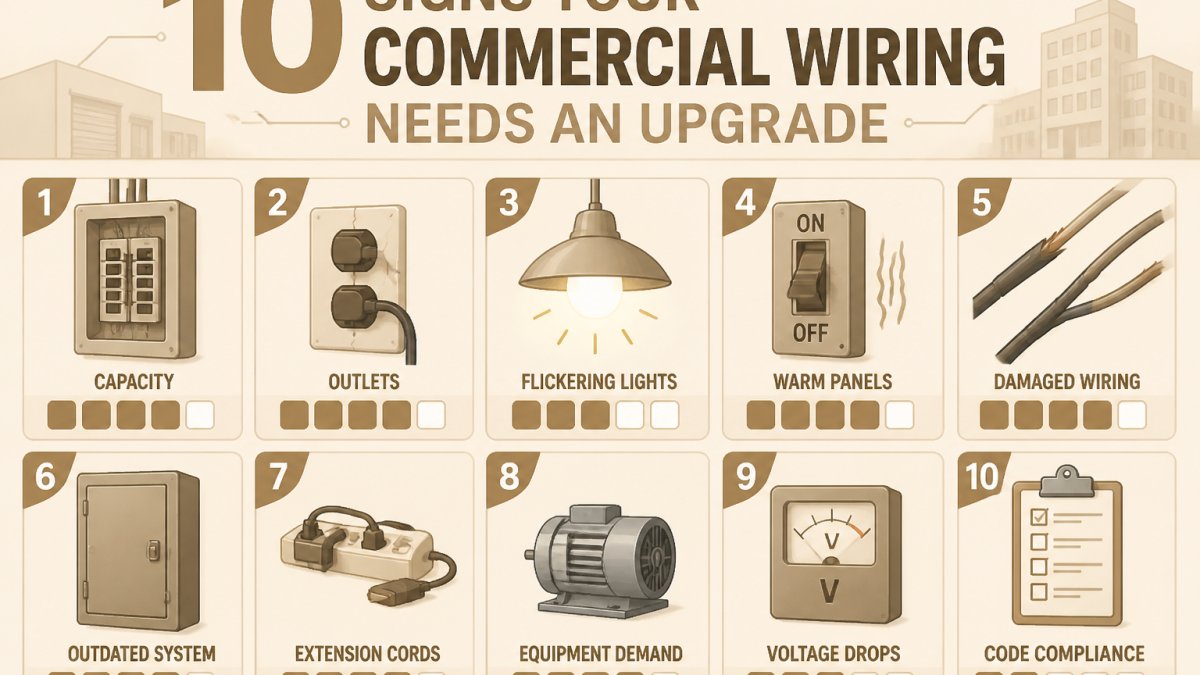
This guide walks through the 10 signs your commercial wiring needs an upgrade. We will show you how to tell a minor fix from a full system problem, and when to call a licensed electrician before a small issue becomes a shutdown.
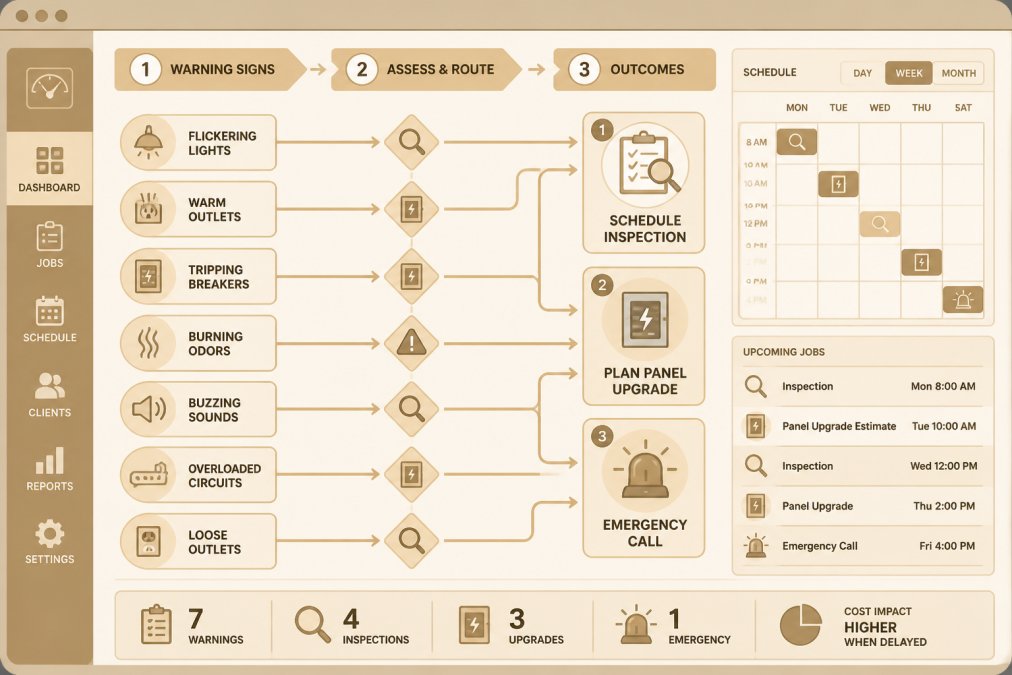
1. Flickering or Dimming Lights During Business Hours
Lights that dim when equipment starts are the clearest early sign of an overloaded circuit. The voltage dips because the wiring cannot supply the demand.
Watch for these patterns:
- Lights flicker when the HVAC or a motor kicks on
- Dimming happens at the same time every day
- Only one part of the building is affected
A single flickering fixture is often a loose connection. Whole sections dimming at once points to a wiring or capacity problem.
2. Warm Outlets, Switches, or Walls
Warm outlets and switch plates are a serious warning. Heat means resistance, and resistance means loose connections or undersized wiring.
Check these spots:
- Outlets that feel hot after normal use
- Switch plates that are warm to the touch
- Discolored or cracked faceplates
- Walls that feel warm near a panel
Warm walls near an electrical panel deserve same-day attention. Heat behind drywall can start a fire inside the wall cavity.
3. Breakers That Trip Again and Again
A breaker that trips once is doing its job. A breaker that trips weekly is telling you the circuit is overloaded.
Frequent breaker trips usually mean one of three things:
- Too much equipment on one circuit
- A failing breaker that no longer holds its rating
- Wiring that is too small for the current load
Never solve this by installing a bigger breaker. That removes the safety limit and lets the wire overheat.
4. Burning Smells, Buzzing, and Arcing
A burning plastic odor, a buzzing sound, or visible arcing are emergency signs. Stop using the circuit and call a licensed electrician right away.
These symptoms point to:
- Overheating insulation
- Loose connections sparking inside a box
- A switchboard or panel near failure
A faint buzzing from a panel is never normal. It means current is jumping where it should flow smoothly.
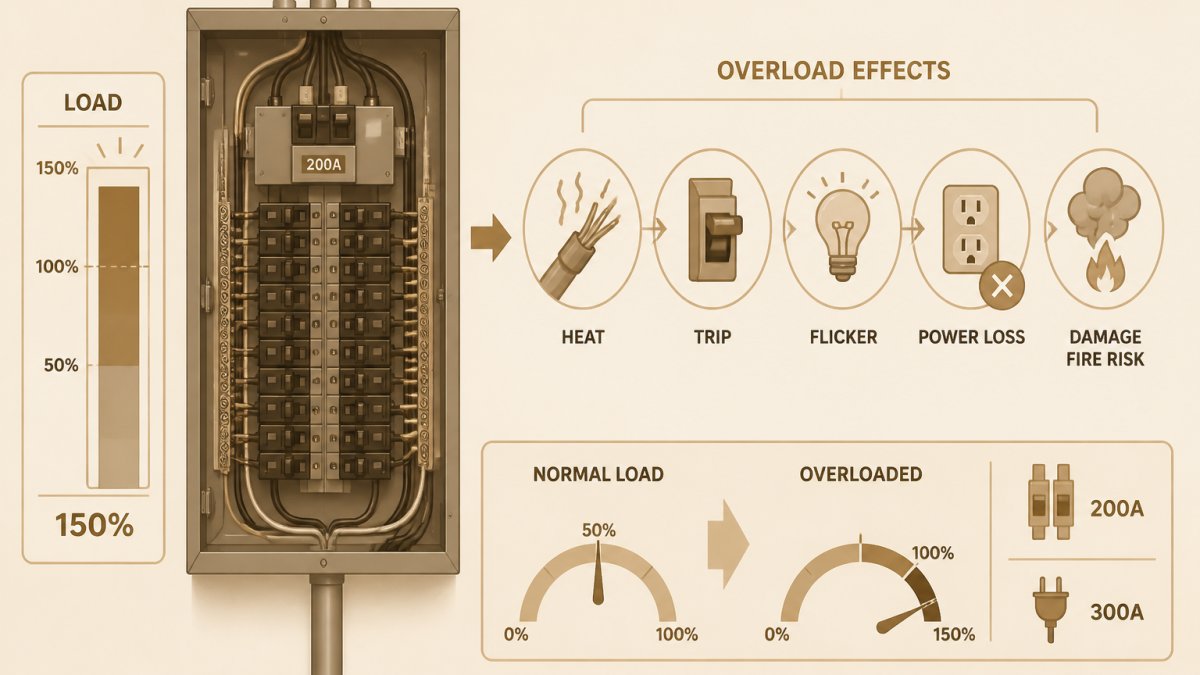
5. Overloaded Circuits and Insufficient Electrical Capacity
Insufficient electrical capacity is the root cause behind most of the signs above. Older commercial buildings were wired for typewriters and a few lights, not server racks, commercial kitchens, and rooftop HVAC units. The difference between a commercial and a residential load is not just size, it is the mix of continuous loads, motor starting currents, and future growth that a service has to absorb.
Signs your building has run out of power:
- You rely on power strips to add outlets
- New equipment needs a dedicated circuit every time
- The panel has no open breaker slots
- Lights dim elsewhere in the building when a large motor starts
- You cannot add a subpanel without a service upgrade
How a commercial load calculation actually works. A licensed electrician does not guess capacity by counting breakers. They build a load calculation from the actual equipment list: nameplate ratings on HVAC, refrigeration, kitchen equipment, motors, and IT gear; continuous versus non-continuous loads; demand factors for equipment that rarely runs all at once; and the starting current that motors and compressors pull briefly on startup. That starting current is why a building can trip a breaker even when the running load looks fine on paper.
Where commercial loads differ from residential.
- HVAC and refrigeration cycle on and off, so the calculation has to account for locked-rotor and inrush current, not just running amps.
- Servers and IT closets are continuous loads that run 24/7 and often need dedicated circuits plus UPS or surge protection.
- Kitchens and production equipment combine high-wattage heating elements with motor loads on the same service.
- EV chargers, signage, and security systems are newer loads that older services were never sized for.
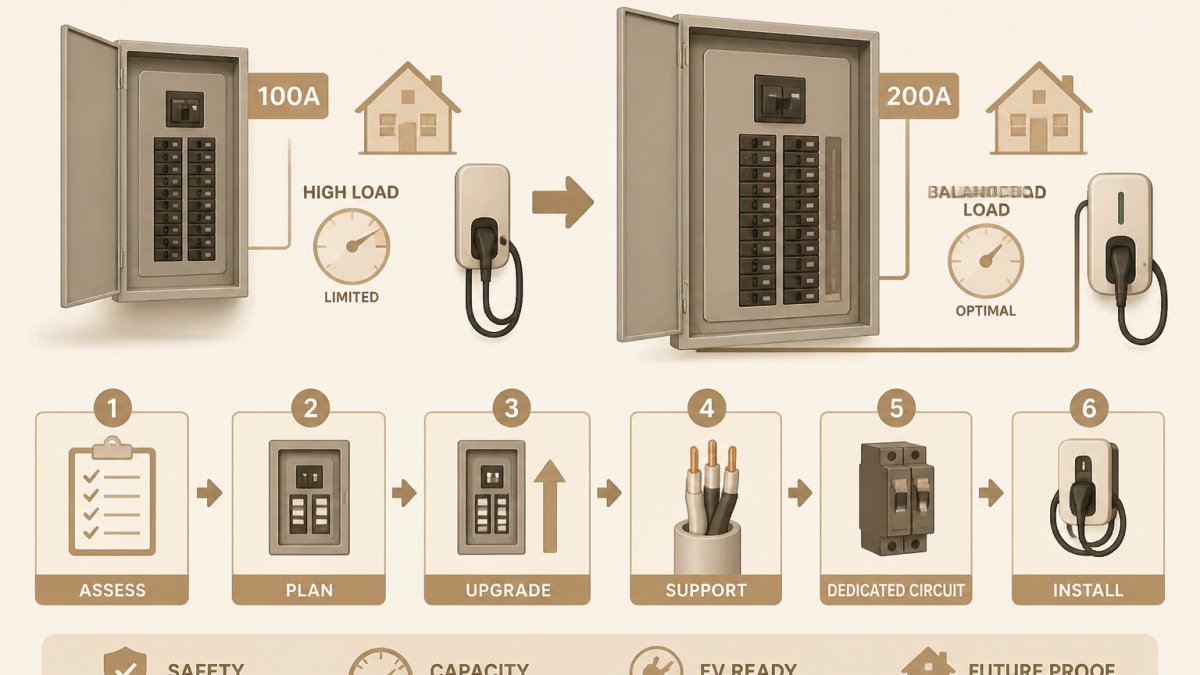
Service versus circuit upgrades. Adding dedicated circuits and a subpanel buys time when the main service still has headroom. A full electrical service capacity increase is the real fix when the calculated load approaches or exceeds the service rating, when the panel has no open slots, or when the utility feed itself is undersized. The two are different scopes, different permits, and different timelines, which is why the load calculation comes first.
Get your free electrical estimate →
Plan for growth, not just today. A common pattern is a business that upgrades once, then outgrows the new service within a few years because expansion was never factored in. Ask the electrician to size the service with documented spare capacity for the next equipment purchase, not just the current one. That single conversation often changes the recommendation from a repair to a planned upgrade.
Never solve repeated breaker trips by installing a larger breaker. The breaker is sized to protect the wire, not the equipment. Upsizing it removes the safety limit and lets the conductor overheat inside the wall.
Before you approve any panel or service upgrade, ask for the load calculation in writing. It is the document that justifies the scope, the permit, and the price.
6. Loose Outlets and Aging Wiring Behind the Walls
Outlets that wobble, plugs that fall out, and dead spots on a wall all point to loose connections. Behind the walls, the problem is often worse.
Older buildings frequently contain outdated wiring, including aluminum wiring, that was never rated for today's loads. Aluminum wiring loosens over time and creates hot spots at every connection.
A commercial electrical inspection can find these issues without tearing the building apart. Electricians use thermal imaging and diagnostic measurements to spot heat and resistance before they fail.
7. When to Schedule a Commercial Electrical Inspection
Schedule a commercial electrical inspection when you see two or more warning signs, when you add major equipment, or every few years as preventive maintenance. Do not wait for a failure. For a business, the cost of an inspection is almost always smaller than the cost of an unplanned outage during operating hours.
What a commercial inspection actually involves. A qualified electrician does not just look at the panel. A typical assessment includes:
- Panel and switchboard condition, breaker types, busbar condition, signs of heat, corrosion, or double-tapped breakers
- Circuit loading and balance, which circuits are near capacity and whether phases are balanced
- Diagnostic measurements, voltage drop under load, ground resistance, and thermal imaging to find hot connections before they fail
- Grounding and bonding, a code-critical system that is often degraded in older buildings
- Wiring type and condition, including aluminum branch circuits, cloth or rubber insulation, and undersized conductors
Code, permits, and inspection requirements. Electrical codes are adopted and enforced at the state and local level, and requirements vary by jurisdiction and by the age and occupancy of the building. A licensed contractor pulls the permit, schedules the inspection, and corrects anything the authority having jurisdiction flags. Skipping the permit may save a few days up front, but it can void insurance coverage and create problems at resale or refinancing.
Scope: repair, panel replacement, or full rewire.
- Targeted repair, a single failed breaker, a loose termination, or one damaged circuit. Lowest cost, shortest downtime.
- Panel replacement, when the panel is obsolete, damaged, or out of slots. Usually a one- to two-day project with a planned outage.
- Service upgrade, when the calculated load exceeds the service rating. Requires utility coordination and a longer lead time.
- Partial or full rewire, when wiring type or condition is the problem. The largest scope, often phased to keep the business open.
Cost and scheduling factors. The final number depends on service size, wire type and accessibility, whether walls or ceilings have to be opened, permit and inspection fees, utility coordination, and after-hours scheduling. Phasing work overnight or on weekends reduces business interruption but raises labor cost, a trade-off worth discussing before the quote is finalized.
Prioritize instead of panicking. Not every symptom means a full rewire. A practical way to triage:
| Sign | Urgency | Recommended Action |
|---|---|---|
| Flickering or dimming lights | Medium | Inspect circuit loading |
| Warm outlets or walls | High | Same-day electrician visit |
| Frequent breaker trips | Medium | Test breakers, review load |
| Burning smell or arcing | Emergency | Cut power, call now |
| No open panel slots | Medium | Plan panel upgrade |
| Loose outlets, aging wiring | High | Schedule full inspection |
Business continuity planning. Treat the electrical assessment like any other continuity risk. Identify which circuits feed point-of-sale systems, servers, refrigeration, security, and life-safety equipment. Ask the electrician to document them so you know what can be shut down, for how long, and in what order. That documentation is what turns a scary upgrade into a scheduled project.
The cheapest time to upgrade commercial wiring is before it fails. A planned panel replacement during a slow week costs far less than an emergency call plus lost business hours.
Two or more warning signs together almost always mean the system, not a single part, is the problem. Get the inspection, get the load calculation, and let the findings, not the symptoms, set the scope.
Frequently Asked Questions
How do I know if I need to upgrade my electrical panel?
Three signals point to a commercial electrical panel upgrade: breakers that trip repeatedly even after load is reduced, a panel that is full with no open slots for new dedicated circuits, and any panel that uses obsolete fuse blocks or recalled breaker brands. Panels installed before 1990 were sized for lighting and office equipment, not today's HVAC loads, kitchen equipment, or EV chargers. A licensed electrician can measure circuit loading and tell you whether the existing service capacity is enough or whether a panel replacement is overdue.
How often should commercial electrical wiring be inspected?
Most commercial properties benefit from a full commercial electrical inspection every three to five years, with annual checks on panels, switchboards, and any equipment that runs continuously. High-load environments like restaurants, retail with refrigeration, and buildings with heavy HVAC use should be inspected more often. After any renovation, tenant improvement, or equipment addition, schedule an inspection before the new load is energized. Regular inspections catch loose connections, warm outlets, and early arcing before they cause downtime or fire risk.
Can old wiring handle modern business equipment?
Often it cannot, at least not safely. Older commercial wiring was sized for lighting, typewriters, and a few motors. Today's buildings run point-of-sale systems, servers, commercial kitchen equipment, and EV chargers, all of which create power demand the original circuits were never designed for. The result is overloaded circuits, frequent breaker trips, and voltage drops that shorten equipment life. If your building predates the equipment you now depend on, have an electrician evaluate electrical load and circuit loading before you add anything else.
What does an electrical wiring upgrade cost depend on?
Electrical wiring upgrade cost depends on the scope of work, not a flat rate. Key factors include the size of the service capacity increase, how much of the existing wiring must be replaced versus re-terminated, whether a new subpanel or switchboard is needed, the number of dedicated circuits required for equipment, and permit and inspection fees. Building age and access behind walls also affect labor. Because every commercial property is different, request a written estimate after an on-site evaluation rather than relying on a general range.