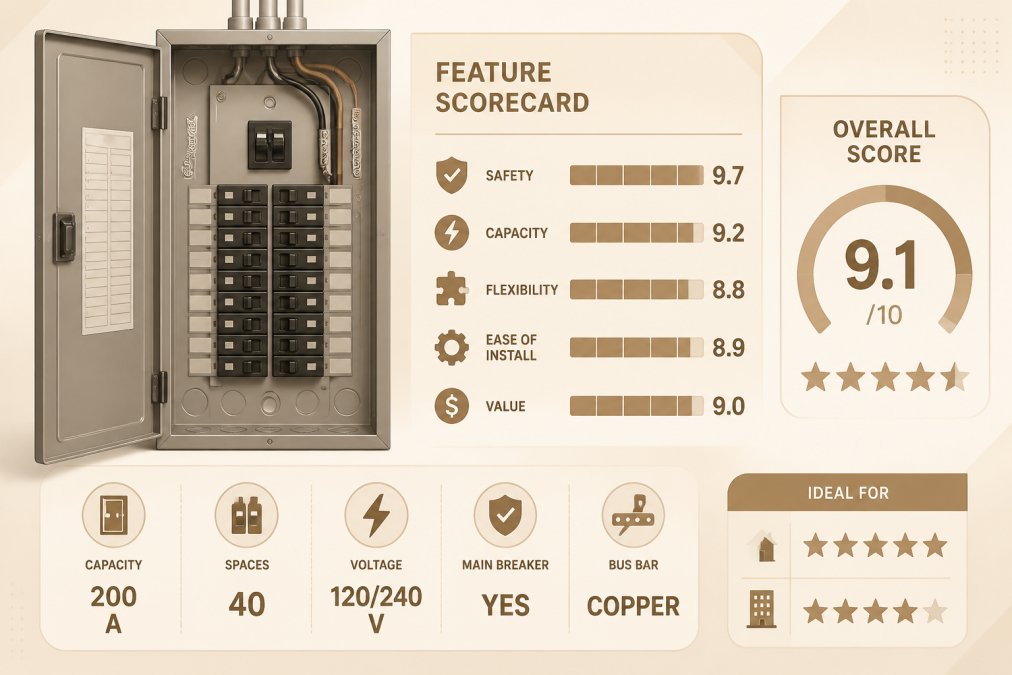
 listicle
Modern Electrical Panel Features Review: 2026 Guide
Table of Contents
- Quick Comparison: Top Modern Electrical Panels Reviewed
- SPAN Smart Panel Review: Best for Solar and Battery Integration
- Leviton Load Center Review: Smart Monitoring with a Clean Look
- Square D QO and Homeline Review: Reliability for Every Budget
- Siemens and Eaton Load Centers Review: Durability and Safety Options
- Smart Electrical Panel Cost: What Drives the Price
- How to Tell If Your Electrical Panel Needs Replacing
- AFCI vs GFCI Breakers Explained
- Frequently Asked Questions
Last Updated: September 20, 2026
Quick Comparison: Top Modern Electrical Panels Reviewed
The best modern electrical panel for most homes is the Square D QO Load Center, balancing build quality, breaker availability, and cost. With solar or battery storage, the SPAN Smart Panel is stronger despite its higher price.
This review from Light Life Electric compares six load centers on smart monitoring, amperage capacity, solar readiness, and surge protection.
| Panel | Smart Monitoring | Solar/Battery Ready | Amperage Range | Best For |
|---|---|---|---|---|
| SPAN Smart Panel | Yes, per-circuit | Yes, built in | 200A typical | Solar, EV, battery homes |
| Leviton Load Center | Yes, via smart breakers | Partial | 100A-225A | Aesthetics and monitoring |
| Square D QO | No | Partial | 100A-400A | Full system upgrades |
| Square D Homeline | No | Partial | 100A-225A | Budget upgrades |
| Siemens PL Series | No | Partial | 100A-225A | Durable general use |
| Eaton BR Series | No | Partial | 100A-225A | Flexible installs, surge |
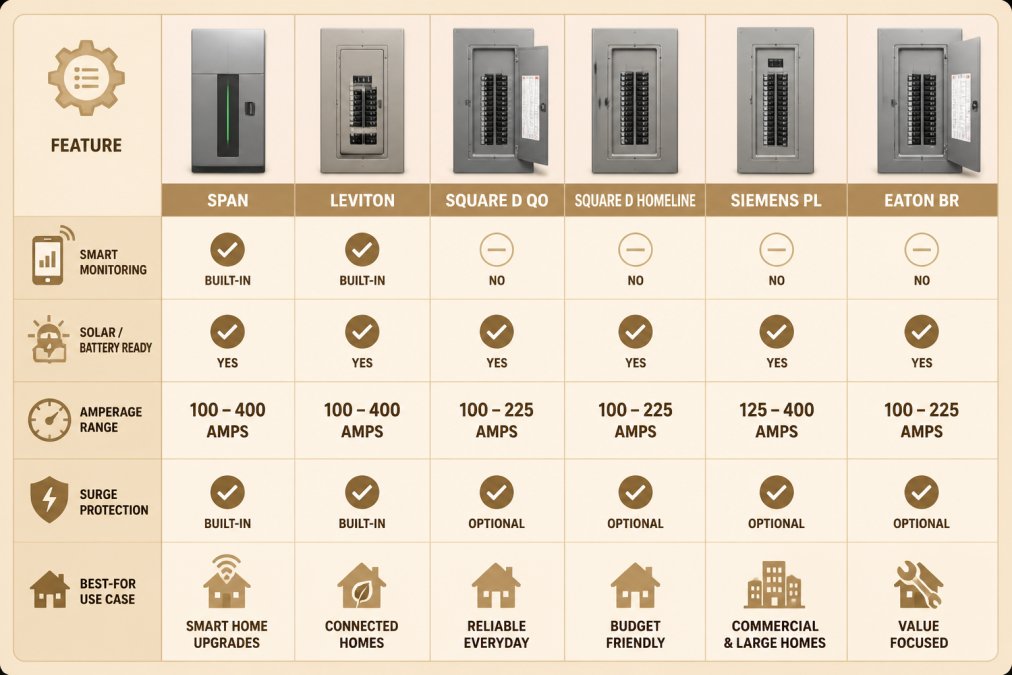
An electrical panel is the metal enclosure that distributes incoming power to every circuit through individual breakers. Modern versions add circuit monitoring, remote control, and surge protection.
SPAN Smart Panel Review: Best for Solar and Battery Integration
The SPAN Smart Panel replaces traditional breakers with digital controls, giving real-time energy data for every circuit. It is the most capable panel here, and the most expensive.
What you get:
- Remote circuit control through a mobile app
- Automated load shedding during outages, so critical circuits stay powered
- Seamless integration with solar and battery storage
- Per-circuit power consumption analytics
SPAN costs significantly more than a conventional load center, and its electronics mean firmware updates matter for the panel's life. If you are building an electrification plan around solar and an EV charger, that premium buys genuine grid independence. If you just need reliable power distribution, you are paying for capability you will never use.

Leviton Load Center Review: Smart Monitoring with a Clean Look
Leviton's load center stands out for one reason most panels ignore: it looks good. The white enclosure and LED indicators on each breaker make it a panel you would not mind leaving exposed.
Smart circuit breakers handle remote monitoring, and the plug-on neutral design speeds installation. The catch is the proprietary breaker system: once you commit to Leviton, third-party options disappear.
Square D QO and Homeline Review: Reliability for Every Budget
Square D sells two lines, and the difference comes down to budget versus build quality.
The QO Load Center is the premium option. Its plug-on neutral design speeds installation, amperage capacity runs from 100A to 400A, and the bus bar construction holds up over decades. Replacement breakers are easy to find at any supply house.
The Homeline line costs less and still carries the Square D name. It uses standardized designs, is stocked at major hardware retailers, and works with a broad range of Homeline breakers. What it lacks is advanced energy management. No circuit monitoring, no remote control.
For a straightforward panel upgrade without smart features, Homeline is the value pick. For a full service upgrade where you want headroom, QO earns its higher price.
Siemens and Eaton Load Centers Review: Durability and Safety Options
Siemens and Eaton compete on the same ground: solid construction and flexible installation rather than smart features.
Get your free electrical estimate →
The Siemens PL Series uses Insta-wire neutrals for faster wiring, copper bus bars, and a powder-coated enclosure that resists corrosion. Contractors like it because it installs cleanly and performs without fuss, though smart connectivity is minimal.
The Eaton BR Series offers something the others do not: in-box surge protection. Eaton also sells many enclosure types for indoor and outdoor mounting, plus quick-connect neutral bars. Standard models ship without smart features.
Smart Electrical Panel Cost: What Drives the Price
Smart electrical panel cost depends on three things: the panel itself, the labor to install it, and whether your service needs upgrading. A like-for-like swap and a full 200-amp service upgrade are different projects. What separates a smart panel from a conventional load center is not the enclosure, it is the electronics, breakers, and app ecosystem layered on top.
Where the money actually goes
- The enclosure and bus. A standard 200A load center is a commodity item. A smart panel enclosure with integrated current transformers, a controller board, and a communications module carries a substantial premium.
- The breakers. This is the hidden cost. Smart panels typically require proprietary breakers, and per-circuit monitoring means buying a smart breaker for every circuit you want to track. A 30-space panel fully populated with smart breakers can cost several times the same panel with standard breakers.
- Labor. A like-for-like swap is a one-day job for a licensed electrician. A service upgrade to 200A or 400A adds utility coordination, a new meter base, new service conductors, and often a mast or riser replacement, all multiplying labor hours.
- Permits and inspection. Every panel replacement needs a permit and a passing inspection. Permit fees vary by jurisdiction and are usually based on project valuation, so a smart panel with a higher declared value can carry a higher fee.
- Legacy wiring remediation. This is the line item most estimates miss. Aluminum branch wiring, ungrounded two-wire circuits, and undersized conductors often need addressing before a new panel can be installed to code. In older homes, remediation can rival the panel cost itself.
What keeps cost down: reusing existing service capacity, choosing a standard load center instead of a smart one, populating only the circuits you want to monitor, and scheduling the work before an emergency forces it. Emergency replacements always cost more because you lose the ability to shop the job.
The ROI question. A smart panel does not pay for itself through energy savings alone in most homes, the per-circuit data is a tool, not a rebate. The math changes when the panel is part of a larger electrification plan: solar, battery storage, an EV charger, and a heat pump all benefit from the load management a smart panel provides. If you are adding those systems anyway, the incremental cost is easier to justify.
How to Tell If Your Electrical Panel Needs Replacing
The clearest signs your panel needs replacing are breakers that trip repeatedly, a panel warm to the touch, rust or scorch marks inside the enclosure, and a service size that no longer matches your home's demand. Any of these warrants a professional inspection.
Use this checklist:
- Breakers trip often, especially when appliances run together
- The panel feels warm or smells like burning
- You see rust, corrosion, or scorch marks
- The panel is a recalled or discontinued brand
- You have 100A service and want to add an EV charger, heat pump, or solar
- Fuses instead of breakers
- Fewer than two open breaker spaces
- Buzzing or crackling sounds from the panel
AFCI vs GFCI Breakers Explained
The difference between AFCI and GFCI breakers comes down to what they protect against. An arc fault circuit interrupter (AFCI) detects dangerous electrical arcs that can start fires inside walls. A ground fault circuit interrupter (GFCI) detects current leaking to ground, which is the shock hazard near water.
| Breaker | Protects Against | Typical Locations |
|---|---|---|
| AFCI | Electrical arcs, fire risk | Bedrooms, living areas, hallways |
| GFCI | Ground faults, shock risk | Kitchens, baths, garages, outdoors |
| Dual-function | Both | Anywhere both risks exist |
Frequently Asked Questions
Which brand of electrical panel is considered the best?
There is no single best brand. Square D QO is widely trusted for durability and parts availability. SPAN leads in smart energy management. Leviton offers the best combination of aesthetics and integrated monitoring. Siemens PL and Eaton BR are known for reliable construction and flexible installation options. The right choice depends on whether you need basic reliability, smart features, or solar readiness.
What is the 80% rule for electrical panels?
The 80% rule means a circuit breaker should not carry more than 80% of its rated amperage continuously. A 200-amp panel should handle a continuous load of no more than 160 amps. This rule, found in the National Electrical Code, prevents overheating and extends equipment life. If your calculated load approaches that threshold, an upgrade is worth discussing with a licensed electrician.
What are the benefits of installing a smart electrical panel?
Smart electrical panels provide real-time energy usage data per circuit, remote circuit control through a mobile app, and automated load shedding during outages. They integrate with solar and battery storage systems, help reduce utility bills through peak demand management, and give you circuit-level visibility that traditional panels cannot match. They also support home electrification as you add EV chargers or heat pumps.
How much does a smart electrical panel cost?
Smart electrical panel cost depends on the panel brand, amperage capacity, installation complexity, and whether your home needs wiring upgrades. Smart panels carry a significant premium over traditional load centers because of the built-in monitoring hardware and software. For an accurate quote based on your home's specific setup, contact a licensed electrical contractor for a free estimate.