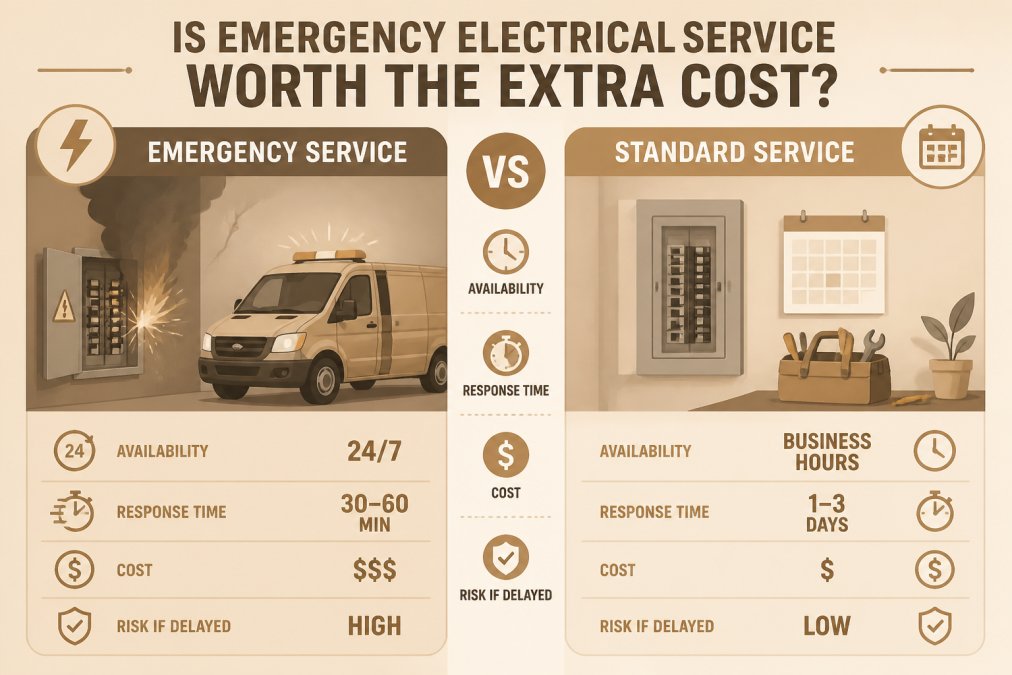
 comparison
Is Emergency Electrical Service Worth the Extra Cost?
Table of Contents
- Emergency Electrical Service vs. Standard Rates: What You're Paying For
- Signs of Electrical Emergency: What Justifies the After-Hours Call?
- The Cost of Waiting: When Delaying an Emergency Electrical Service Call Backfires
- How to Troubleshoot Electrical Issues Safely Before You Call
- Why 24/7 Availability Matters for Electrical Hazards
- Does Homeowners Insurance Cover Emergency Electrical Repairs?
- Conclusion: Making the Call on Emergency Electrical Service
- Frequently Asked Questions
Last Updated: September 9, 2026
The question of whether emergency electrical service is worth the extra cost usually surfaces at the worst possible moment: when your circuit breaker won't reset, an outlet sparks, or the power dies at midnight. The real calculation isn't the hourly rate, it's comparing an immediate response against the damage, fire risk, and safety hazards that can develop while you wait for standard business hours.
This guide breaks down what you're actually paying for with an emergency electrical service, when the premium is justified, and how to make a smart decision before you dial.
Emergency Electrical Service vs. Standard Rates: What You're Paying For
An emergency electrical service call is fundamentally a labor cost problem. Normal-hours service keeps overhead low by scheduling you into a route with other jobs. An after-hours response pulls a licensed professional away from their evening, dispatches a dedicated truck, and often requires coordinating with a supplier if parts are needed immediately.
The premium covers the electrician's overtime rate, the operational cost of a 24/7 on-call rotation, and the opportunity cost of that technician not being available for scheduled work the next day. Most contractors charge a flat emergency surcharge on top of their standard hourly rate.
Trip Fees, Diagnostic Fees, and After-Hours Surcharges Explained
Before you authorize any work, ask the dispatcher to itemize the charges. You will typically see three line items on an emergency invoice:
- Trip fee: A flat charge to cover the electrician's travel time and vehicle costs to reach your property. This applies whether the fix takes five minutes or five hours.
- Diagnostic fee: The charge for the licensed professional to assess the problem, test circuits, and identify the root cause. This is often waived if you approve the repair.
- After-hours surcharge: A premium added to the standard hourly rate for calls outside normal business hours, typically applied to evenings, weekends, and holidays.
Some contractors bundle these into a single "emergency dispatch" charge. Always ask for a breakdown before work begins so there are no surprises on the final invoice.
What the Numbers Actually Look Like (and Why Quotes Vary)
Pricing for electrical services varies widely based on the scope of work, time of day, and specific contractor. Emergency rates typically include a premium for after-hours response. For specific pricing, it's best to contact a licensed professional for a detailed estimate.
The hourly rate is only half the story. Some contractors use a flat-rate menu: a fixed price for a "breaker replacement" or "outlet repair" regardless of how long it takes. Others bill time-and-materials, meaning the final invoice depends on diagnostic time and parts runs. Flat-rate pricing protects you from clock-watching, but it often builds in a buffer that makes the job more expensive.
The "Emergency vs. Urgent" Decision Matrix
Before you pay the premium, ask yourself one question: Is this a fire hazard or a disruption? That single distinction separates a true emergency from an urgent-but-deferrable issue.
| Situation | Classification | Recommended Action |
|---|---|---|
| Active sparking, burning smell, smoke from outlets | Emergency | Shut off power at the main breaker if safe, evacuate if smoke is heavy, call 911 if fire is visible, then call an emergency electrician. |
| Breaker trips repeatedly but no heat or smell | Urgent | Stop using that circuit, unplug devices on it, call during business hours. The risk is low if the breaker is doing its job. |
| Outlet dead, no other symptoms | Urgent | Test the GFCI, check the breaker, schedule a standard visit. |
| Partial power loss, lights dimming, buzzing panel | Emergency | Call immediately. These symptoms indicate loose connections or overloaded circuits that can arc and ignite framing. |
| Complete outage, neighbors also dark | Not your problem | Call the utility company, not an electrician. |
If you land in the "urgent" column, you can safely wait until morning, but not indefinitely. A breaker that trips weekly should be diagnosed within days, not months. Running through this matrix before you dial will save you from paying a $300 premium for a problem that could have waited.
The real cost trap is paying the after-hours rate for a problem that was never an emergency. Run the matrix, check the simple fixes below, and reserve the premium call for genuine hazards.
Signs of Electrical Emergency: What Justifies the After-Hours Call?
Not every electrical issue is an emergency, but some genuinely are. Calling for emergency electrical service when you only have a minor inconvenience wastes money, while waiting on a true hazard puts your property and family at risk.
A genuine electrical emergency involves an immediate threat to life or property, active sparking, burning smells, smoke from outlets or the panel, or a complete power outage affecting medical equipment. These warrant an immediate response regardless of the surcharge.
Burning Smells, Sparking Outlets, and Other Red Flags
The most reliable indicators that you need immediate help are:
- Burning smell coming from an outlet, switch, or your electrical panel. This often indicates melted wiring or an overheating component.
- Visible sparks when you plug in a device or flip a switch.
- Scorch marks or discoloration around outlets or your breaker box.
- A circuit breaker that won't reset or trips immediately after resetting, which can signal a short circuit.
- Buzzing sounds from outlets or the panel.
- Warm or hot outlets when touched, which suggests an overloaded circuit.
If you notice any of these, shut off power to the affected area at the breaker if you can do so safely, and call a licensed professional right away. These are electrical hazards that can escalate to a fire risk quickly.
The Cost of Waiting: When Delaying an Emergency Electrical Service Call Backfires
The emergency surcharge often looks expensive compared to a standard service call, but it is almost always cheaper than the alternative. A minor issue addressed immediately rarely becomes a major one. Left to simmer for a day or two, the same problem can damage your electrical panel, ruin appliances, or compromise wiring behind your walls.
Consider a circuit breaker that trips constantly. A prompt emergency visit might identify a failing breaker needing replacement, a relatively contained repair. If you wait, the repeated stress can damage appliances or overheat wiring in the wall, turning a single breaker replacement into a far more expensive rewiring project.
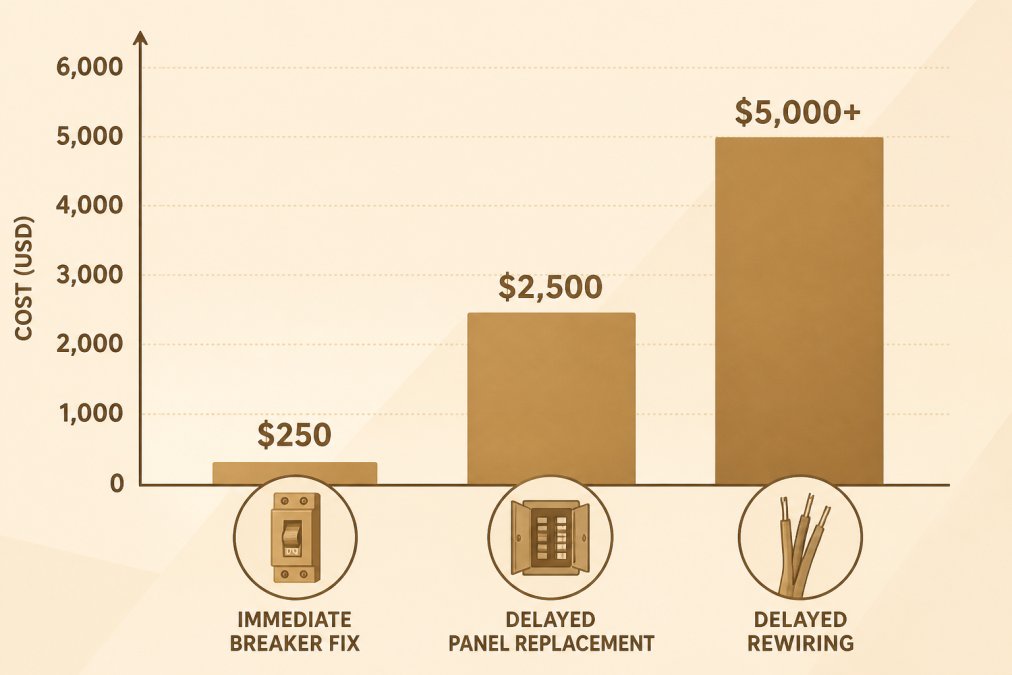
The same logic applies to a short circuit. Caught early, it might only require replacing a damaged outlet and a section of wire. Left unchecked, it can cause arcing, a leading cause of electrical fires in residential properties.
How to Troubleshoot Electrical Issues Safely Before You Call
Before you pick up the phone, take a few safe steps to determine whether you need emergency dispatch or can wait for a standard appointment. These steps help you gather information, not fix the problem yourself.
Start with the simplest check. If a single outlet or light fixture has stopped working, check whether a GFCI outlet in the same room or circuit has tripped. GFCI outlets have test and reset buttons, and they are common in kitchens, bathrooms, and garages. Press the reset button and see if power is restored.
If an entire section of your home is dark, check your main breaker panel. A tripped breaker will sit in a position between "on" and "off." Reset it by pushing it firmly to "off" and then back to "on." If it trips again immediately, or within a few minutes, you have a genuine problem that needs professional diagnosis.
For a complete power outage affecting your whole neighborhood, check with neighbors or look outside for downed lines. If the outage is widespread, it is likely an issue with the utility grid, not your home's wiring. In that case, you do not need an electrician at all, though you should still report the outage to your utility provider.
Why 24/7 Availability Matters for Electrical Hazards
The value of 24/7 availability is containment. Electrical hazards do not pause during business hours, and a minor fault can become a serious threat to your home within hours.
An arcing panel generates heat that can ignite nearby wood framing, and a short circuit in a wall can smolder for hours before flames become visible. In both scenarios, the difference between a contained repair and a house fire is measured in minutes. That is the real justification for after-hours premium pricing.
Emergency electrical service also includes rapid power restoration. If a storm knocks out power or a breaker failure leaves you without lights or refrigeration, an immediate response prevents food loss and damage to sensitive electronics.
Does Homeowners Insurance Cover Emergency Electrical Repairs?
Insurance coverage for emergency electrical repairs is not automatic, but it is more common than many homeowners assume. The key distinction is between the cause of the damage and the repair itself.
Standard policies typically cover sudden and accidental damage from an electrical event, such as a fire, a power surge, or a short circuit (iii.org). If a covered peril causes the damage, your policy may pay for repairs and the service call. However, most policies do not cover fixing the underlying fault, such as replacing an old panel or worn wiring, because that is considered maintenance.
The Insurance Information Institute's guide on homeowners coverage explains that standard policies generally exclude damage from wear and tear or neglect. If your wiring failed because it was outdated or poorly maintained, the claim may be denied. Before you authorize expensive emergency work, contact your insurer to confirm whether the specific situation is covered, and ask whether the diagnostic fee can be included in a claim if the repair is approved.
The HO-3 Policy: What It Covers and What It Silently Excludes
Most U.S. homeowners carry an HO-3 policy, the industry standard (iii.org). It covers your dwelling and property against "named perils", including fire, lightning, and sudden electrical surge damage. The critical phrase is "sudden and accidental." A panel failure from an incorrectly installed breaker that arced is sudden and accidental. A failure because the panel is 40 years old and corroded is wear and tear, and the claim will be denied.
The claim usually covers the damage caused by the electrical fault, not the fault itself. If a short circuit fries your refrigerator compressor, the policy may pay for a new refrigerator, but not to rewire the outlet that caused the short. That is why a single emergency can produce two bills: one to the insurer for the damaged appliance, and one to you for the wiring repair.
How to File a Claim That Actually Gets Paid
If you believe your situation qualifies as sudden and accidental, follow this sequence before calling the electrician:
- Document everything. Take photos of the damaged outlet, the tripped breaker, scorch marks, or the failed appliance. Note the exact time the problem started and what was running on that circuit.
- Call your insurer before authorizing major work. Most carriers have a 24/7 claims line. Describe the situation and ask whether the claim number should be provided to the electrician. Some insurers require pre-approval for repairs above a certain threshold.
- Ask the electrician for a code-compliant invoice. The invoice should separate the diagnostic fee, the repair labor, and the materials. Insurers often deny claims when the invoice is a single lump sum with no breakdown.
- Keep the failed parts. If the electrician replaces a breaker or outlet that caused the damage, ask them to leave the old part with you. An adjuster may want to inspect it.
- Get a written statement about the cause. Ask the electrician to note on the invoice whether the failure was "sudden and accidental" or "due to wear and tear." That single line often determines whether the claim is approved.
The Deductible Math
Most policies carry a deductible of $1,000 to $2,500. If your emergency repair costs $900, filing a claim is pointless, it is below your deductible, and the claim may raise your premium at renewal. A $3,000 panel replacement with a $1,000 deductible is worth a claim. A $400 outlet repair is not.
The Real Coverage Gap: Service Line and Surge Protection
Standard HO-3 policies also exclude damage to the service line from the utility pole to your home, and most surge damage to electronics unless you have a specific endorsement. If a tree falls on your service drop, the utility may repair their side, but the mast and meter on your house are your responsibility, often running $1,500 to $4,000. Surge protectors are inexpensive compared to replacing a home theater system after a lightning strike.
Before an emergency, review your policy declarations page and ask your agent: "Is my service line covered?" and "Do I have surge endorsement coverage?" For the emergency call itself, the rule is simple: if the repair is under your deductible, pay the electrician directly and skip the claim. If it's over your deductible and the cause is sudden, document everything and file promptly.
Conclusion: Making the Call on Emergency Electrical Service
The decision to pay for emergency electrical service comes down to cost-benefit analysis. If you face a true hazard, a burning smell, sparking outlets, or a breaker that will not reset, the surcharge is a small price for protecting your home and family. If the issue can wait, schedule a standard appointment and save the premium.
A licensed professional can also perform a safety inspection while on site, catching underlying issues before they become emergencies. For homeowners in Southwest Florida, Light Life Electric offers 24/7 emergency response backed by Florida certified electricians who are fully licensed, bonded, and insured. We handle everything from permits to final inspection, ensuring code-compliant repairs that pass inspection the first time.
Get your free electrical estimate and know exactly what you are paying for before any work begins.
Frequently Asked Questions
How much more expensive is emergency electrical service compared to standard rates?
Emergency electrical service typically includes a premium on top of standard hourly rates, along with trip and diagnostic fees. The exact premium depends on the contractor and the time of day. Contact a licensed professional for a specific quote before authorizing work.
What constitutes a true electrical emergency in a home?
A true electrical emergency involves a situation that poses an immediate fire risk or electrical hazard. This includes a burning smell coming from outlets or your electrical panel, visible sparks, a circuit breaker that repeatedly trips and won't reset, or a complete power outage that affects your safety systems. If you notice these signs of electrical emergency, you should evacuate if necessary and call a 24/7 service immediately.
Does homeowners insurance cover emergency electrical repairs?
Homeowners insurance often covers sudden and accidental electrical damage, such as a short circuit that damages wiring or a power surge that destroys appliances. However, it typically does not cover the cost of repairing the underlying problem if it is due to poor maintenance or a pre-existing code violation. It's best to check with your provider to understand your specific policy, but emergency dispatch fees are often covered when the repair itself is a covered peril.
Can waiting for a standard appointment lead to more expensive electrical damage?
Yes, waiting can turn a minor issue into a major one. A frequently tripping circuit breaker might indicate a failing appliance, but it could also signal overloaded wiring that, if left unchecked, can melt insulation and cause a fire. Delaying a repair to save on after-hours rates can result in a much larger bill for a full panel replacement or structural damage. The cost of emergency service is often a fraction of the cost of the damage it prevents.
Are there ways to minimize the cost of an emergency electrical call-out?
Yes. First, safely troubleshoot the issue to determine if it's something you can handle, like a resetting a tripped GFCI outlet or replacing a blown fuse. If you must call, describe the exact symptoms clearly so the dispatcher can send the right tools and parts. Ask about the trip fee and diagnostic fee upfront to avoid hidden fees. Finally, consider having a preventative maintenance checkup to catch wiring issues before they become after-hours emergencies.
The extra cost of emergency electrical service is not a penalty. It is the price of immediate response, specialized expertise, and the prevention of secondary damage. When you weigh a surcharge against potential fire damage or a full panel replacement, the math usually favors making the call.