 ultimate-guide
Is a Commercial Electrical Maintenance Plan Worth It?
Quick Summary
A commercial electrical maintenance plan is worth it when the cost of preventable failures, downtime and emergency repairs exceeds the annual plan cost. Preventive inspections catch overheating and wear early, when repairs are smaller and can be scheduled around business hours.
- Preventive programs schedule repairs around business hours and avoid emergency call-out and overtime premiums.
- A dated maintenance log supports compliance conversations with insurers, inspectors and auditors.
- Calculate ROI using your own 24 to 36 months of unplanned electrical spend and downtime costs.
- Request a written plan scope that separates inspection labor, testing, minor repairs and documentation.
- Set an annual baseline inspection for the full system, with shorter intervals for critical equipment.
Table of Contents
- What a Commercial Electrical Maintenance Plan Covers
- Preventive vs. Reactive Maintenance: The Real Cost Difference
- NFPA 70B Compliance Requirements for Business Facilities
- Commercial Electrical Inspection Checklist for Facility Managers
- Is Commercial Surge Protection Worth the Cost?
- Calculating the ROI of Your Electrical Maintenance Plan
- Scheduling Your First Electrical Assessment With Light Life Electric
- Frequently Asked Questions
Is a Commercial Electrical Maintenance Plan Worth It?
A routine preventive maintenance program can prevent a large share of electrical system failures. For facility managers, that principle reframes the question. A commercial electrical maintenance plan for businesses is less a line item to justify than a way to stop expensive failures before they start. The decision usually comes down to a few clear factors.
What a Commercial Electrical Maintenance Plan Covers
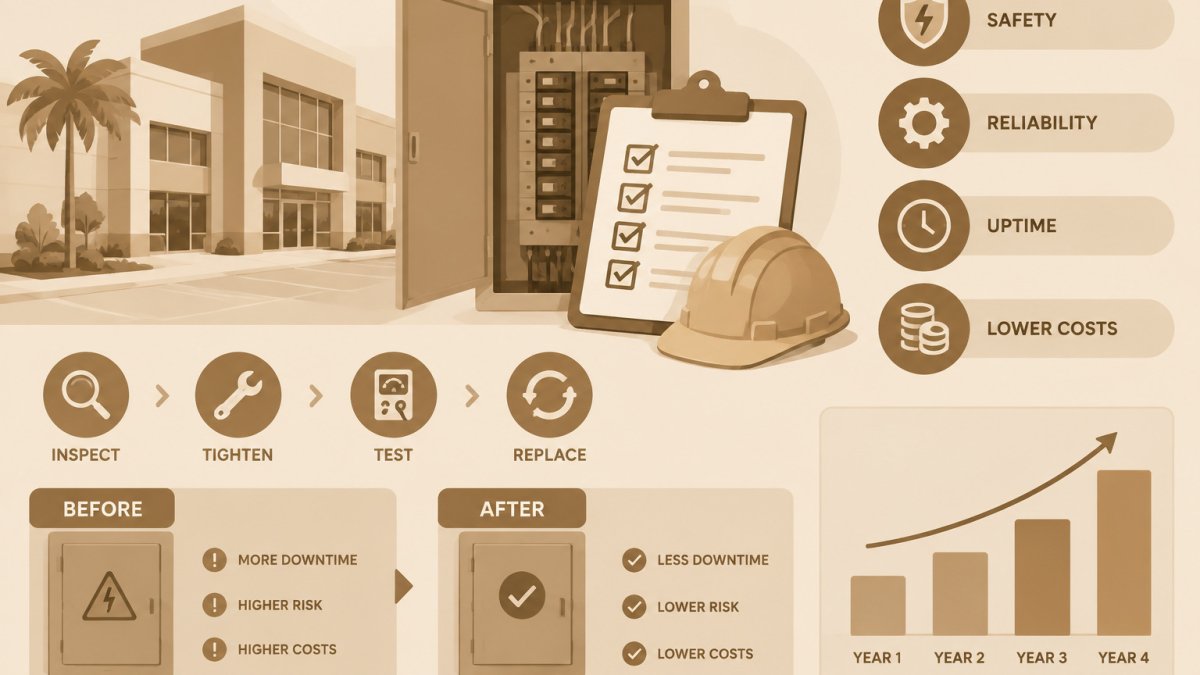
A commercial electrical maintenance plan is a scheduled program of inspections, testing, minor repairs and documentation for the electrical systems in a building. Its purpose is to catch wear, overheating and degradation while they are still inexpensive to fix.
Most plans address the same core components:
- Main service equipment and electrical panels
- Circuit breakers, disconnects and grounding systems
- Transformers and power distribution equipment
- Lighting controls and emergency lighting
- Generator and transfer switch readiness
The value of a plan lies in the record it creates. A maintenance log showing dated inspections, test results and corrective actions gives a facility manager a clear history to act on, and it supports compliance conversations with insurers, inspectors and auditors.
Preventive vs. Reactive Maintenance: The Real Cost Difference
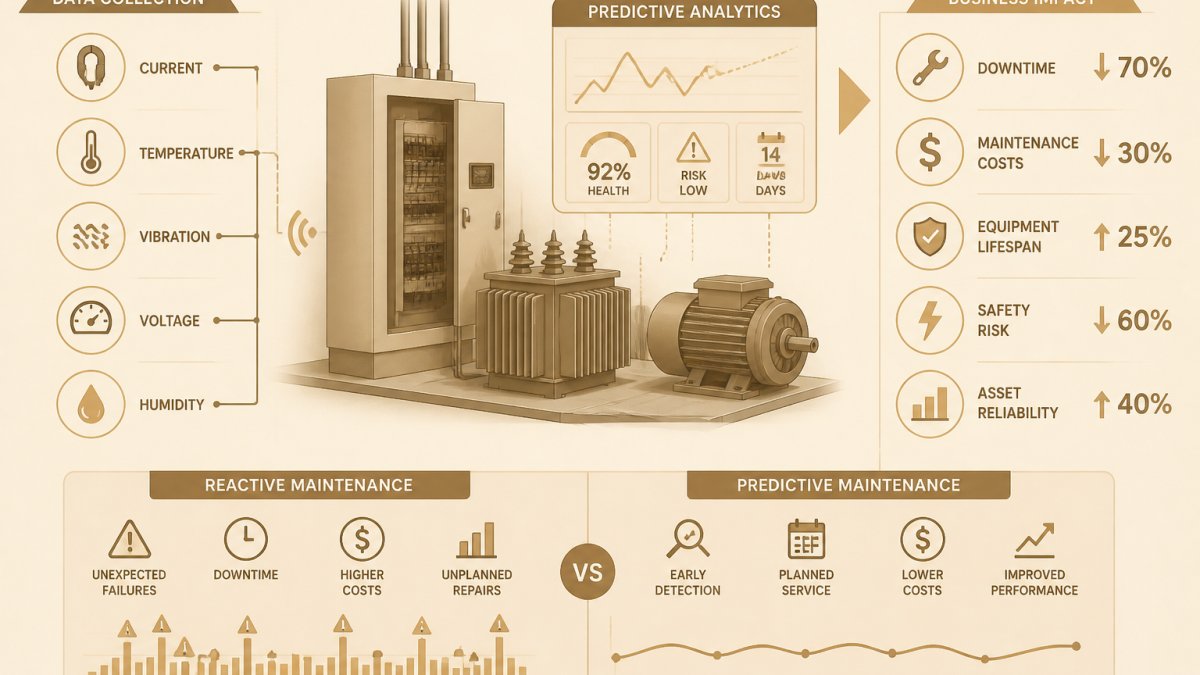
Reactive maintenance means waiting for something to fail and then responding.
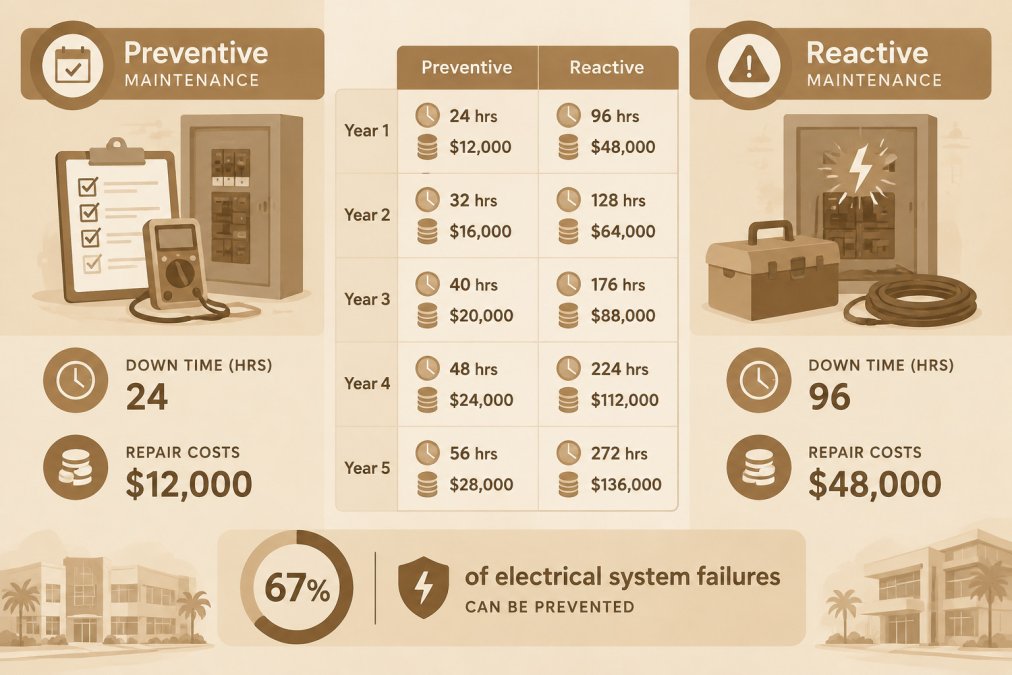
Preventive maintenance spreads cost across the year. Planned visits are scheduled around business hours, parts can be sourced without rush premiums, and repairs are smaller in scope.
Reactive repairs also carry a hidden cost. Each unplanned outage stresses equipment further, and emergency work is often done under time pressure, which leaves less room for proper diagnosis.
NFPA 70B Compliance Requirements for Business Facilities
NFPA 70B is the recommended practice from the National Fire Protection Association for electrical equipment maintenance (NFPA 70B, Standard for Electrical Equipment Maintenance). Facility owners should review the current edition of NFPA 70B with a qualified contractor so their maintenance planning reflects the requirements that apply to their occupancy and equipment.
Compliance usually depends on three things: a documented maintenance plan, assessments of equipment condition, and records of completed work. Your insurer, local authority having jurisdiction, or lender may ask for these. Review the current edition with a qualified contractor so your program reflects the requirements that apply to your specific occupancy and equipment.
How Often Inspections and Testing Should Happen
Inspection frequency depends on the equipment, its operating environment and its criticality. High-load switchgear and equipment in harsh or humid conditions typically warrants more frequent attention than low-demand circuits in a climate-controlled space. A reasonable approach is to set an annual baseline for the full system and shorter intervals for critical or high-stress components, then adjust based on what the findings show.
Commercial Electrical Inspection Checklist for Facility Managers
Most checklists on this topic are a single flat list. A useful one separates tasks by cadence, states what a passing result looks like, and tells you what to do with the findings. Use the tiers below to review your current program or to prepare for a contractor assessment.
Daily and Weekly Tasks (Facility Staff)
- Walk the main electrical room and confirm panels and disconnects are labeled, closed, and clear of stored materials
- Check for obvious signs of overheating, discoloration, odor, buzzing, or warm panel covers
- Confirm emergency lighting indicators show ready status
- Log any breaker trips, nuisance faults, or flickering circuits with date and location
Pass criteria: no obstructions within the working clearance around panels, no visible heat damage, all emergency indicators lit. If it fails: restrict access, tag the equipment, and schedule a contractor visit before returning it to normal service.
Monthly Tasks
- Review the breaker trip log for repeat faults on the same circuit
- Inspect generator and transfer switch readiness indicators and log fuel or battery status
- Verify that panel schedules still match the circuits actually in use after any tenant build-out or equipment change
- Confirm infrared scans or other testing scheduled for the quarter are on the calendar
Pass criteria: no repeated trips on the same circuit, generator ready, panel schedules current. If it fails: a repeated trip on the same breaker is a diagnostic signal, not a reset-and-forget event, schedule testing.
Quarterly Tasks
- Thermal imaging scan of main service equipment, panels, and high-load terminations
- Torque check on accessible terminations per the manufacturer's specifications
- Test emergency lighting and exit signage for the required duration
- Review the maintenance log for open corrective actions and close them out
Pass criteria: no hot spots above the baseline established at commissioning, terminations at specified torque, emergency lighting meets duration. If it fails: document the anomaly, schedule repair, and re-scan after repair to confirm the fix.
Annual Tasks
- Full system inspection by a qualified contractor, including switchgear, transformers, and grounding and bonding
- Load testing and relay testing on critical equipment
- Review the single-line diagram and update it for any changes made during the year
- Reconcile the maintenance log against the plan scope and adjust frequency based on findings
Pass criteria: documented inspection report with test results, updated drawings, and a written list of corrective actions with dates. If it fails: the annual review is where you catch a program that has drifted, missing records, skipped tests, or equipment added without coverage.
Documentation Mechanics
A checklist is only as good as the record it produces. Each entry should capture the date, the equipment identifier, the task performed, the result, the corrective action, and the technician's name.
Watch out: a checklist that is filled out from memory at the end of the month is worse than no checklist, because it creates a record that will not hold up if it is ever examined after an incident. Require the technician to record the reading or observation, not just a checkmark.
How to Use This Checklist
If you are evaluating a contractor, ask whether their plan produces this level of record and whether their scope covers each tier. If you are building an internal program, start with the daily and monthly tiers, then bring in a qualified contractor for the quarterly and annual testing that requires specialized equipment and training. The checklist is not a substitute for the contractor's inspection, it is the record that makes the contractor's work verifiable.
Get your free electrical estimate →
Is Commercial Surge Protection Worth the Cost?
Surge protection is often the first question facility managers ask when they review a maintenance budget. Surges from lightning and utility switching can damage sensitive electronics, controls and network equipment, and the damage is not always immediately visible. Whether the investment pays off depends on how much connected equipment you run, how exposed your site is and what downtime would cost you.
Calculating the ROI of Your Electrical Maintenance Plan
Most articles on this topic list benefits qualitatively, fewer outages, longer equipment life, safer facilities, and stop there. That is not enough to defend a budget line. What follows is a calculation framework you can run with your own numbers, plus the inputs most facility managers overlook.
The Core Formula
The simplest defensible model is:
Annual Net Benefit = (Avoided Failure Cost + Avoided Energy and Equipment Cost) − Annual Plan Cost
ROI (%) = (Annual Net Benefit ÷ Annual Plan Cost) × 100
Payback (months) = (Annual Plan Cost ÷ Annual Net Benefit) × 12
Run it for a single year first. If the payback period is shorter than your budget cycle, the plan is easy to justify. If it is longer, the framework still tells you which equipment to prioritize.
Building the Inputs
Step 1, Count your failure history. Pull the last 24 to 36 months of electrical repair invoices, emergency call-out charges, overtime labor, and equipment replacements.
Step 2, Estimate the preventable share. Not every failure is preventable.
Step 3, Add downtime cost. For each unplanned event, estimate the hours of lost operations and multiply by your facility's hourly operating value.
Step 4, Add avoided energy and equipment cost. Degraded connections and failing equipment draw more power and fail sooner.
A Worked Example Structure
You do not need invented dollar figures to see how the math works. Plug in your own:
| Line item | Your input |
|---|---|
| Unplanned electrical spend, trailing 36 months | $______ |
| Preventable share (from your own event review) | ____% |
| Average downtime hours per unplanned event | ______ |
| Facility operating value per hour | $______ |
| Avoided energy and equipment cost (from assessment) | $______ |
| Annual plan cost (written scope) | $______ |
If the avoided-cost total exceeds the plan cost, the plan pays for itself. If it does not, the framework still tells you which equipment to cover first, often the highest-load switchgear and the equipment in the harshest operating environment.
Watch out: counting every historical failure as preventable inflates the ROI and undermines the case when the numbers are challenged. Use your own event review, not a rule of thumb, and document the assumptions so a CFO or insurer can follow the logic.
What the Framework Does Not Capture
Two benefits resist easy quantification: insurance and liability. A documented maintenance plan gives you a dated record of inspections, test results, and corrective actions, which is exactly what an adjuster or claims reviewer asks for after an electrical fire or equipment failure. Whether that record lowers your premium depends on your carrier and policy, so ask your broker directly rather than assuming. The framework above is the financial case; the documentation record is the risk case. Present both.
Scheduling Your First Electrical Assessment With Light Life Electric
The most useful first step is an assessment that establishes your current baseline: what equipment you have, what condition it is in and where the gaps are. Light Life Electric's commercial team can review your electrical systems, explain what a maintenance program would include for your building, and outline a scope you can compare against your budget. You can review our commercial electrical services to see what is covered, then contact Light Life Electric to request a free estimate and schedule the assessment.
Frequently Asked Questions
What is included in a commercial electrical maintenance plan?
A commercial electrical maintenance plan is a scheduled program of inspections, testing, preventive repairs and documentation for a building's electrical system. Typical components include panel and breaker inspection, thermal imaging of connections, load testing, grounding checks, and a maintenance log that records findings and corrective work. Many businesses set these up as managed service agreements with a qualified contractor, which keeps schedules, compliance records and asset tracking in one place. The exact scope depends on facility size and equipment; contact Light Life Electric for a plan that matches your property.
How often should commercial electrical systems be inspected?
Inspection frequency depends on the equipment, its age, its load and the standard that applies to the facility. NFPA 70B, the national standard for electrical equipment maintenance, sets the framework for how facilities should plan and document maintenance intervals. High-load equipment, switchgear and critical systems generally warrant more frequent checks than general lighting and receptacle circuits. A qualified electrical contractor can set intervals based on a baseline assessment of your facility.
Why is NFPA 70B compliance important for businesses?
NFPA 70B is a national standard that provides guidance on how facilities should address electrical maintenance needs. Documented compliance helps businesses demonstrate due diligence to insurers, inspectors and tenants, and it reduces the risk of failures that cause downtime, equipment damage or fire. Keeping accurate maintenance records is a core part of meeting the standard.
Is commercial surge protection worth the cost?
For many commercial facilities, surge protection is worth the cost because a single surge can damage servers, point-of-sale systems, HVAC controls and other sensitive equipment, and the replacement and downtime expenses can exceed the price of protective devices. Whole-building surge protective devices at the main panel and point-of-use protection for critical equipment are the two most common approaches. The right combination depends on your equipment value and exposure to utility disturbances. Pricing depends on panel configuration and equipment, so request a quote for current figures from Light Life Electric.