 ultimate-guide
Is a 200 Amp Panel Upgrade Worth the Cost?
Last Updated: November 4, 2026
Quick Summary
A 200 amp panel is worth it for homes adding central air, electric water heaters, EV chargers, heat pumps, or induction ranges, because it provides room for 40 or more circuits and the extra capacity these loads need. Homeowners should first count open circuits and review actual loads before assuming an upgrade is mandatory.
- A 200-amp panel typically provides space for 40 or more circuits.
- Upgrading to 200A service is a cost-effective way to enable residential electrification in cold climates.
- A 200-amp service accommodates solar arrays ranging from roughly 7kW to 15kW or more.
- Frequent breaker trips and warm panels are warning signs that the panel needs replacing.
- A load calculation shows whether a home truly needs 200 amps before committing to the upgrade.
Table of Contents
- Benefits of Upgrading to a 200 Amp Panel
- How to Tell If Your Electrical Panel Needs Replacing
- Load Calculation: How Electricians Size Your Service
- Cost to Upgrade an Electrical Panel to 200 Amps
- Electrical Panel Upgrade Tax Credits and Rebates
- Scheduling Your 200 Amp Upgrade With Light Life Electric
- Frequently Asked Questions
Most homes built in the last few decades were wired for far more electricity than their original service can deliver.
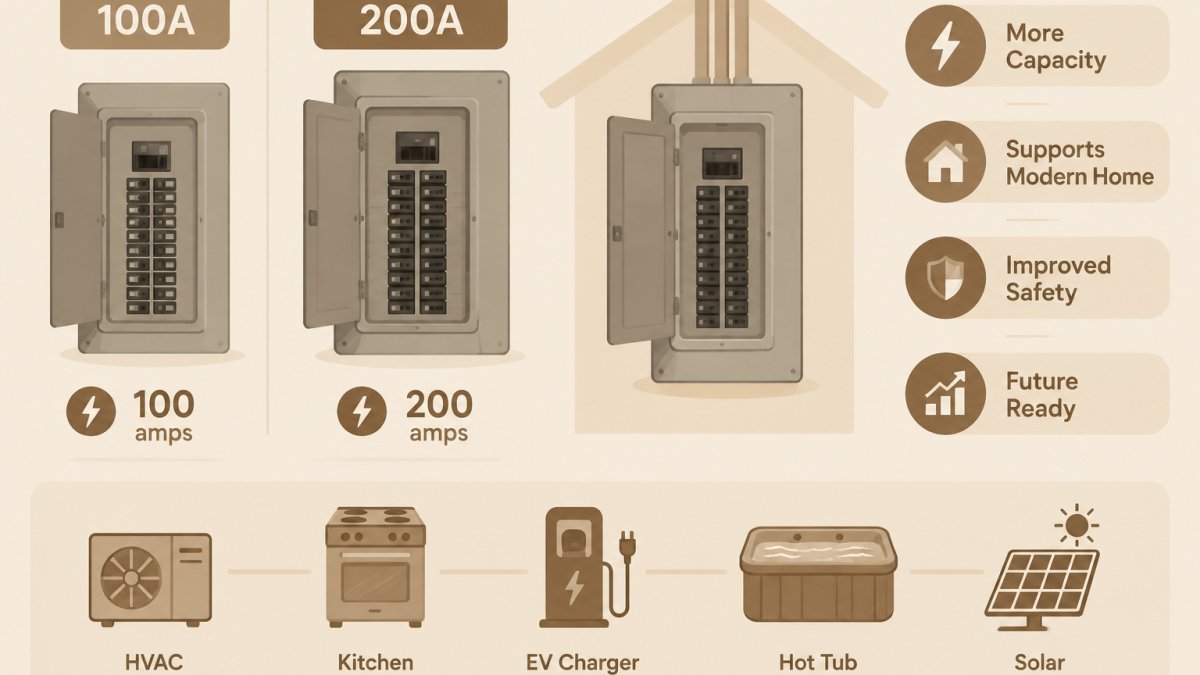
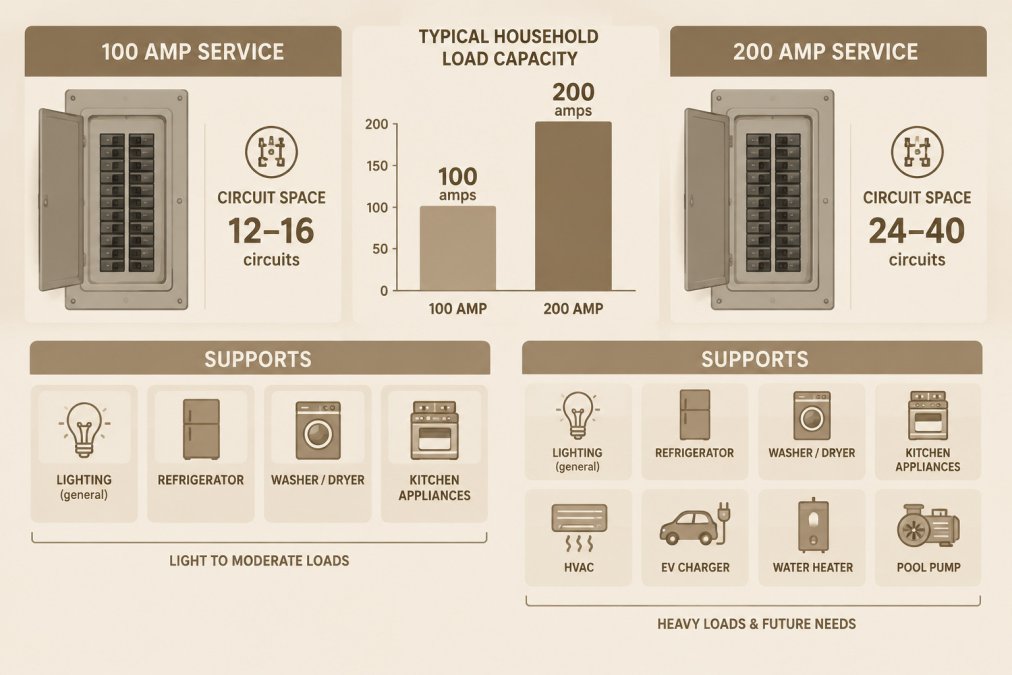
A 200-amp panel provides space for 40 or more circuits, according to Boston Solar's guide to residential capacity requirements.
Here is how the practical difference breaks down:
| Feature | 100-Amp Service | 200-Amp Service |
|---|---|---|
| Typical circuit capacity | Limited open slots | 40 or more circuits |
| Central AC and electric heat | Often strained | Comfortably supported |
| EV charger addition | Frequently requires load management | Generally straightforward |
| Future expansion | Limited | Room to add solar or batteries |
A 200-amp panel is typically sufficient to power the electrical needs of most updated homes, according to New York State's guidance on residential electrical panel upgrades.
Benefits of Upgrading to a 200 Amp Panel
The benefits fall into a few clear categories, and they tend to matter most to homeowners who plan to add equipment over the next decade.
- Capacity for new loads. A higher-amperage service lets you add appliances without rationing usage.
- Support for electrification. Upgrading to 200A service is identified as a cost-effective way to enable residential electrification in cold climates, according to Slipstream's research on pathways to full home electrification.
- Room for solar. A 200-amp panel accommodates solar arrays ranging from roughly 7kW to 15kW or more, according to Boston Solar's residential capacity guide.
- Greater distribution flexibility. Higher-amperage panels distribute power more effectively, which supports modernizing a home's energy systems, as noted by Rewiring America's panel upgrade analysis.
- Fewer nuisance trips. When the total load is spread across more circuits, breakers are less likely to trip from routine overlapping use.
Room for Modern Appliances and Electrification
The most common reason homeowners upgrade is that a new appliance will not fit on the existing service. A heat pump, an induction range, and a Level 2 EV charger can each draw significant current, and running all three at once on a 100-amp service is where problems start. A 200-amp panel gives those loads headroom so they do not compete for the same capacity.
Safety Gains and Reduced Overload Risk
An overloaded panel runs hot, and heat is what degrades wire insulation and breaker contacts over time. Moving to a larger service reduces how often circuits operate near their limits. Upgrading also lets an electrician replace worn or obsolete equipment at the same time, which removes a second source of risk.
How to Tell If Your Electrical Panel Needs Replacing
Warning signs usually appear before a panel fails outright. Frequent breaker trips, lights that dim when a major appliance starts, a panel that feels warm to the touch, a burning smell near the box, and breakers that will not reset are all reasons to call a licensed electrician. A panel that is decades old or from a manufacturer with known reliability problems deserves a professional inspection even if it seems to work.
Load Calculation: How Electricians Size Your Service
Electricians do not size a service by guessing, and you do not have to guess either. A load calculation is the standard approach, and it gives electricians a repeatable way to add up the loads a home can reasonably draw at once and compare that total to the service rating. Understanding the shape of that calculation is the fastest way to know whether 200 amps is necessary, overkill, or not enough.
The standard method, step by step
A residential calculation under NEC Article 220 generally works like this:
- General lighting and receptacles. Take the square footage of the home and multiply by 3 volt-amperes (VA) per square foot for general lighting and general-use receptacles. A 2,000-square-foot home produces 6,000 VA before any appliance is counted.
- Small-appliance and laundry circuits. Add 1,500 VA for each 20-amp small-appliance branch circuit in the kitchen (the code minimum is two) and 1,500 VA for the laundry circuit.
- Apply the demand factors. The first 3,000 VA of the general lighting and small-appliance total is counted at 100 percent; the remainder is counted at 35 percent. This is why a large house does not scale linearly.
- Add fixed appliances. Nameplate ratings for the water heater, range, dryer, dishwasher, disposal, and similar fixed equipment are added, with the code's specific demand factors applied to cooking equipment and dryers rather than simple addition.
- Add the largest motor at 25 percent. The largest motor load, often the air conditioner compressor or a well pump, gets an extra 25 percent added to account for starting current.
- Add heating and cooling, but not both. The calculation uses the larger of the heating load or the cooling load, not the sum, because a house rarely runs the furnace and the air conditioner at the same time.
- Compare to the service. Divide the total VA by 240 volts to get amps, then compare that number to the existing service rating. A result comfortably under 100 amps means a 100-amp service is adequate; a result approaching or exceeding 100 amps is where a 200-amp upgrade starts to make sense.
A worked example
Consider a 2,000-square-foot home with a 40-gallon electric water heater (4,500 VA), a 30-amp electric range, a 30-amp dryer, a 2.5-ton central air conditioner, and a dishwasher. The general lighting load is 6,000 VA, plus 4,500 VA for the two kitchen circuits and laundry, for 10,500 VA. The first 3,000 VA counts at 100 percent and the remaining 7,500 VA counts at 35 percent, giving 3,000 + 2,625 = 5,625 VA.
Where the calculation gets interesting
Two loads change the math more than any other: EV charging and heat pumps. A Level 2 charger is a continuous load, so the NEC requires it to be sized at 125 percent of its rating, a 40-amp charger counts as 50 amps in the calculation. Heat pumps are efficient but draw a large compressor load, and cold-climate models can add backup resistance heat that the calculation must account for.
Get your free electrical estimate →
Watch out: a load calculation based only on the main breaker size or a visual walkthrough is not a calculation. Ask for the actual VA totals and the code article cited, because a panel that 'looks fine' can still be over its calculated capacity.
When the calculation says 200 amps is not enough
A 200-amp service is generous for most homes, but not all. Homes with dual EV chargers, electric resistance heat as a primary system, a large shop or ADU on the same meter, or all-electric kitchens with multiple ovens can calculate above 200 amps. In those cases the conversation moves to a 320-amp or 400-amp service, or to load management devices that let a charger or heat pump shed load automatically.
Cost to Upgrade an Electrical Panel to 200 Amps
Pricing depends on the home's configuration, the condition of the existing wiring, the utility's requirements, and local permitting, so there is no single figure that applies to every house. What a homeowner can do is understand the line items, because the difference between a low quote and a high quote is almost always which of those line items are included.
What the project actually includes
A 200-amp upgrade is not just a panel swap. A complete job typically includes:
- The panel and main breaker. A 200-amp load center with 40 or more spaces, plus the main breaker and branch breakers.
- Service entrance conductors. The wires from the meter to the panel must be sized for 200 amps, which often means replacing the existing service cable.
- The meter base and service mast. The meter socket and the conduit or mast that carries the service drop must be rated for the new amperage, and the mast must meet the utility's clearance requirements.
The utility side is the hidden cost
Most articles stop at the panel, but the utility's portion of the job is where budgets quietly grow. Before the electrician can energize a new 200-amp service, the utility typically has to confirm that its transformer and service drop can support the added load.
Watch out: a quote that does not mention the meter base, the service drop, or utility coordination is not a complete quote.
What drives the price up or down
Several factors move the number more than others. A home with a buried service lateral costs more than one with an overhead drop because trenching and conduit are involved. A panel located in a finished basement or behind drywall adds labor for access and repair. Older homes with aluminum branch wiring, undersized grounding, or a fuse box rather than a breaker panel require more remediation.
How to compare estimates
The most reliable way to compare costs is to request an itemized estimate that lists the panel, meter base, service entrance conductors, grounding, utility coordination, permit fees, and inspection fees separately. Two quotes that differ by thousands of dollars are usually not quoting the same scope, one may exclude the meter base or the utility's reconnect fee. Ask each contractor to confirm the amperage of the service entrance conductors, the make and model of the panel, the number of breaker spaces included, and whether the price includes patching and painting after the old panel is removed.
Electrical Panel Upgrade Tax Credits and Rebates
Federal tax credits and state or utility rebates for electrical upgrades change over time and depend on what else the upgrade enables, such as heat pumps or solar. Check the current rules with the IRS and your local utility before you commit to a project.
Scheduling Your 200 Amp Upgrade With Light Life Electric
Light Life Electric is a family-owned electrical contractor serving Southwest Florida, and we handle the full job from permits to final inspection. If your breakers are tripping, your panel is aging, or you are planning an EV charger or heat pump, we can evaluate your current service and explain your options clearly. Our team is Florida certified and fully licensed, bonded, and insured, and we also offer 24/7 emergency response when power problems cannot wait.
Frequently Asked Questions
Is a 200 amp upgrade worth it?
For most homes with central air conditioning, an electric water heater, an EV charger, or plans for a heat pump or induction range, a 200 amp panel is worth the investment. A 200 amp panel generally leaves more room for additional circuits, which can help with future electrification. Homes that only run gas appliances and light loads may not need it yet. A licensed electrician can perform a load calculation to show whether your current service is adequate or whether an upgrade makes sense for your household.
Does a 200 amp panel increase home value?
A modern 200 amp panel is often viewed favorably by buyers and appraisers because it signals that the electrical system can handle current appliances and future upgrades. Many buyers ask about panel capacity during inspections, especially if they plan to add an EV charger or solar system. While the exact resale impact varies by market and property, a documented service upgrade with permits and inspection records helps reassure buyers. Keep your permit paperwork and final inspection report with your home records.
Can I get a federal tax credit for upgrading my electrical panel?
Federal energy credits have changed over time, and eligibility for a panel upgrade depends on how the upgrade is tied to other qualifying work, such as heat pump installation or home energy improvements. Some programs, including those administered through state and utility rebate channels, may offer incentives for electrification projects. Confirm current eligibility with the IRS guidance and your utility before scheduling work, and ask your contractor for an itemized invoice and permit records that support any credit claim.
What are the signs that my current electrical panel is overloaded?
Common signs include breakers that trip repeatedly, lights that dim when large appliances start, a panel that feels warm or has a burning smell, and buzzing or crackling sounds from the box. Older panels from certain manufacturers also have known reliability concerns. If you have no open slots for new circuits or you are considering an EV charger or heat pump, a load calculation is the most reliable way to confirm whether your service needs upgrading. Any of these symptoms warrants a prompt inspection by a licensed electrician.