 how-to
How to Prepare for an Electrical Panel Upgrade
Table of Contents
- Signs You Actually Need an Electrical Panel Upgrade
- Electrical Panel Upgrade Permit Requirements Explained
- Average Cost to Upgrade an Electrical Panel: What Drives the Price
- How to Prepare Your Home Before the Electrician Arrives
- How Long Does an Electrical Panel Replacement Take?
- What Happens After Your Electrical Panel Upgrade
- Frequently Asked Questions
Last Updated: August 26, 2026
Signs You Actually Need an Electrical Panel Upgrade
Most homeowners don't think about their electrical panel until something goes wrong. That's exactly the problem. By the time a panel failure becomes obvious, you're already dealing with a safety hazard, not just an inconvenience.
An electrical panel upgrade is necessary when your home's electrical service can no longer safely handle the demands placed on it. The panel, also called the breaker box or load center, distributes power from the utility company to every circuit in your home. When it's undersized or outdated, the consequences range from nuisance tripping to house fires.
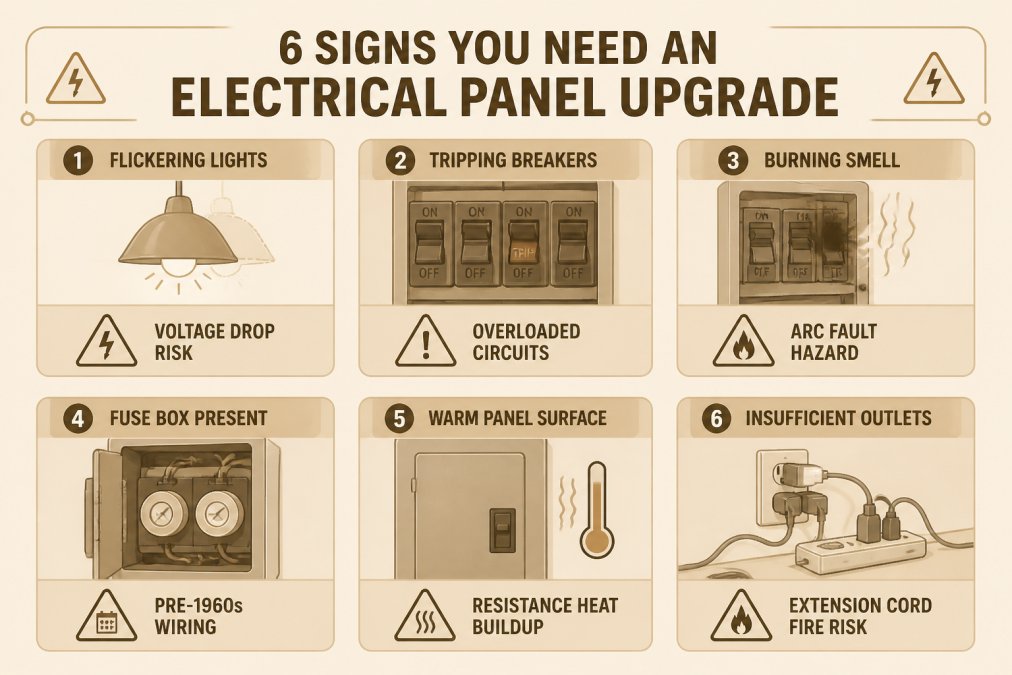
Watch for these warning signs:
- Circuit breakers trip repeatedly, especially under normal loads
- Lights flicker or dim when appliances start up
- You detect a burning smell or see scorch marks near the panel
- Your home still uses a fuse box rather than circuit breakers
- You rely on extension cords because you've run out of outlets
- The panel feels warm to the touch
- You're adding a major appliance, EV charger, or home addition
Any one of these signals warrants a professional assessment. Two or more means the conversation about an electrical panel upgrade shouldn't wait.
100-Amp vs. 200-Amp Service: Which Amperage Does Your Home Need?
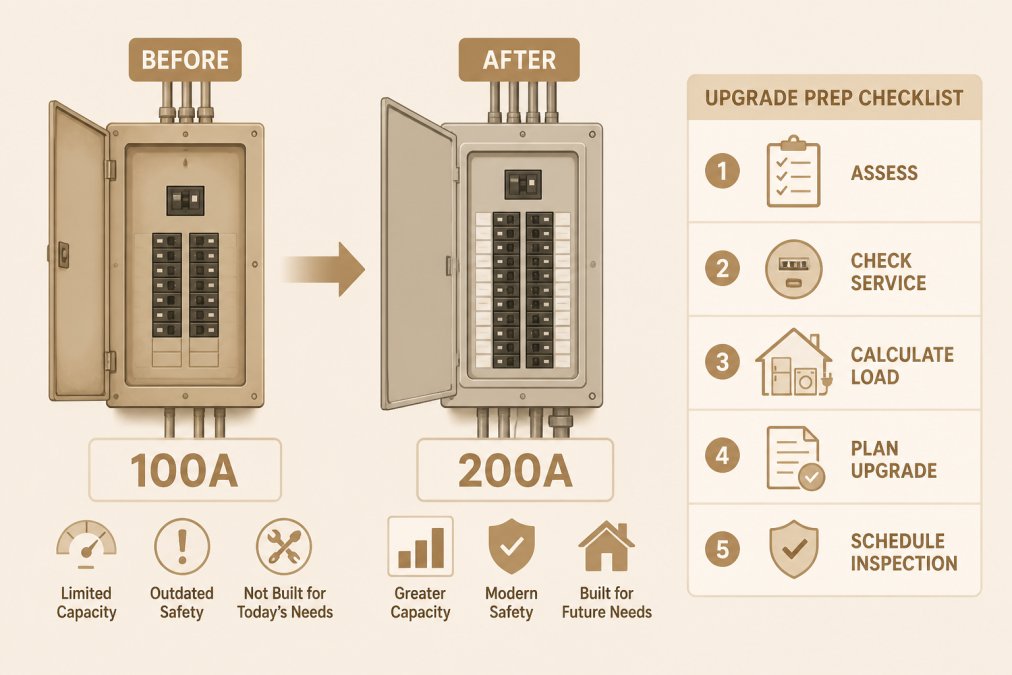
The right amperage depends on your home's square footage, age, and electrical load. A 100-amp service was the standard for decades and still meets minimum code in some jurisdictions, but it's genuinely insufficient for most modern homes. A 200-amp service is now the practical baseline for any home with central air conditioning, electric appliances, and standard modern loads.
Homes over 2,500 square feet, homes with electric vehicle chargers, or homes planning to add a hot tub, workshop, or whole-home generator should strongly consider 200-amp or even 400-amp service. A load calculation, performed by a licensed electrical contractor, is the only reliable way to determine the right service size for your specific situation. Guessing is not a strategy here.
Electrical Panel Upgrade Permit Requirements Explained
Skipping the permit is the most expensive shortcut a homeowner can take. Electrical panel replacement without a permit is a code violation that can void your homeowner's insurance, complicate a home sale, and create liability if something goes wrong.
Electrical permits are required by virtually every jurisdiction for panel upgrades. The permit process ensures that the work is inspected by a licensed electrical inspector who verifies compliance with the National Electrical Code (NEC) as adopted by your local authority. In most areas, only a licensed electrical contractor can pull the permit on your behalf, which is one reason hiring a certified professional matters beyond just the technical work.
The permit process typically follows this sequence:
- Your electrical contractor submits a permit application with the scope of work
- The local building department reviews and approves the application
- Work proceeds after permit issuance
- The inspector schedules a final inspection once installation is complete
- A passed inspection closes the permit
At Light Life Electric, handling the entire permit process from application to final inspection is a standard part of every panel upgrade job, not an add-on service.
Coordinating with Your Utility Company
This is the step most guides underemphasize. Before the electrician can replace your panel, the utility company must disconnect power at the meter. This is not something your contractor does unilaterally. It requires scheduling with the utility, and in many areas, a separate inspection of the meter base and service entrance cable before the utility will reconnect.
Contact your utility company early. In some service territories, scheduling the disconnect and reconnect can add days to your project timeline. Your electrical contractor should coordinate this directly, but confirming the timeline on your end prevents surprises.
Average Cost to Upgrade an Electrical Panel: What Drives the Price
The average cost to upgrade an electrical panel varies considerably based on several factors. Rather than quoting a number that may not reflect your situation, it's more useful to understand what drives the price so you can have an informed conversation with any contractor.
Key cost factors include:
- Current service size and target amperage: Moving from 100-amp to 200-amp service costs more than simply replacing a failed panel of the same size
- Panel location: A panel in an accessible utility room costs less to replace than one in a finished basement or tight crawlspace
- Service entrance condition: If the service entrance cable, meter base, or grounding and bonding system need replacement, expect additional cost
- Local permit and inspection fees: These vary by jurisdiction and are typically passed through at cost
- Utility coordination fees: Some utilities charge for the disconnect/reconnect service call
- Code compliance upgrades: Older homes may require arc fault circuit interrupter (AFCI) or ground fault circuit interrupter (GFCI) breakers throughout the home as a condition of the upgrade
Get your free electrical estimate from Light Life Electric to understand the specific cost factors for your home before committing to a project.
Special Considerations for Older Homes with Knob-and-Tube or Aluminum Wiring
Older homes introduce complications that go beyond the panel itself. Homes built before the 1940s may contain knob-and-tube wiring, which lacks a ground conductor and cannot safely support modern electrical loads. Homes built between roughly 1965 and 1973 may contain aluminum branch circuit wiring, which expands and contracts differently than copper and requires special connectors and devices rated for aluminum use.
In both cases, upgrading the panel without addressing the branch circuit wiring creates a false sense of security. A licensed electrician should inspect the full home electrical system, not just the panel, before finalizing the scope of work. As noted in guidance from the Consumer Product Safety Commission on electrical fire hazards, aluminum wiring connections are a documented source of residential electrical fires when not properly maintained or updated.
How to Prepare Your Home Before the Electrician Arrives
The biggest mistake homeowners make is assuming the electrician handles all the logistics. Preparation on your end directly affects how smoothly installation day goes and how long the job takes.
Here's what to do before your electrical contractor arrives:
- Confirm the permit is pulled. Ask your contractor to confirm permit issuance before installation day. Work that starts before permit approval creates compliance problems.
- Notify your utility company. Even if your contractor is coordinating, confirm the disconnect appointment is scheduled.
- Identify all critical circuits. Know which circuits power medical equipment, refrigeration, or other time-sensitive loads. This affects planning for the outage window.
- Label your existing breakers. If your current panel is unlabeled or poorly labeled, spend 30 minutes mapping circuits before the electrician arrives. It speeds up the job.
- Back up any sensitive electronics. Power fluctuations can occur during the transition. Unplug computers and back up important data the night before.
Clearing Access to the Panel and Service Entrance
The panel and the service entrance cable path must be completely clear on installation day. This sounds obvious, but it's one of the most common causes of job delays.
Get your free electrical estimate →
Remove everything stored in front of or around the panel, including shelving, boxes, and furniture. If the panel is in a garage, clear a working radius of at least three feet on all sides. The service entrance, which is the point where power enters your home from the utility, also needs to be accessible. Trim any vegetation near the weatherhead or service drop if needed.
Your electrical contractor will need to work in this area for several hours. Obstructed access adds time and cost.
Planning for a Power Outage During Installation
Your home will be without power for the duration of the panel swap, typically four to eight hours. Plan for this the same way you'd plan for any scheduled outage.
Practical steps:
- Charge phones, laptops, and portable power banks the night before
- Fill a cooler with ice if the outage extends through meal times
- Arrange alternative accommodations for pets sensitive to temperature changes
- Notify anyone in the home who depends on electrically powered medical equipment well in advance
- Plan to be home or have a trusted adult present for the duration
How Long Does an Electrical Panel Replacement Take?
An electrical panel replacement typically takes four to eight hours on installation day. The full project timeline, from permit application to final inspection, usually spans one to two weeks.
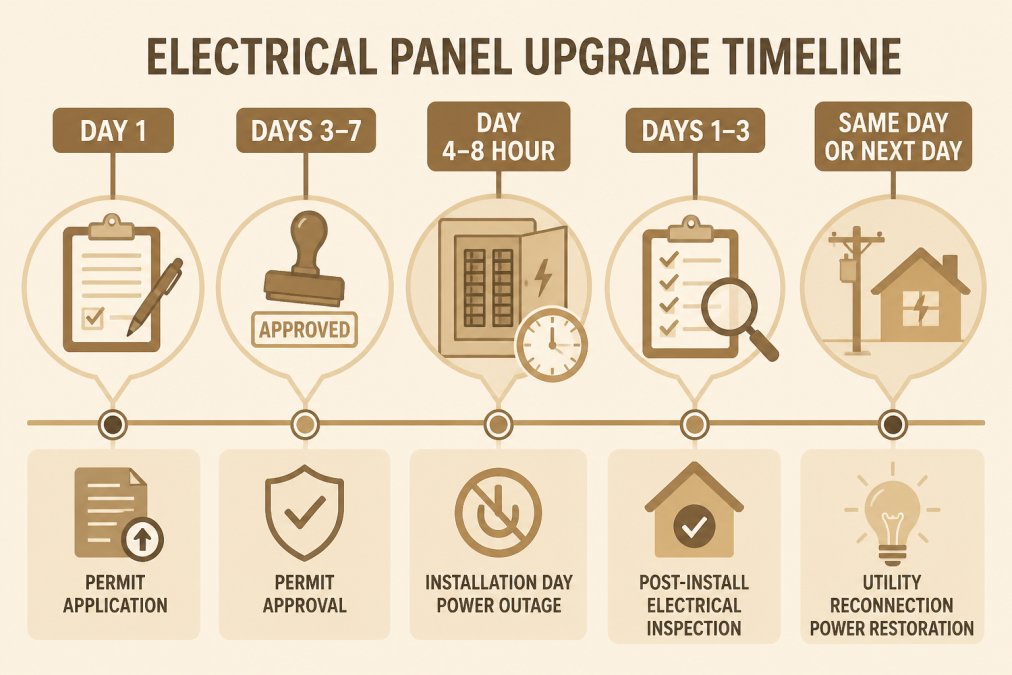
The installation-day timeline breaks down roughly as follows:
| Phase | Typical Duration | Notes |
|---|---|---|
| Utility disconnect | 30-60 min | Scheduled separately with utility |
| Old panel removal | 1-2 hours | Includes labeling existing circuits |
| New panel installation | 2-3 hours | Mounting, wiring, breaker installation |
| Grounding and bonding | 30-60 min | Code compliance check |
| Inspector walkthrough | 30-60 min | Scheduled in advance |
| Utility reconnect | 30-60 min | May be same day or next day |
Factors that extend the timeline include older wiring that requires remediation, difficult panel locations, and utility scheduling backlogs. A straightforward swap in an accessible location on a home with solid wiring typically lands at the lower end of the range.
What Happens After Your Electrical Panel Upgrade
Installation day is not the end of the process. What you do immediately after the upgrade determines how well it protects your home long-term.
Once power is restored, your electrician should walk through the panel with you, explain each circuit, and confirm that all breakers are functioning correctly. Test GFCI and AFCI breakers according to manufacturer instructions, typically by pressing the test button and confirming the reset works.
Post-Upgrade Documentation, Insurance, and Resale Value
This is the angle most homeowners overlook, and it's genuinely important. Collect the following documents and store them somewhere accessible:
- Closed permit: Confirm the permit is officially closed after the inspection passes. Your local building department can provide a copy.
- Inspection certificate: The signed inspection report from the electrical inspector
- Panel directory: A complete, accurate label of every circuit in the new panel
- Manufacturer documentation: Keep the panel's installation manual and warranty information
Notify your homeowner's insurance carrier after the upgrade is complete. Many insurers reduce premiums for homes with updated electrical panels because the fire risk profile improves meaningfully. Some older panels, particularly certain brands with documented safety issues, may have been flagged by your insurer as a condition of coverage. An upgrade can resolve that condition and potentially affect your insurability.
From a resale perspective, according to guidance from the National Association of Realtors on home improvement value, updated electrical systems consistently appear on buyer inspection request lists. A documented, permitted panel upgrade removes a common negotiation point and signals to buyers that the home has been maintained responsibly.
Smart Panel Integration and Surge Protection
The electrical panel upgrade is also the right moment to consider smart panel technology and whole-home surge protection. Smart panels allow circuit-level monitoring and control from a smartphone app, which gives homeowners visibility into energy consumption by circuit and the ability to remotely shut off individual circuits. This is particularly useful for homes with solar, battery storage, or EV charging.
Whole-home surge protection, installed at the main disconnect, protects every device in the home from voltage spikes caused by lightning or utility switching events. The IEEE standards for surge protection devices distinguish between Type 1 devices installed at the service entrance and Type 2 devices installed at the panel, and most electricians recommend both for comprehensive protection.
If smart panel integration is a goal, discuss it before installation day. Some smart panel systems require specific enclosures or configurations that affect the equipment your electrician orders. Retrofitting after the fact is possible but costs more.
A panel upgrade is one of the most consequential electrical projects a homeowner can undertake, and the preparation work before the electrician arrives is what separates a smooth job from a costly one. Light Life Electric handles every stage of the electrical panel upgrade process, from permit application and utility coordination to final inspection and post-installation walkthrough. Our Florida certified electricians are licensed, bonded, and insured, and we don't consider a job complete until the permit is closed and you understand your new system. Get your free electrical estimate and find out exactly what your home needs.
Frequently Asked Questions
Do I need a permit for an electrical panel upgrade?
Yes. An electrical panel upgrade almost always requires a permit under the National Electrical Code (NEC), and most local jurisdictions enforce this strictly. Your licensed electrician pulls the permit on your behalf, schedules the inspection, and ensures the installation meets current code compliance standards. Skipping the permit can create serious problems when you sell the home or file an insurance claim. A reputable electrical contractor handles the entire permit process from application through final inspection.
How long does an electrical panel upgrade take?
The physical installation typically takes four to eight hours on the day of the job, though the full project timeline is longer. Permit approval can take several days to two weeks depending on your local building department. After installation, a municipal inspector must sign off before the utility company restores permanent service. Plan for your power to be off for most of the installation day and schedule accordingly.
What is the 120% rule for electrical panels?
The NEC 120% rule governs how much total load a panel can carry when solar or other back-fed power sources are connected. The combined amperage of the main breaker and any back-fed breaker (such as a solar inverter breaker) cannot exceed 120% of the panel's rated ampacity. For example, a 200-amp panel can accept a back-fed breaker up to 40 amps. This rule exists to prevent the bus bar from being overloaded, and it directly affects whether your current panel can support a solar installation.
What's the average cost to upgrade an electrical panel?
Electrical panel upgrade costs vary based on the current panel's amperage, the target amperage (typically 200 amps for most homes), local permit fees, utility coordination costs, and whether older wiring like knob-and-tube or aluminum needs remediation. Homes with older infrastructure or those requiring a service entrance cable replacement will see higher costs. For an accurate estimate specific to your home's setup, contact a licensed electrical contractor for a free assessment.