 ultimate-guide
Emergency Electrician Services in Sarasota: What to Expect
Table of Contents
- When Do You Need an Emergency Electrician in Sarasota?
- Signs of Electrical Panel Failure You Should Never Ignore
- Understanding the Cost of Emergency Electrical Repair
- What to Expect From 24/7 Emergency Electrical Services
- Electrical Safety Protocols for Homeowners Before Help Arrives
- Why Choose a Licensed and Insured Local Electrician
- Your Emergency Preparedness Checklist
- Get a Free Estimate for Your Electrical Repairs
- Frequently Asked Questions
Last Updated: September 4, 2026
When your circuit breaker trips repeatedly or you smell something burning near your electrical panel, you need emergency electrician services in Sarasota that respond quickly, diagnose correctly, and fix it safely. At Light Life Electric, our Florida certified electricians handle urgent residential and commercial failures daily. This guide explains what to expect when you call, how to spot serious warning signs, and how to prepare before a professional arrives.
Emergency electrician services in Sarasota cover urgent issues like power outages, sparking outlets, burning odors, and panel failures that cannot wait for regular business hours. The key difference between an emergency call and a standard appointment is risk: if faulty wiring threatens your safety or property, you need 24/7 availability.
When Do You Need an Emergency Electrician in Sarasota?
Not every electrical problem requires an immediate call, but some situations are genuinely dangerous. Contact emergency electrician services in Sarasota right away if you notice sparking outlets, a burning plastic smell, warm wall plates, or a power loss that only affects your home while neighbors keep their lights on.
Electrical hazards do not improve with time, and delayed action increases the risk of fire or damage. If your circuit breaker trips repeatedly after you reset it, that is your system telling you something is wrong.
Storm damage also justifies an emergency call. High winds and lightning can compromise wiring and service entrances, leaving you without power and at risk of electrical hazards. In those cases, same-day service is not a luxury, it is a necessity.
Signs of Electrical Panel Failure You Should Never Ignore
Your electrical panel is the heart of your home's wiring system, and when it starts failing, the warning signs are usually clear. The five most common indicators of failure are flickering lights, a burning smell near the panel, buzzing sounds, a warm panel face, and breakers that trip frequently without an obvious cause.
Flickering lights often mean loose connections or an overloaded circuit. A burning odor suggests overheated wires or a failing breaker. Buzzing typically indicates arcing, which poses a serious fire risk. A warm panel face means components are working too hard. Frequent trips can signal that your panel is outdated.
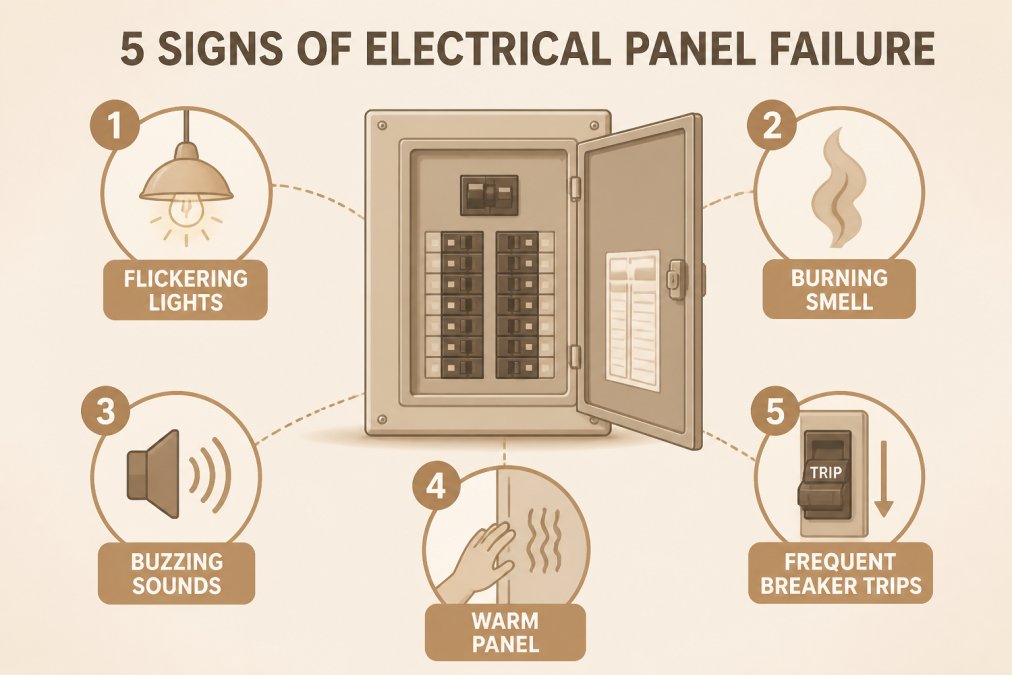
If you notice any of these signs, do not wait for regular business hours. Turn off the affected circuit if you can do so safely, and call a licensed electrician immediately. Addressing these issues early prevents more extensive damage.
Understanding the Cost of Emergency Electrical Repair
Here is how emergency electrical pricing works, so you are never caught off guard.
The Two-Part Billing Structure
Emergency electrical repairs are almost always billed in two parts: a trip charge and a labor rate. The trip charge covers travel time, vehicle costs, and the overhead of dispatching someone outside normal business hours. Labor is billed by the hour, often in 15-minute increments, starting when the technician arrives.
Expect a trip charge noticeably higher than a standard daytime service call fee. That premium reflects the reality of 24/7 availability: the electrician is on call and ready to respond at a moment's notice.
What Drives the Final Number
Beyond the base trip and hourly rate, four factors move the final price up or down:
- Time of day and day of week. A call at 2 AM on a Sunday will carry a higher premium than one at 6 PM on a Tuesday. Holiday calls are typically the most expensive.
- Parts and materials. A simple outlet replacement costs a few dollars in parts. A new circuit breaker can run depending on the amperage and brand. A full panel replacement is a completely different scale of project.
- Diagnostic complexity. A tripped breaker that resets cleanly is a 15-minute fix. A burning smell that requires opening walls to trace the source can take hours. Reputable contractors charge for the time it actually takes to find and fix the root cause, not a flat "guess and go" rate.
- Accessibility. An outdoor panel at ground level is easy to work on. A panel tucked behind stored boxes in a cramped garage, or one that requires a ladder to reach, adds time and therefore cost.
The "Free Estimate" Trap
Many companies advertise a "free estimate" for emergency work. A legitimate free estimate over the phone is a rough range, not a firm quote. No honest electrician can quote a precise price without seeing the system.
A reputable contractor will provide a transparent pricing model: a clear trip charge, a stated hourly rate, and a commitment to explain any parts markup before installing them. Ask for those three numbers on the phone. If the dispatcher cannot provide them, that is a red flag.
How to Get an Accurate Quote Before Work Begins
When the technician arrives, you should receive a written estimate before any repair work starts. This estimate should itemize the trip charge, estimated labor hours, and parts required. A professional will also explain what happens if the job turns out to be more complex than the initial diagnosis.
A transparent pricing model is about trust. The contractor who puts a firm number in writing before starting work is the one who expects to see you again for preventative maintenance, not the one who needs to make up for a low bid with upsells.
For a clear picture of what your situation will cost, request a free estimate before committing to any repair. Legitimate emergency electrician services in Sarasota will give you a firm number before starting work.
What to Expect From 24/7 Emergency Electrical Services
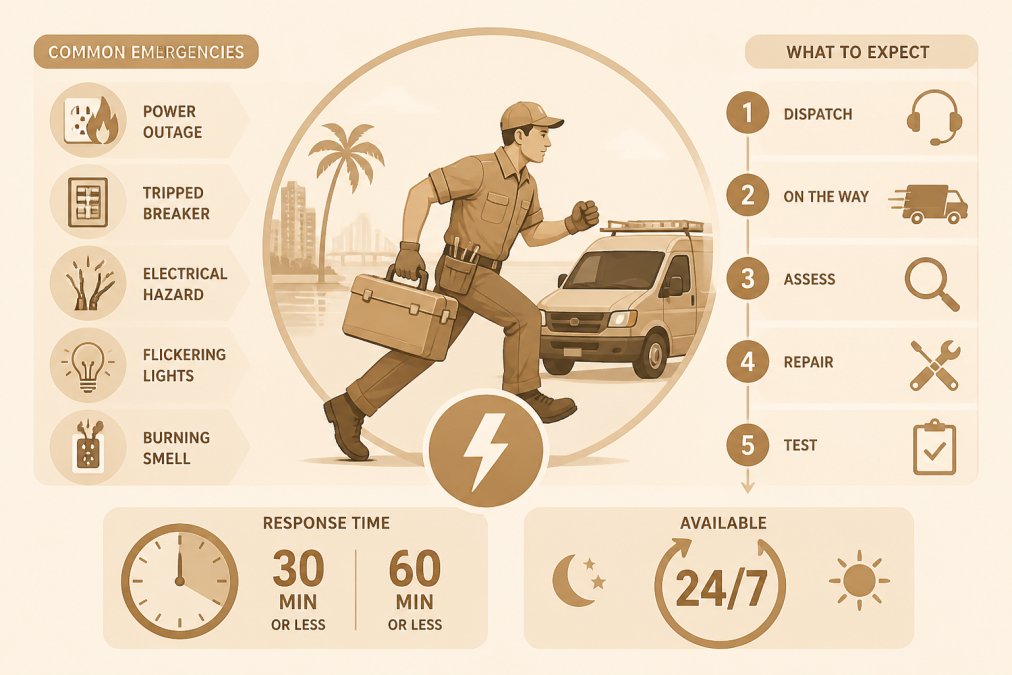
When you call a 24/7 emergency electrical service, the dispatcher will ask about your symptoms, determine whether the situation is life-threatening, and schedule the nearest available technician to your location.
Response times vary based on location and severity, but a professional service will give you an estimated arrival window and keep you updated. When the electrician arrives, they will assess the situation, explain the problem, and provide a clear price before beginning work.
Emergency services are not just for total power failures. They also cover partial outages, sparking fixtures, and other urgent issues that compromise safety.
Electrical Safety Protocols for Homeowners Before Help Arrives
While you wait for a professional, your priority is keeping everyone in the home safe. If you smell burning or see sparks, turn off power at the main breaker only if you can reach the panel without stepping in water or touching metal surfaces. Otherwise, evacuate and call emergency services first.
For power outages, unplug sensitive electronics to protect them from surges when power returns. Leave one light switch on so you know when service is restored. Avoid using candles near curtains or flammable materials, and keep flashlights in accessible locations throughout the home.
Electrical safety protocols for homeowners also include knowing where your main shutoff is located and how to operate it. During a storm or before any major repair, familiarize yourself with this switch. If you have a generator, never connect it directly to your home's wiring without a transfer switch, as backfeeding creates serious hazards for utility workers and your household.
Why Choose a Licensed and Insured Local Electrician
Electrical work is not a DIY project or a job for an unlicensed handyman. But "licensed and insured" is a phrase every contractor prints on their truck. What does it actually mean, and why does it matter more for emergency repairs?
What a Florida License Actually Requires
The state of Florida issues electrical contractor licenses through the Department of Business and Professional Regulation (DBPR). To earn that license, an electrician must pass a rigorous exam covering the National Electrical Code (NEC), Florida-specific amendments, and business practices. The license requires continuing education to stay current with code changes, updated on a three-year cycle.
When you hire a Florida certified electrical contractor, you are hiring someone who has demonstrated mastery of the NEC and Florida's amendments. Recent cycles have introduced significant changes around arc-fault circuit interrupters (AFCIs), ground-fault protection, and service panel requirements. An unlicensed handyman will not know these updates.
Local Code Compliance Is Not Optional
Emergency repairs are not exempt from code requirements. When a licensed electrician makes an emergency repair, that work must comply with the current code, just like a new installation.
Consider a common scenario: a breaker keeps tripping because the circuit is overloaded. An unlicensed operator might install a larger breaker, which is a dangerous code violation. The wiring was sized for the original breaker's amperage. Upsizing the breaker without upsizing the wire creates a fire hazard. A licensed electrician knows the correct fix is redistributing the load, adding a new circuit, or upgrading the panel.
The Insurance Question
Licensing and insurance go hand in hand. A licensed contractor carries workers' compensation and liability insurance because the state requires it. If a worker is injured on your property, workers' comp covers their medical bills (dol.gov). If the work causes damage, liability insurance covers the repair.
An unlicensed operator typically carries no insurance. If something goes wrong, your only recourse is a lawsuit against someone who may have no assets. Worse, many homeowner's insurance policies contain exclusions for damage caused by unlicensed work (iii.org).
Why Local Knowledge Matters for Emergency Work
A local contractor knows the specific inspection requirements in your jurisdiction. They have relationships with local building officials, which smooths the permitting process. And in an emergency, they can respond faster because their technicians are in the area.
Local contractors also understand regional stressors on electrical systems. This area experiences severe thunderstorms, high humidity, and salt air near the coast, which accelerate corrosion in panels and connections. A local electrician sees these failure modes regularly and knows to check for them.
The Practical Test: Ask These Questions Before Hiring
Before you let anyone work on your electrical system, ask these four questions:
- What is your Florida license number? Look it up on the DBPR website to verify it is active and in good standing.
- Are you licensed, bonded, and insured? Ask for proof of insurance and confirm the policy is current.
- Will you pull a permit if the repair requires one? Some emergency repairs do not require permits, but a contractor who refuses to pull one when needed is hiding something.
- Do you guarantee your work in writing? A written warranty on parts and labor is the mark of a contractor who stands behind the job.
The difference between a licensed professional and a general contractor becomes obvious during inspections. Code violations mean rework, delays, and added costs. A Florida certified electrical contractor who is licensed, bonded, and insured protects your investment.
Your Emergency Preparedness Checklist
Preparation turns a chaotic situation into a manageable one. Use this checklist to ensure your home is ready for an electrical emergency, whether it is a storm-related outage or a sudden panel failure.
- Save your emergency electrician's contact information in your phone and post it near your panel
- Locate and test your main breaker shutoff so you know it operates smoothly
- Keep flashlights and batteries in every bedroom, not just the kitchen
- Install surge protectors on sensitive electronics like computers and televisions
- Unplug appliances during severe storms to prevent surge damage
- Schedule a preventative maintenance inspection annually to catch issues early
- Verify your smoke detectors function and replace batteries twice per year
The most valuable step is scheduling a professional electrical inspection before problems arise. Preventative maintenance identifies worn components and loose connections while they are still inexpensive to fix.
Get a Free Estimate for Your Electrical Repairs
Electrical emergencies are stressful, but choosing the right contractor should not be. Light Life Electric is a family-owned electrical contractor serving Southwest Florida with a team of Florida certified electricians who are licensed, bonded, and insured. We offer 24/7 emergency response and handle everything from permits to final inspection.
Whether you need urgent panel repairs, a full upgrade, or ongoing maintenance for a commercial property, our team provides code-compliant installations and repairs that minimize disruption to your home or business.
Frequently Asked Questions
What constitutes an electrical emergency in a home?
An electrical emergency is any issue that poses an immediate fire hazard or safety risk. This includes visible sparks, burning smells from outlets or your panel, power outages affecting only your home, and a circuit breaker that won't reset. If you hear buzzing from your electrical panel or notice scorch marks, treat it as urgent. For any of these, shut off power to the affected area if you can do so safely and call a licensed emergency electrician in Sarasota right away.
How quickly can an emergency electrician respond to a power outage?
Response times vary by company and time of day, but reputable 24/7 services in the Sarasota area typically aim to have a technician on site within a few hours. When you call, ask for an estimated arrival window. A professional service will give you a clear time frame and keep you updated. The speed of service depends on the nature of the emergency, with issues like sparking panels or exposed wires prioritized over less immediate problems.
Are emergency electrical services more expensive than standard repairs?
Yes, emergency calls usually cost more than scheduled repairs. The exact cost of emergency electrical repair depends on the time of day, the severity of the issue, and the parts needed. Many companies also apply a separate trip or dispatch fee for after-hours calls. Always ask for a clear estimate before work begins. A licensed electrician will explain the breakdown of the emergency fee and the repair costs so you know what to expect.
What safety steps should I take before an electrician arrives?
Your first step is to prevent injury, not fix the problem. If you see sparks or smell burning, turn off power at the main breaker only if the panel is dry and safe to access. Do not touch water or stand on wet floors. Keep family members and pets away from the affected area. Have a fire extinguisher rated for electrical fires nearby. Leave the repair to the professional; your job is to secure the scene until they arrive.
Electrical problems rarely announce themselves at convenient hours. When they do, you need a response you can trust. Contact Light Life Electric for prompt, professional service, and get your free electrical estimate today.
Frequently Asked Questions
Q: What constitutes an electrical emergency in a home?
A: An electrical emergency is any issue that poses an immediate fire hazard or safety risk. This includes visible sparks, burning smells from outlets or your panel, power outages affecting only your home, and a circuit breaker that won't reset. If you hear buzzing from your electrical panel or notice scorch marks, treat it as urgent. For any of these, shut off power to the affected area if you can do so safely and call a licensed emergency electrician in Sarasota right away.
Q: How quickly can an emergency electrician respond to a power outage?
A: Response times vary by company and time of day, but reputable 24/7 services in the Sarasota area typically aim to have a technician on site within a few hours. When you call, ask for an estimated arrival window. A professional service will give you a clear time frame and keep you updated. The speed of service depends on the nature of the emergency, with issues like sparking panels or exposed wires prioritized over less immediate problems.
Q: Are emergency electrical services more expensive than standard repairs?
A: Yes, emergency calls usually cost more than scheduled repairs. The exact cost of emergency electrical repair depends on the time of day, the severity of the issue, and the parts needed. Many companies also apply a separate trip or dispatch fee for after-hours calls. Always ask for a clear estimate before work begins. A licensed electrician will explain the breakdown of the emergency fee and the repair costs so you know what to expect.
Q: What safety steps should I take before an electrician arrives?
A: Your first step is to prevent injury, not fix the problem. If you see sparks or smell burning, turn off power at the main breaker only if the panel is dry and safe to access. Do not touch water or stand on wet floors. Keep family members and pets away from the affected area. Have a fire extinguisher rated for electrical fires nearby. Leave the repair to the professional; your job is to secure the scene until they arrive.