 ultimate-guide
Bradenton Electrician Guide: Costs, Permits & Safety
Table of Contents
- What a Bradenton Electrician Actually Does (Beyond Flipping Breakers)
- Electrical Permit Requirements in Florida: What Homeowners Need to Know
- What Drives the Cost of an Electrical Panel Upgrade
- How to Find a Licensed Electrician Near Me (Without Getting Burned)
- DIY vs. Professional Electrical Work: Where the Line Actually Is
- Emergency Electrical Repairs: What to Do Before Help Arrives
- Smart Home Integration and Energy Efficiency: Upgrades That Pay Off
- Frequently Asked Questions
Last Updated: September 10, 2026
What a Bradenton Electrician Actually Does (Beyond Flipping Breakers)
A Bradenton electrician is a licensed trade professional who diagnoses, repairs, and installs electrical systems across Manatee and Sarasota Counties. At Light Life Electric, we handle everything from a tripping breaker to a full commercial build-out.
Most homeowners only call when something breaks. That's a mistake. A good electrician performs load calculations, voltage testing, and grounding and bonding checks that catch fire hazards before they start, and pulls permits and coordinates inspections so your home stays code-compliant and insurable.
Electrical work is one of the few trades where a shortcut can kill someone. Below: what a licensed contractor does, what it costs, and how to avoid hiring the wrong one.
Electrical Permit Requirements in Florida: What Homeowners Need to Know
Permits are the most misunderstood part of electrical work, and where the most expensive mistakes happen. Here's how the system works, and where the line falls between a legal like-for-like swap and work requiring a licensed contractor and inspection.
Who Has Authority Over Electrical Work
Electrical permitting runs through a layered system. The Florida Building Code adopts the National Electrical Code (NEC) as the statewide standard, and the Florida Department of Business and Professional Regulation (DBPR) licenses the contractors allowed to pull permits and perform the work (floridabuilding.org). Your local building department, the authority having jurisdiction, or AHJ, issues the permit, inspects, and signs off. In Manatee County that's the county building department; inside city limits, the municipal building department may be the AHJ instead.
That layering is why "do I need a permit?" has a different answer two miles apart. Confirm with the AHJ that covers the property address, not your mailing address.
When You Need a Permit vs. When You Don't
As a general rule, a permit is required whenever work creates, extends, or alters a circuit, changes the electrical service, or touches a life-safety system. You need one for:
- New circuits or outlet installation
- Panel upgrades or replacements, including a service change
- EV charger installation (Level 2 especially)
- Generator installation and transfer switch wiring
- Any commercial wiring or tenant improvement
- Service upgrades, meter changes, or a new service mast
- Rewiring, including replacing aluminum or cloth-insulated branch wiring
- Recessed lighting added on a new switch leg
You typically don't need one for:
- Replacing a switch, dimmer, or outlet with an identical unit on an existing circuit
- Swapping a light fixture on an existing box and circuit
- Replacing a ceiling fan with the same model
- Replacing a lamp cord or a plug-in device
If you're unsure which side of the line a job falls on, ask the AHJ before you start. A five-minute call beats a failed inspection.
What the Permit Process Actually Looks Like
A permitted job follows a predictable sequence:
- Application. The licensed contractor files the permit with the AHJ, listing the scope, the valuation, and the contractor license number.
- Rough-in inspection. For new circuits or a service change, the inspector verifies the wiring, box fill, grounding, and bonding before drywall goes back up.
- Final inspection. After the devices, panel, and fixtures are installed, the inspector confirms the work matches the approved scope and the NEC.
- Certificate of completion / final approval. The AHJ closes the permit. Keep this document, you will need it at resale.
Timelines depend on the AHJ's queue.
Why DIY Electrical Work Often Costs More in the Long Run
A homeowner who installs an outlet without a permit saves the permit fee and inspection. Then the house sells, the buyer's inspector flags the unpermitted circuit, and the seller pays a licensed electrician to open the wall, correct the work, and pull a retroactive permit, often costing more than permitting it the first time. Add the risk of an insurance denial after a fire, and the math isn't close.
For the official code text, see the National Fire Protection Association's NEC overview. For licensing and contractor verification, the state DBPR maintains a public license lookup.
What Drives the Cost of an Electrical Panel Upgrade
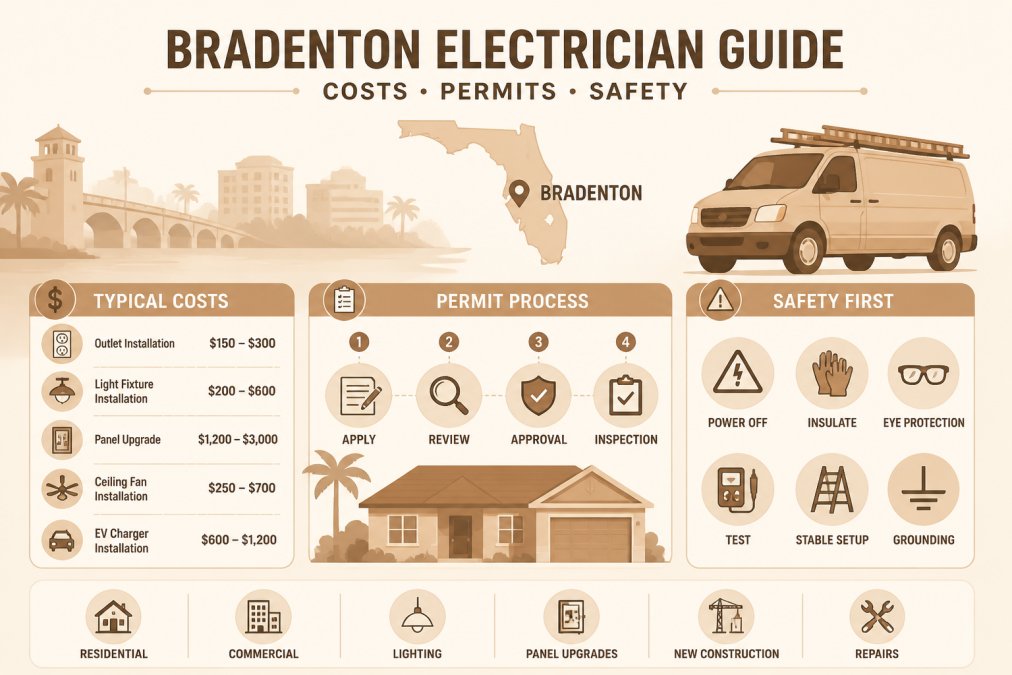
Panel upgrade pricing depends on amperage, panel location, and whether the service mast and meter need replacement. A 200-amp upgrade costs more than a simple panel swap because it involves new breakers, a larger service entrance, and a permit.
The biggest cost variables:
- Amperage: 100-amp vs. 200-amp vs. 400-amp service
- Access: a panel in a finished garage costs more to reach than one in an open utility room
- Wiring condition: old aluminum or cloth-insulated wiring may need replacement
- Permit and inspection fees: set by your local jurisdiction
- Utility coordination: some jobs require a temporary disconnect
Why Two Quotes for the Same Job Can Differ by Thousands
A low quote often excludes the permit, inspection, or utility disconnect, and may assume the existing wiring is reusable when it isn't. Ask every contractor for a written, itemized scope. If a bid is dramatically lower, something is missing.
How to Find a Licensed Electrician Near Me (Without Getting Burned)
Searching for a licensed electrician near me returns a mix of real contractors and lead-generation sites. A lead-gen site sells your contact info to whoever pays; a licensed contractor is accountable for the work.
Get your free electrical estimate →
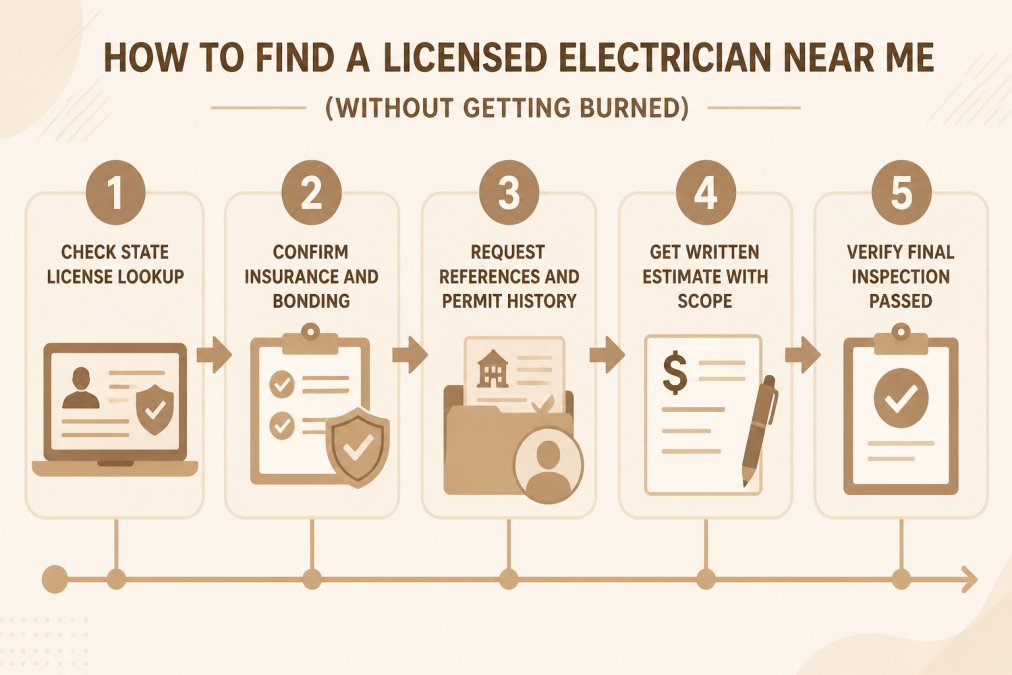
Five Questions That Separate Pros from Pretenders
- What's your license number? Verify it through your state's licensing database.
- Are you insured and bonded? Ask for a certificate of insurance, not just a verbal yes.
- Will you pull the permit? A real contractor pulls it in their name.
- Can you provide references from similar jobs? Ask for recent, local ones.
- Is the estimate written and itemized? Verbal quotes protect no one.
Light Life Electric is a family-owned, Florida certified electrical contractor that handles every detail from permits to final inspection.
DIY vs. Professional Electrical Work: Where the Line Actually Is
The line is simple: if the work involves opening a panel, adding a circuit, or touching wiring inside a wall, hire a professional. Replacing a light bulb or faceplate is fine. Anything carrying current beyond a plug-in device is not DIY.
Why the hard line? Mistakes cause fires that smolder inside walls for hours, unpermitted work surfaces during a sale and can kill the deal, and most homeowner policies exclude damage from unpermitted electrical work.
- Safe DIY: swapping bulbs, replacing a lamp cord, resetting a tripped breaker once
- Not DIY: panel work, new circuits, outlet installation, wiring repair, anything requiring a permit
If your breaker keeps tripping, that's a symptom, not a fix, the circuit is overloaded or there's a fault. Repeated resets without diagnosis are how fires start.
Emergency Electrical Repairs: What to Do Before Help Arrives
If you smell burning, see sparks, or lose power to part of the house, cut power at the main breaker and call for emergency service. Don't reset a breaker that trips immediately. Don't touch a panel that's wet or warm.
What to do while you wait:
- Shut off the main breaker if it's safe to reach
- Unplug affected appliances
- Keep everyone away from the panel
- Note what you saw, heard, or smelled for the electrician
Light Life Electric offers 24/7 emergency electrical response. Prompt service matters when a commercial kitchen or medical office is down.
Smart Home Integration and Energy Efficiency: Upgrades That Pay Off
Most articles on this topic list gadgets. The upgrades that can pay off are tied to load management, lighting, and the realities of an older home in a hot, humid climate. Here's where energy audits and smart-home retrofits fit in.
Start With an Energy Efficiency Audit, Not a Shopping Cart
An energy efficiency audit is the starting point, and the step most homeowners skip. A qualified electrician or auditor walks the home and measures where power actually goes: HVAC draw, water heating, lighting load, phantom loads, and the condition of the panel and branch circuits.
The audit answers the question that matters before you buy anything: does the existing panel have capacity for the upgrades you want? A 100-amp panel near its calculated load can't support a Level 2 EV charger, a heat pump water heater, and a new range without a service upgrade. Finding that out after delivery is an expensive lesson.
In this climate, cooling load dominates the bill, so the fixes that help most reduce peak demand, smart thermostats with load control, variable-speed HVAC, and LED lighting that cuts both wattage and heat gain inside the conditioned space.
Smart Home Retrofits in Older Homes
Older homes present a specific challenge: the wiring wasn't designed for the number of always-on devices a modern household runs. A smart-home retrofit usually means one of three things:
- Neutral wire availability. Many smart switches require a neutral wire in the box. Older switch loops often do not have one, which means either a different switch model or pulling a new cable.
- Box fill and depth. Smart switches and dimmers are physically deeper than the originals. A shallow metal box may not have the cubic-inch capacity, and the fix is a box extension or replacement.
- Grounding. Two-wire ungrounded circuits are common in older housing stock. Smart devices and surge protectors need a valid equipment ground to function as designed, so the retrofit may require a grounding conductor.
A licensed electrician can assess all three in one visit and tell you which rooms are retrofit-ready and which need wiring work first, the difference between a smart home that works and one that flickers.
The Upgrades That Consistently Justify Their Cost
- Smart thermostats and load controllers: reduce peak demand and strain on your panel, and can be enrolled in utility demand-response programs where available.
- LED lighting retrofit: cuts lighting energy use and lasts far longer than incandescent, with the added benefit of less heat inside the conditioned space.
- Whole-home surge protection: protects electronics from grid spikes and lightning, which is a real risk in this region's storm season.
- EV charger installation: adds resale value and future-proofs your garage, but only if the panel has the capacity, which is why the audit comes first.
- Energy efficiency audit: identifies where power is actually being wasted before you spend money on devices.
Frequently Asked Questions
How much does an electrician charge per hour in Florida?
Hourly rates in Florida typically range based on the complexity of the work, the electrician's certification level, and whether it's an emergency call. Rather than quoting a flat rate, most established contractors provide upfront pricing after diagnosing the issue. Light Life Electric offers free estimates so you know the scope and cost before any work begins, avoiding the surprise charges that come with open-ended hourly billing.
What electrical work can be done without a permit in Florida?
Minor tasks like replacing a light fixture, swapping an outlet cover, or changing a ceiling fan in an existing approved box generally don't require a permit. However, new circuit installations, panel upgrades, service changes, and any work involving new wiring do require permits in most Florida jurisdictions. When in doubt, ask your contractor whether the job needs an electrical permit. Pulling permits protects you at resale and ensures the work meets current electrical code compliance.
How do I verify if an electrician is licensed in Florida?
Florida requires electrical contractors to hold a state certification or registration through the Department of Business and Professional Regulation (DBPR). You can verify any contractor's license status on the DBPR website by searching their name or license number. Also confirm they carry general liability insurance and workers' compensation coverage. A licensed, bonded, and insured electrician protects you from liability if something goes wrong, and ensures the work will pass inspection.
What should I do if my circuit breaker keeps tripping?
A breaker that trips once after a power surge is normal. A breaker that trips repeatedly signals an underlying problem: an overloaded circuit, a short, or a failing breaker. Unplug devices on that circuit and try resetting it once. If it trips again immediately, stop resetting it and call a licensed electrician. Repeated tripping can indicate wiring damage or a panel that's reached capacity, which a load calculation can confirm. Diagnosis is typically part of a service call.