 listicle
Best Emergency Electrical Projects: On Time, On Budget
Table of Contents
- What Makes Emergency Electrical Projects Successful
- Emergency Electrical Repair Cost Factors
- Minimizing Downtime During Electrical System Failure
- How to Budget for Emergency Electrical Services
- Case Studies: Emergency Electrical Projects Delivered On Schedule and Within Budget
- Risk Mitigation and Vendor Vetting for Emergency Support
- Conclusion: Building a Reliable Emergency Electrical Plan
- Frequently Asked Questions
Last Updated: September 16, 2026
What Makes Emergency Electrical Projects Successful
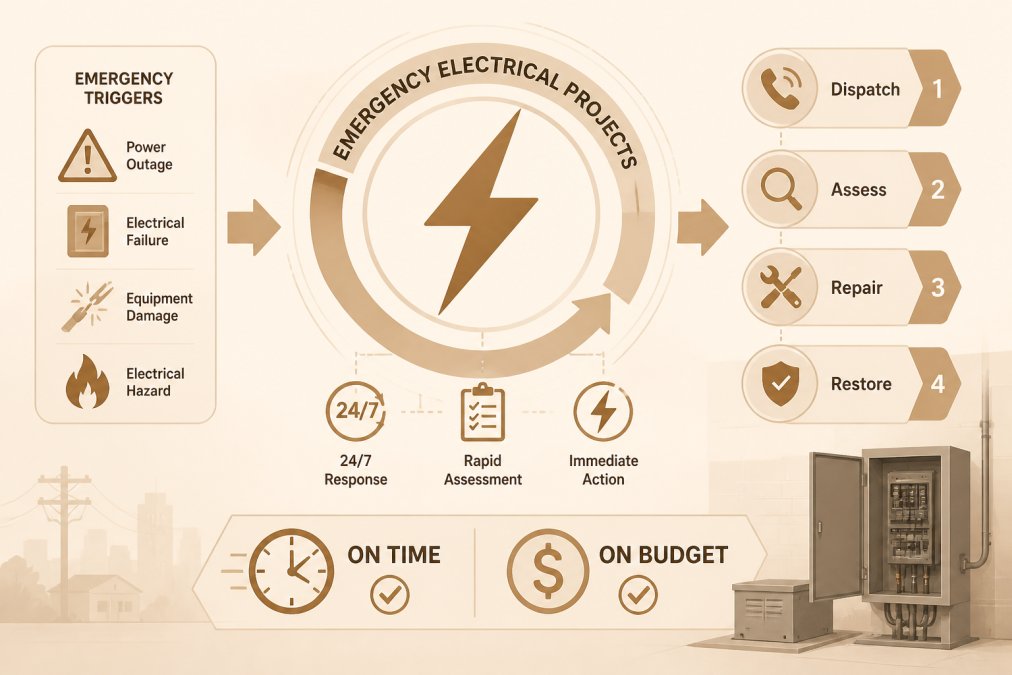
Emergency electrical projects succeed when speed and budget discipline are planned before the crisis. The best share three traits: a pre-vetted contractor, a documented scope of work, and a decision-maker who can approve spending in minutes.
Below, we break down what drives cost, how to protect uptime, and how to build an emergency plan.
Emergency electrical support is the coordinated response to an unplanned failure in a property's power system, from a tripped main breaker to a failed commercial panel. The difference between a controlled repair and a disaster comes down to preparation.
Emergency Electrical Repair Cost Factors
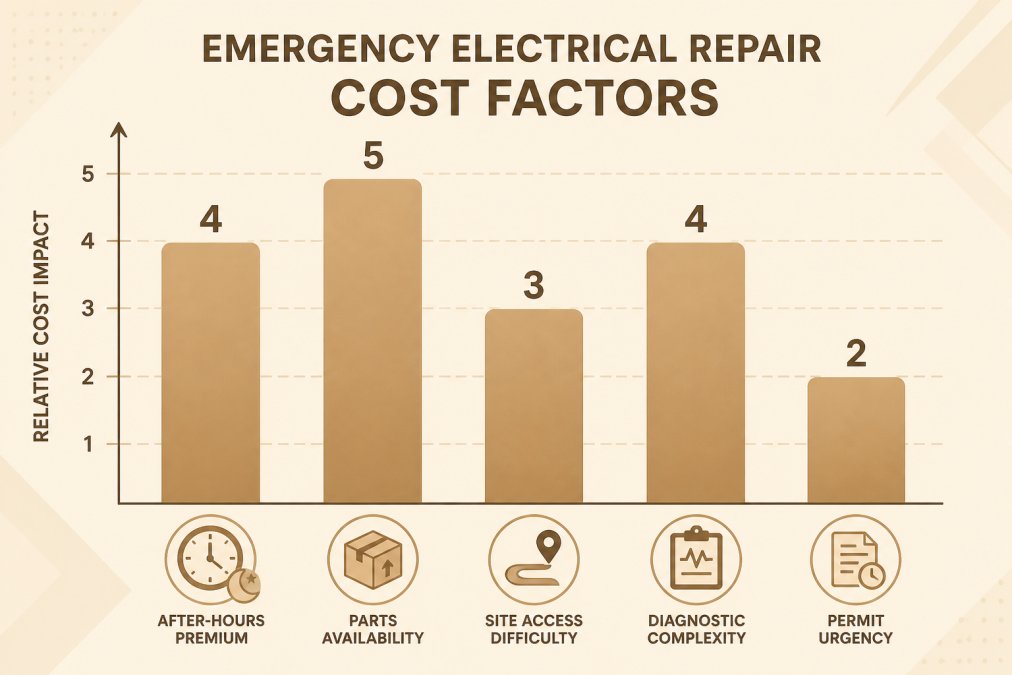
Emergency electrical repair costs are driven by urgency, access, and diagnostic complexity, not the repair itself. A panel swap during business hours and the same swap at midnight on a holiday are different jobs with different economics.
The biggest cost drivers include:
- After-hours labor premiums. Most contractors bill emergency calls at a multiplier of their standard rate, commonly 1.5x for evenings and weekends and 2x for holidays, plus a minimum call-out charge. The multiplier is the largest controllable line item, so a service agreement that locks in rates pays for itself on the first call.
- Parts availability. Common breakers and standard commercial panels are usually stocked locally. Older switchgear, obsolete breaker frames, and specialty transformers may need sourcing or rebuilding, and that lead time, not the part price, stretches the schedule.
- Site access difficulty. Tight mechanical rooms, occupied tenant spaces, and rooftop equipment add labor hours for rigging, staging, and coordination, a schedule risk as much as a cost risk.
- Diagnostic complexity. Faults not visible at the panel, a damaged conductor inside a wall, a failing lug, a neutral issue on a multi-wire branch circuit, require tracing and testing before repair begins. Diagnostic time is often the largest variable on the invoice.
- Permit urgency. Most jurisdictions allow expedited or after-hours inspections for a fee, and some require a licensed electrician to pull the permit before work starts. Skipping it usually costs more when the work must be opened up for inspection.
A common mistake is assuming the visible symptom is the actual fault. A tripping breaker can point to a failing appliance, a damaged conductor, or an overloaded circuit; a flickering circuit may be a loose neutral, a failing breaker, or a utility-side issue. The diagnostic path determines whether the job is a $200 fix or a panel replacement.
How emergency pricing differs from scheduled work
Scheduled electrical work is priced from a defined scope: the contractor walks the job, counts fixtures and circuits, and quotes a fixed number. Emergency work inverts that sequence. The scope is unknown at the call, so the contractor prices the response, call-out, diagnostic window, and labor to isolate the fault, then quotes the repair.
That is why the most useful question during an emergency is not "what will this cost?" but "what is the cost to diagnose, and what is the range of repair outcomes?" A contractor who answers both is pricing transparently; one who quotes a single number before seeing the fault is padding for the unknown.
What actually keeps an emergency repair on budget
Three levers do most of the work: a pre-negotiated service agreement that fixes after-hours multipliers and response times; an up-to-date panel schedule and circuit directory, which cuts diagnostic time; and a decision-maker who can authorize the diagnostic and repair in one call. None require spending money in advance, only deciding, before the emergency, who you call, what you'll pay, and who can say yes.
Minimizing Downtime During Electrical System Failure
Minimizing downtime starts with isolating the fault fast and restoring critical circuits first. Your electrician should triage by priority: life-safety systems, then refrigeration and servers, then general lighting and convenience loads.
For commercial properties, a documented shutdown sequence prevents a small failure from cascading.
How to Budget for Emergency Electrical Services
Budgeting for emergency electrical services means reserving funds for the unexpected and understanding how your contractor bills. Two pricing models dominate: fixed-cost and time-and-materials.
Get your free electrical estimate →
| Pricing Model | Best For | Budget Certainty | Risk |
|---|---|---|---|
| Fixed-cost | Defined scope, planned upgrades | High | Contractor pads for unknowns |
| Time-and-materials | Unknown faults, diagnostics | Low | Cost can climb with discovery |
| Service agreement | Ongoing 24/7 operations | Medium | Requires upfront commitment |
| Turnkey project | Full panel or system replacement | High | Larger upfront scope |
Case Studies: Emergency Electrical Projects Delivered On Schedule and Within Budget
Projects that finish on time and on budget follow the same playbook, regardless of property type. What separates a real case study from a marketing anecdote is the audit trail: what was promised, what was spent, what slipped, and what the post-project review found.
Case study 1: Commercial plaza, failed main panel
The situation. A partial outage took down several tenant spaces in a multi-tenant commercial building. The property manager called a pre-vetted contractor with an existing service agreement rather than shopping for the lowest after-hours quote.
Case study 2: Residential panel upgrade after repeated trips
The situation. A homeowner dealing with constant breaker trips faced a choice: patch the immediate fault or replace the aging panel. The patch was cheaper on the day; the upgrade was cheaper over the year.
The post-project audit framework
- Did the repair match the documented scope? Compare the final invoice against the original scope of work, line by line.
- Did the final cost match the quote? If not, identify whether the variance came from a genuine scope change or an estimate that was too thin.
- Did the schedule hold? Note the time from call to power restoration, and whether any delay came from parts, access, permits, or approval.
- What failed, and why? Document the failure mode so a repeat failure can be recognized faster.
- What pattern does this reveal? A panel that keeps tripping, a consistently overloaded circuit, or gear older than the rest of the system all signal a permanent fix instead of repeat emergency calls.
NFPA 70 National Electrical Code information from the National Fire Protection Association sets the safety and compliance standards that any legitimate contractor should be working to, and the audit is a fair place to confirm the repair was documented against the code edition in force at the time of the work.
Risk Mitigation and Vendor Vetting for Emergency Support
Risk mitigation for emergency projects means reducing unknowns before they happen. Vendor vetting is where that work starts, and the step most property owners skip until it's too late.
Use this checklist when vetting an emergency electrical contractor:
- Confirm current state electrical licensure and ask for the license number
- Verify bonding and insurance, including general liability coverage
- Ask for documented response-time commitments in a service level agreement
- Request references from comparable commercial or residential emergency jobs
- Confirm the contractor handles permits and final inspection
- Check that pricing is transparent, with after-hours rates stated upfront
- Verify experience with your specific systems, such as three-phase or critical power
What should a post-project audit cover?
A post-project audit should confirm the repair matched the scope, review the final invoice against the quote, and document what failed and why. Tracking this over time reveals patterns, a panel that keeps tripping, a consistently overloaded circuit, so you can plan a permanent fix instead of repeat emergency calls. Most owners skip this step, and it's the one that saves the most money long term.
Conclusion: Building a Reliable Emergency Electrical Plan
The best projects completed on schedule and within budget for emergency electrical support aren't lucky. They're the result of a vetted contractor, a documented scope, and a budget reserve ready before the lights go out.
Frequently Asked Questions
What factors influence the cost of emergency electrical repairs?
Emergency electrical repair cost factors include time of day (after-hours rates), parts availability, site accessibility, complexity of the fault, and whether permits are required. For example, a midnight call-out for a failed breaker panel costs more than a scheduled daytime repair. Licensed contractors like Light Life Electric provide transparent estimates before work begins, so you know what to expect. Always ask for a breakdown of labor, materials, and any emergency surcharges.
How can electrical contractors minimize downtime during system failures?
Minimizing downtime during electrical system failure requires rapid diagnosis, pre-stocked critical parts, and a clear communication plan. Contractors should prioritize restoring power to essential systems first, then tackle secondary issues. For commercial properties, having a service level agreement (SLA) with guaranteed response times helps reduce operational impact.
What should be included in an emergency electrical service estimate?
A thorough emergency electrical service estimate should itemize labor (including after-hours differential), materials, equipment rentals, permit fees, and any necessary testing or inspection costs. It should also outline the scope of work, timeline, and payment terms. Ask if the estimate is fixed-cost or time-and-materials; fixed-cost provides budget certainty. Light Life Electric offers free estimates that cover all these elements, so you can budget with confidence.
Why is project management critical for commercial electrical repairs?
Project management ensures that commercial electrical repairs are completed on schedule and within budget by coordinating resources, scheduling, and safety compliance. A dedicated project manager tracks progress, manages subcontractors, and communicates with stakeholders. This is especially important for multi-tenant properties where downtime affects multiple businesses.