 listicle
Alternatives to DIY Electrical Repairs for Safety
Table of Contents
- Why DIY Electrical Repairs Are Riskier Than You Think
- Tasks Homeowners Can Safely Handle vs. What Requires a Pro
- Benefits of Hiring a Professional Electrician for Safety and Code Compliance
- How to Find a Licensed Electrician Near Me: A Vetting Guide
- Electrical Safety Inspection Checklist: What to Look For
- Cost-Benefit Analysis: Professional Electrical Work vs. DIY
- Insurance and Legal Consequences of DIY Electrical Repairs
- Conclusion
- Frequently Asked Questions
Last Updated: September 14, 2026
Why DIY Electrical Repairs Are Riskier Than You Think
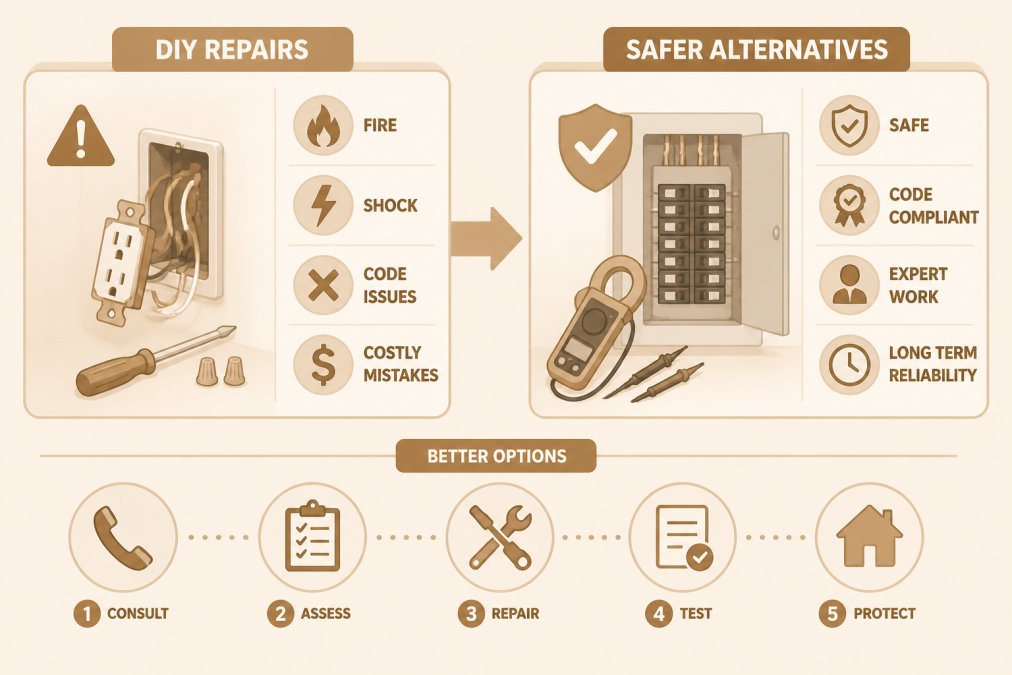
DIY electrical repairs are the most dangerous category of home improvement work, because the failure mode is not a crooked shelf. It is fire, electrocution, or a dead circuit that takes the rest of the house with it. This guide from Light Life Electric covers where the danger sits, which tasks you can safely handle, and how to hire a licensed electrician when the job crosses the line.
The physics explains the stakes. A standard household circuit carries 120 volts, and a service panel feeds 240 volts into the home, more than enough to stop a heart (osha.gov). Worse, most wiring sits behind drywall, so a mistake may not announce itself for months, until a loose connection overheats inside a wall cavity.
Most guides treat every electrical task as equally lethal. That is neither true nor useful. Some jobs are within reach for a careful homeowner; others require a licensed professional, a permit, and an inspection. The skill is knowing which is which before you pick up a screwdriver.
Tasks Homeowners Can Safely Handle vs. What Requires a Pro
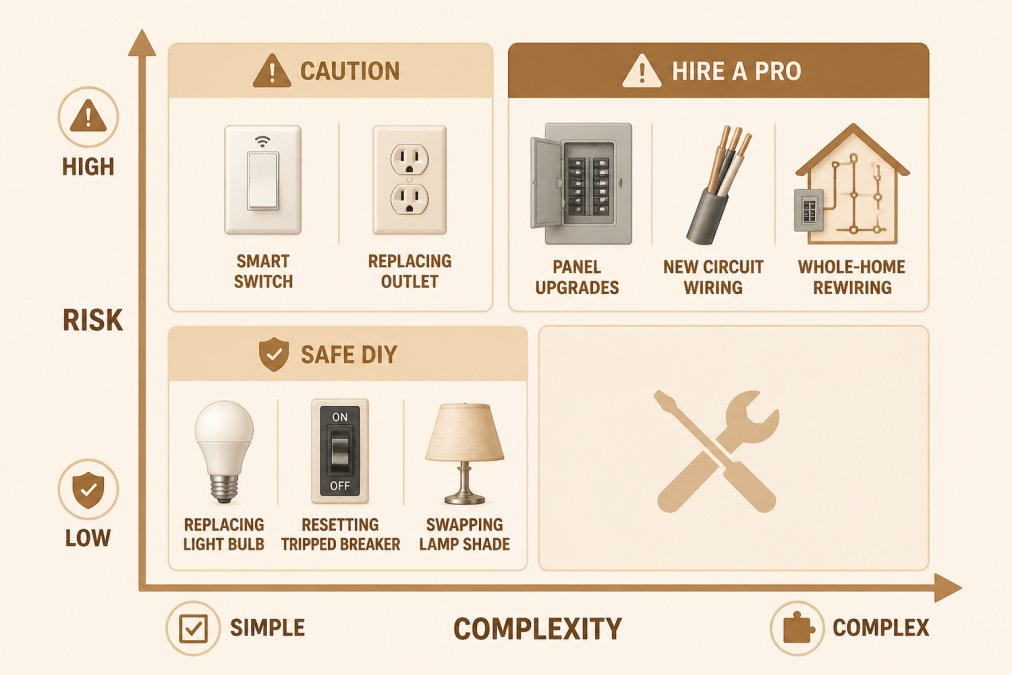
Most homeowners can safely handle simple, low-voltage tasks that involve no new wiring and no work inside the panel. Everything that adds a circuit, moves a wire, or opens the service panel belongs to a licensed electrician.
Safe DIY Electrical Tasks
The safe list is shorter than most people hope: replacing a light bulb, resetting a tripped circuit breaker once, swapping a burned-out switch plate cover, and unplugging a device that keeps tripping a GFCI outlet. Replacing a standard outlet or switch is borderline, doable if the breaker is confirmed off, the wiring is copper and intact, and the box is not crowded.
If any condition fails, stop. A common mistake is assuming the breaker labeled "Kitchen" controls the kitchen outlet you are working on; labeling is often wrong, and a non-contact voltage tester is the only way to confirm a circuit is dead before you touch it.
Jobs That Demand a Licensed Electrician
Anything inside the service panel is off-limits. So is running new wiring, adding a circuit for a hot tub or EV charger, replacing a panel, installing a subpanel, and any work on aluminum wiring. These tasks require an electrical permit, an inspection, and a licensed electrician who carries insurance for exactly this risk.
Benefits of Hiring a Professional Electrician for Safety and Code Compliance
Hiring a licensed professional buys three things you cannot buy at a hardware store: code compliance, liability coverage, and a paper trail that matters when you sell. The electrical code your home must meet is adopted and enforced locally, and a licensed electrician works to that standard on every job.
Code compliance is not bureaucratic box-ticking. The National Electrical Code exists because people died from the shortcuts it now prohibits, and the National Fire Protection Association maintains and publishes it. A licensed electrician knows which edition your jurisdiction has adopted and what your local inspector will look for.
The second benefit is accountability. A licensed electrician carries insurance and stands behind the work. If something fails, there is a business to call. If your own wiring fails, you are the business, and the defendant.
The third benefit is speed. Panel upgrades, service changes, and new circuits involve permits and inspections, and a contractor who handles the process from permit to final inspection removes a layer of coordination most homeowners underestimate.
How to Find a Licensed Electrician Near Me: A Vetting Guide
Searching for a licensed electrician near me returns dozens of names, and the difference between them is rarely visible on the first page of results. Vetting is a process, not a phone call.
Start with license verification. Every state runs a public license lookup, and in Florida the Florida Department of Business and Professional Regulation lets you confirm a contractor's license status, expiration date, and complaint history in minutes. If a contractor cannot give you a license number on request, the conversation is over.
Then confirm insurance. Ask for a certificate showing both general liability and workers' compensation coverage. If a worker is injured on your property and the contractor is uninsured, that exposure can land on your homeowner's policy.
Step-by-Step Contractor Vetting Process
- Verify the license number through your state's official lookup tool
- Request a certificate of insurance for liability and workers' compensation
- Ask whether the quoted job requires a permit, and who pulls it
- Request two or three local references from jobs completed in the last year
- Get the scope of work, materials, and timeline in writing before work begins
- Confirm how the contractor handles inspection failures and rework
- Never pay the full amount upfront; tie payments to milestones
Electrical Safety Inspection Checklist: What to Look For
An electrical safety inspection checklist is a homeowner's early-warning system. Walk your home twice a year and look for signs of faulty installation and aging wiring before they become emergencies.
- Circuit breakers that trip repeatedly or feel hot to the touch
- Outlets or switch plates that are warm, discolored, or buzzing
- A burning smell near the panel or any outlet
- GFCI outlets that will not reset
- Two-prong outlets in kitchens, bathrooms, or near water
- Flickering lights when appliances cycle on
- Extension cords used as permanent wiring
- Scorched or cracked insulation visible at the panel
- A service panel with no clear labeling
- Any outlet that sparks when you plug something in
Any single item on this list is a reason to call a licensed electrician for a professional assessment. A home inspection during a sale covers some of this ground but is not a substitute for an electrical-specific evaluation, especially in older homes.
A short circuit or an overloaded circuit often announces itself through the breaker. If the same breaker trips more than once, the circuit is telling you something is wrong. Resetting it and moving on is how small problems become fires.
Cost-Benefit Analysis: Professional Electrical Work vs. DIY
The upfront cost of professional electrical work is higher than a DIY parts run. The total cost usually is not, once you account for permits, inspections, rework, and the resale value of unpermitted work, the part most guides skip.
A homeowner comparing the two typically looks only at the line item: labor versus parts. That omits three later costs: rework, since a failed inspection means paying a professional to redo what you already paid for in materials and weekends; insurance exposure, covered below; and resale, since unpermitted electrical work can stall a sale or force a price reduction when a buyer's inspector flags it.
Get your free electrical estimate →
What the Numbers Actually Look Like
Exact pricing varies by region, home age, and access, but the shape is consistent. A simple device swap, an outlet, a switch, a dimmer, is a small parts cost plus an hour of labor. A new dedicated circuit for a kitchen appliance, hot tub, or EV charger involves a permit, a home run of cable, a breaker, and an inspection, with labor the smaller share of the bill. Panel and service work sits at the top, because the equipment is expensive and the job cannot legally proceed without a permit and final inspection.
| Factor | DIY Electrical Work | Licensed Electrician |
|---|---|---|
| Upfront cost | Materials only | Labor plus materials |
| Permit and inspection | Often skipped | Handled by contractor |
| Code compliance | Uncertain | Verified |
| Insurance coverage | None | Contractor liability applies |
| Resale impact | Can stall a sale | Clean paper trail |
| Rework risk | High on complex jobs | Covered by contractor |
The Costs That Do Not Show Up on the Receipt
The real asymmetry is not the labor rate; it is what happens when the work fails. A DIY mistake on a simple swap is usually cheap to fix, because the fix is the same job done correctly. A mistake on a new circuit or panel is expensive: the failed inspection fee, the rework, the second inspection, and possible damage to drywall, insulation, or a finished ceiling that must be opened and repaired. Add the skipped permit, and the municipality can require the work be removed and re-permitted, paying twice for the same wall.
There is also a time cost DIYers underestimate. A licensed electrician does the same job repeatedly and carries the tools, stock, and code knowledge to finish in a single visit. A first-time DIYer makes multiple hardware-store trips, waits on a permit they did not know they needed, and loses weekends to a job a professional would close out in a day.
When DIY Still Makes Sense
For simple swaps, DIY can make sense if you are careful, the circuit is confirmed dead with a tester, and the wiring is copper and intact. For anything involving the panel, new circuits, or water-adjacent outlets, the math favors hiring a professional every time, not because the labor is cheap, but because the permit, the inspection, and the contractor's insurance are what you are actually buying.
Insurance and Legal Consequences of DIY Electrical Repairs
Homeowner's insurance can deny a claim when the loss traces back to unpermitted or non-compliant electrical work, the consequence most DIYers never see coming. The useful part is understanding how the denial happens, because it is a process, not a switch.
How a Claim Turns Into a Denial
When you file a fire or smoke claim, the insurer assigns a cause-and-origin investigation to determine where the fire started and what started it. If the origin is inside a wall, at a junction box, or at the panel, the investigator examines the wiring. Signs of homeowner work, a splice that does not match the system, a missing connector, a breaker the wrong size for the conductor, a circuit never permitted, move the claim from "covered loss" to "coverage question."
Standard policies typically require the home be maintained in a safe condition and in compliance with applicable codes, and many exclude losses from faulty workmanship or from work that required a permit and did not get one. The insurer is not denying because you did the work yourself; it is denying because the work was non-compliant, and that non-compliance caused the loss. That is why a small, correct DIY swap rarely triggers a denial while an unpermitted circuit often does.
What You Are Left Holding
If the claim is denied or reduced, the damage is yours to pay for. The second hit is the house itself: an insurer that has investigated a non-compliant electrical loss may decline to renew, and a new insurer will ask about the electrical system before writing coverage. Until the system is brought up to code and inspected, the home can be difficult or expensive to insure.
The third hit is the repair order. Municipalities can require unpermitted work be removed, re-permitted, and re-inspected, meaning you pay a professional to undo and redo what you already paid for. Sometimes the work must be exposed, drywall opened, insulation pulled, before an inspector signs off.
The Legal Side
Unpermitted work can create disclosure obligations when you sell. Most states require sellers to disclose known material defects and, often, known unpermitted work. A buyer who discovers it after closing may pursue remedies, and the seller's defense is weaker when the work was never inspected. If a contractor or subsequent owner is injured by your wiring, the liability follows the work.
This is the part competitors gloss over: the risk of DIY electrical work is not only physical but financial, and it can outlast the project by years. The permit and the inspection are not paperwork, they are the record that tells an insurer, a buyer, and a municipality the work was done to code.
Conclusion
The hardest part of electrical work is not the wiring. It is knowing where your competence ends and a licensed professional's begins, and honoring that line even when a job looks simple.
Light Life Electric is a family-owned, Florida certified electrical contractor serving Southwest Florida with licensed, bonded, and insured electricians. We handle the entire process from permits to final inspection, offer 24/7 emergency response, and complete projects on schedule and within budget. Get your free electrical estimate and put the work in hands that carry the insurance for it.
Frequently Asked Questions
Is DIY electrical work legal?
In most states, homeowners can perform minor electrical work on their own property, but major work often requires a permit and inspection. However, if you cause a fire or injury, you could be held liable. Many jurisdictions require licensed electricians for anything beyond simple tasks like replacing a switch or outlet. Always check local building regulations before starting any electrical project.
Why is it dangerous to perform your own electrical repairs?
DIY electrical repairs expose you to risks like electrocution, fire hazards, and short circuits. Without proper training, you might miss signs of faulty wiring or overloaded circuits. Even a small mistake can lead to a house fire or serious injury. Licensed electricians have the tools and knowledge to work safely and meet electrical code requirements.
How do I verify if an electrician is licensed and insured?
Ask for their license number and verify it with your state's licensing board. Check for insurance certificates for general liability and workers' compensation. A reputable electrician will provide references and proof of bonding. You can also look up reviews and complaints with the Better Business Bureau or local consumer protection agencies.
What are the most common electrical hazards in older homes?
Older homes often have outdated wiring, insufficient outlets, and lack of ground fault circuit interrupters (GFCIs). Aluminum wiring, knob-and-tube wiring, and overloaded circuits are common. These can lead to shocks, fires, and code violations. An electrical safety inspection can identify these issues and recommend upgrades like rewiring or panel replacement.
How does professional electrical work impact home insurance coverage?
Many insurance policies require that electrical work be done by licensed professionals. If a fire is caused by unpermitted or DIY electrical work, your claim could be denied. Hiring a licensed electrician ensures the work meets code and is documented, which can protect you financially and legally. Keep records of all permits and inspections.