 listicle
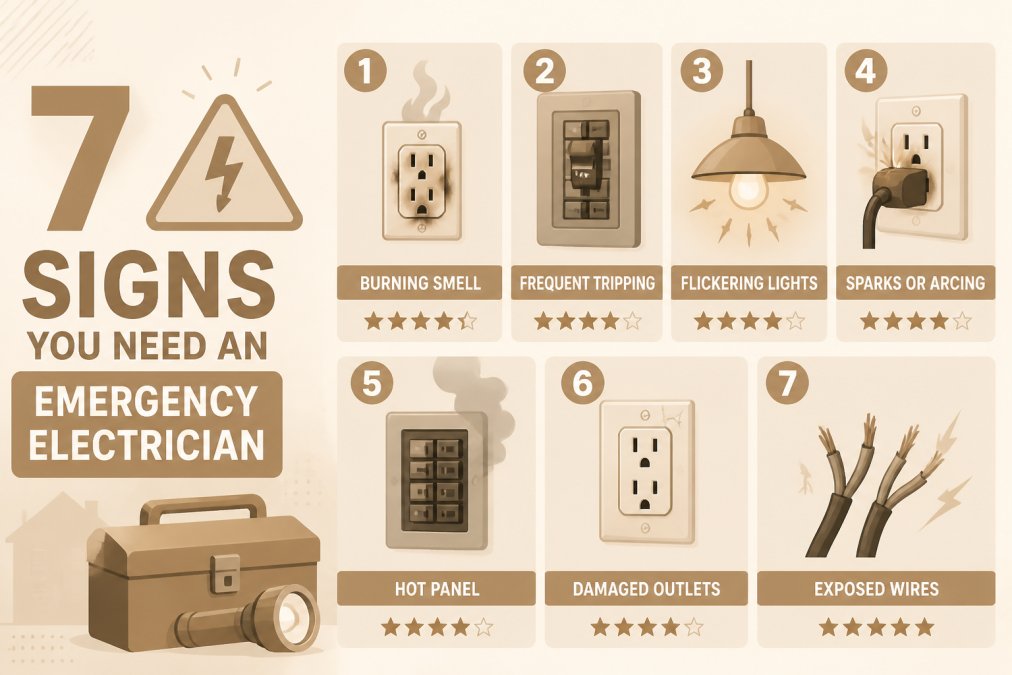
7 Signs You Need an Emergency Electrician
Table of Contents
- 1. Burning Smell or Smoke From Outlets
- 2. Frequent Circuit Breaker Tripping
- 3. Flickering or Dimming Lights
- 4. Buzzing or Humming Sounds From Outlets or Switches
- 5. Discolored, Charred, or Warm Outlets and Switches
- 6. Sparks or Electrical Shocks
- 7. Outdated Wiring in Older Homes
- Urgent vs. Non-Urgent: When to Call an Emergency Electrician
- Frequently Asked Questions
Last Updated: September 13, 2026
1. Burning Smell or Smoke From Outlets
A burning smell or visible smoke from an outlet is the single most urgent sign you need an emergency electrician (esfi.org). According to the U.S. Fire Administration electrical fire safety data, electrical fires account for thousands of residential structure fires each year, and a burning odor at the wall is often the first warning before ignition. At Light Life Electric, we treat every burning-smell call as a potential fire in progress, not a diagnostic appointment.
The smell usually comes from overheating insulation, arcing contacts, or a failing connection behind the drywall, heat has already damaged hidden components.
What to Do Before Help Arrives
Cut power at the breaker for that circuit, then evacuate if you see smoke or flame and call 911. Do not pour water on an electrical fire or open the outlet plate. Once the danger is cleared, a licensed electrician should inspect the full circuit, not just the outlet, because heat damage travels along the wiring.
2. Frequent Circuit Breaker Tripping
A breaker that trips once is doing its job. A breaker that trips repeatedly is telling you the circuit is overloaded, shorted, or faulting to ground, one of the clearest signs of electrical fire hazards, since a bypassed breaker defeats the one safety device protecting that wire (osha.gov).
Common causes include too many high-draw appliances on one circuit, a loose neutral, damaged insulation, or a failing breaker.
How to Reset a Tripped Circuit Breaker Safely
- Unplug everything on the affected circuit.
- Locate the tripped breaker in the electrical panel; it sits between ON and OFF.
- Push it fully to OFF, then firmly to ON.
- If it holds, plug devices back in one at a time.
- If it trips again immediately, stop and call an electrician.
3. Flickering or Dimming Lights
Lights that flicker across the whole house point to a loose service neutral or a failing main breaker, not a bad bulb. Dimming when the air conditioner or dryer kicks on suggests voltage fluctuation from an overloaded service or undersized panel.
A single flickering fixture is often just a loose connection at that box. Whole-home flickering is a utility-side or panel-side problem that needs professional diagnosis. Persistent flickering also stresses electronics and can indicate arcing that precedes a fire.
4. Buzzing or Humming Sounds From Outlets or Switches
A buzzing outlet or switch is arcing electricity. Humming from a dimmer is sometimes normal, but a sharp buzz or crackle at a receptacle means a loose wire is sparking inside the box, eroding the connection until it fails, how many electrical fires begin.
Turn the circuit off at the panel and leave it off until an electrician inspects it. Do not keep using the outlet because it "still works." A connection that buzzes today can arc tomorrow.
5. Discolored, Charred, or Warm Outlets and Switches
Scorch marks, brown staining, or a warm wall plate are physical evidence of overheating. Charring means the outlet has already reached ignition temperatures at least once, while warmth without discoloration is an earlier warning that amperage is exceeding what the device can safely carry.
Replace the device only after the cause is identified. A new outlet on the same overloaded or loose wiring will overheat again.
6. Sparks or Electrical Shocks
A spark when you plug something in is not normal, and a shock from an appliance or outlet means current is reaching a surface it should not. Both indicate a short circuit or ground fault and can escalate without warning.
Stop using the circuit, and do not touch the device again. If anyone received a shock, treat it as a medical concern first, then have the circuit inspected before it is re-energized. A licensed electrician will test for ground faults and check whether GFCI protection is missing or failed.
7. Outdated Wiring in Older Homes
Knob-and-tube and aluminum branch wiring were installed to standards that predate the electrical loads a modern home draws. That mismatch, not the age of the wire, makes outdated wiring an emergency-adjacent sign rather than a cosmetic one.
Knob-and-tube wiring has no equipment grounding conductor. Its conductors run on ceramic knobs and tubes, with splices wrapped in friction tape or early rubber insulation that hardens and cracks with heat cycling. Once brittle, attic movement or a rodent can expose live conductor to wood framing. With no ground path, a fault has nowhere safe to go, and the first symptom is often a scorched joist rather than a tripped breaker.
Aluminum branch-circuit wiring, common in homes built roughly between the mid-1960s and mid-1970s, fails at the terminations rather than mid-run. Aluminum expands and contracts more than the brass or steel terminals it connects to, so every heat cycle loosens the connection. A loose connection raises resistance, resistance raises heat, and heat oxidizes the aluminum, raising resistance further. That loop makes aluminum terminations a classic origin point for outlet fires, and why a proper repair uses a listed connector or pigtail rather than simply re-tightening the screw.
Older Homes vs. New Construction: Different Risk Profiles
Older homes (roughly pre-1980) tend to carry:
- No equipment ground on part or all of the branch circuits
- A 60-amp or 100-amp service that was sized for lighting and a few appliances, not central air, an EV charger, and a heat pump
- Two-prong receptacles, or three-prong receptacles installed without a ground (a common and dangerous shortcut)
- Decades of homeowner and handyman additions, backstabbed receptacles, undersized extensions, junctions buried behind drywall
- Federal Pacific Stab-Lok or Zinsco panels in some vintages, which have a documented history of failing to trip under fault conditions
Newer homes (roughly post-2000) tend to carry:
Get your free electrical estimate →
- AFCI and GFCI protection that catches many arc and ground faults before they become fires
- A grounded system and a panel sized for modern load
- Failures concentrated at loose backstab terminations, overloaded multi-outlet circuits, and DIY smart-switch or EV-charger installs that exceeded the circuit's rating
That difference changes the emergency threshold. In an older home, a warm wall plate or faint burning smell is more likely a wiring-level fault, with no AFCI to interrupt it and no ground to divert it. In a newer home, the same symptom more often traces to a single device or bad splice, still urgent, but usually more contained.
What to Do If You Have Knob-and-Tube or Aluminum Wiring
- Do not add load to the circuit. No space heaters, no window AC units, no EV charging on an unverified circuit.
- Have a licensed electrician perform a safety inspection that includes opening a representative sample of outlets, switches, and panel terminations, not just a visual walk-through.
- Ask specifically whether the inspection checked for aluminum terminations, missing grounds, and any panel with a known failure history.
- Treat a full rewire or a panel upgrade as the permanent fix, and a pigtail or AFCI/GFCI retrofit as interim risk reduction, not a cure.
If you are unsure which category your home falls into, the panel label, receptacle type, and wiring visible in an unfinished basement or attic will usually tell an electrician in a few minutes. That is a scheduled visit, not an emergency, unless you are already seeing one of the signs above.
Urgent vs. Non-Urgent: When to Call an Emergency Electrician
An emergency electrician is a licensed professional who responds outside standard business hours to electrical hazards that threaten life, property, or the electrical system. Not every symptom qualifies. The distinction matters because emergency dispatch carries a higher rate than a scheduled visit, and a genuine hazard should never wait until Monday.
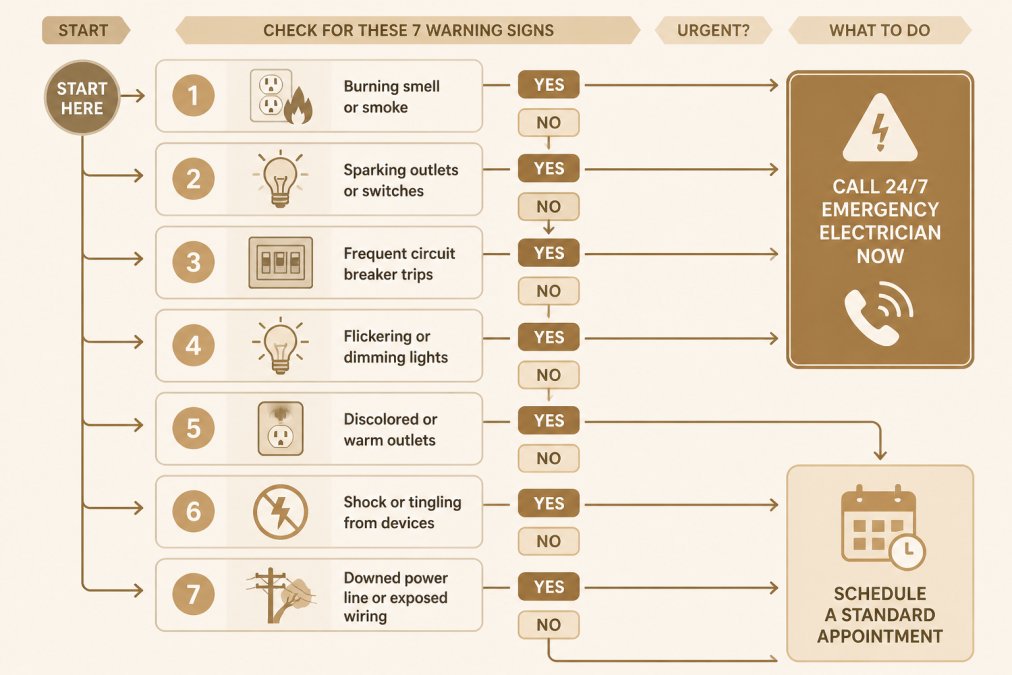
Call immediately, day or night, for a burning smell, visible smoke, sparks, a shock, or a charred outlet. These are active fire or shock risks. Schedule a standard appointment for a single flickering fixture, one breaker trip with a known cause, or a buzzing dimmer that has always hummed.
| Warning Sign | Urgency | Action |
|---|---|---|
| Burning smell or smoke | Emergency | Cut power, call now |
| Sparks or shock | Emergency | Stop using circuit, call now |
| Charred or warm outlet | Emergency | Take outlet offline, call now |
| Repeated breaker trips | Urgent | Call same day |
| Whole-home flickering | Urgent | Call same day |
| Single flickering fixture | Non-urgent | Schedule a visit |
| Buzzing outlet or switch | Urgent | Turn circuit off, call |
Triage Before the Electrician Arrives
Most guides stop at "call a pro." The first five minutes are yours, and what you do in them determines whether a bad night becomes a disaster.
If you smell burning or see smoke at a device:
- Do not touch the device. Do not pull the plug, do not flip the switch.
- Go to the panel and switch the affected breaker to OFF. If you cannot identify the circuit, switch the main breaker to OFF.
- If you see flame or heavy smoke, leave the building and call 911 from outside. Electrical fires can travel inside walls faster than you can chase them.
- Never pour water on an energized electrical fire. A Class C extinguisher is the only correct tool, and only if the circuit is already de-energized.
If someone received a shock:
- Do not touch the person if they may still be in contact with the source. Kill the breaker first.
- Call 911. Even a brief shock can cause cardiac arrhythmia that shows up minutes later.
- Do not re-energize the circuit until an electrician has tested it.
If you see sparks:
- Stop using the circuit. Unplug nothing at the sparking device, leave it alone.
- Kill the breaker.
- Tape the breaker in the OFF position or note it clearly so no one resets it "to see if it works."
If the panel itself is hot, buzzing, or smoking:
- Do not open the panel cover.
- Call 911 if there is smoke or flame, then call the utility if the service mast or meter is involved.
- Evacuate and wait outside for responders.
The Cost Trade-Off, Honestly
Emergency dispatch is priced higher than a scheduled visit because it pulls a licensed electrician out of off-hours into a hazard call. That premium is worth it when the risk is fire, shock, or carbon monoxide from a backfed generator setup, not for a symptom stable for weeks.
A useful rule: if the symptom is new, sudden, or accompanied by heat, smell, or sound, treat it as urgent. If it is old, stable, and cosmetic, one dim bulb, one fixture that has always flickered, book a standard appointment and save the premium for a real emergency.
Prepare for the Visit So the Tech Can Work Fast
A prepared homeowner cuts diagnostic time, which cuts the bill. Before the electrician arrives:
- Write down every symptom: which rooms, which devices, when it started, what was running at the time.
- Note the last time anything changed, a new appliance, a new EV charger, a remodel, a storm.
- Clear access to the electrical panel. Move boxes, furniture, and anything leaning against it.
- Unlock gates, secure pets, and clear a path to the affected outlets.
- If you have them, have the panel schedule (the list of what each breaker controls) and any prior electrical invoices ready.
- Do not attempt repairs yourself in the meantime. A homeowner "fix" often hides the evidence the electrician needs.
Light Life Electric is a family-owned, Florida certified electrical contractor with 24/7 emergency response, handling the work from permits through final inspection. For the cost of emergency electrical services, pricing depends on the diagnosis, circuit involved, and repair required, so we quote after we see the problem rather than guessing over the phone. If you are unsure which category your issue falls into, call and describe it. We would rather talk you out of an unnecessary emergency visit than have you wait on a real one.
Frequently Asked Questions
Are there warning signs before an electrical fire?
Yes. Most electrical fires give warning signs first: a burning smell from outlets, discolored or charred wall plates, buzzing sounds, flickering lights, and breakers that trip repeatedly. These are signs of electrical fire hazards caused by arcing, overloaded circuits, or failing insulation. If you notice any of them, stop using the affected outlets, turn off power at the panel if it is safe, and call an emergency electrician rather than waiting.
Should I call an electrician if my breaker keeps tripping?
If the breaker trips once and resets normally, it may just be an overloaded circuit. But if it trips again right away, or the breaker feels hot, smells burnt, or will not stay on, stop resetting it. Repeated tripping points to a short circuit, ground fault, or failing breaker. A licensed electrician should inspect the panel and wiring before you use that circuit again.
Is a burning smell from an outlet an emergency?
Yes. A burning smell from an outlet is one of the clearest signs of electrical fire hazards and should be treated as an emergency. Unplug anything connected to it, avoid touching the outlet, and turn off the circuit at the breaker panel if you can do so safely. Then call a 24/7 emergency electrician. Smoke, sparks, or visible charring mean you should leave the area and call 911 first.
How quickly should an emergency electrician respond?
For hazards like smoke, sparks, or burning odors, a 24/7 emergency electrician should typically arrive within a few hours, and many companies prioritize these calls over routine work. Response time depends on your location and technician availability. When you call, describe the specific hazard so the dispatcher can prioritize correctly. If there is active fire or smoke, evacuate and call 911 before contacting any contractor.
What determines the cost of emergency electrical services?
The cost of emergency electrical services depends on the time of day, the complexity of the fault, parts needed, and whether the work requires permits or panel upgrades. After-hours and weekend calls usually carry higher rates than standard appointments. Because pricing varies by job, ask for a written estimate before work begins. Get your free electrical estimate so you know the scope before authorizing repairs.