 how-to
How to Tell If Your Electrical Panel Needs Replacing
Table of Contents
- Warning Signs Your Electrical Panel Needs Replacing
- Frequently Tripped Breakers Causes and What They Reveal
- Age, Corrosion, and Other Physical Clues on the Panel
- Electrical Panel Capacity Assessment: Is Your Panel Keeping Up?
- Electrical Panel Replacement Cost and What Affects It
- DIY vs. Professional Assessment: What You Can Safely Check
- Frequently Asked Questions
Last Updated: September 28, 2026
Warning Signs Your Electrical Panel Needs Replacing
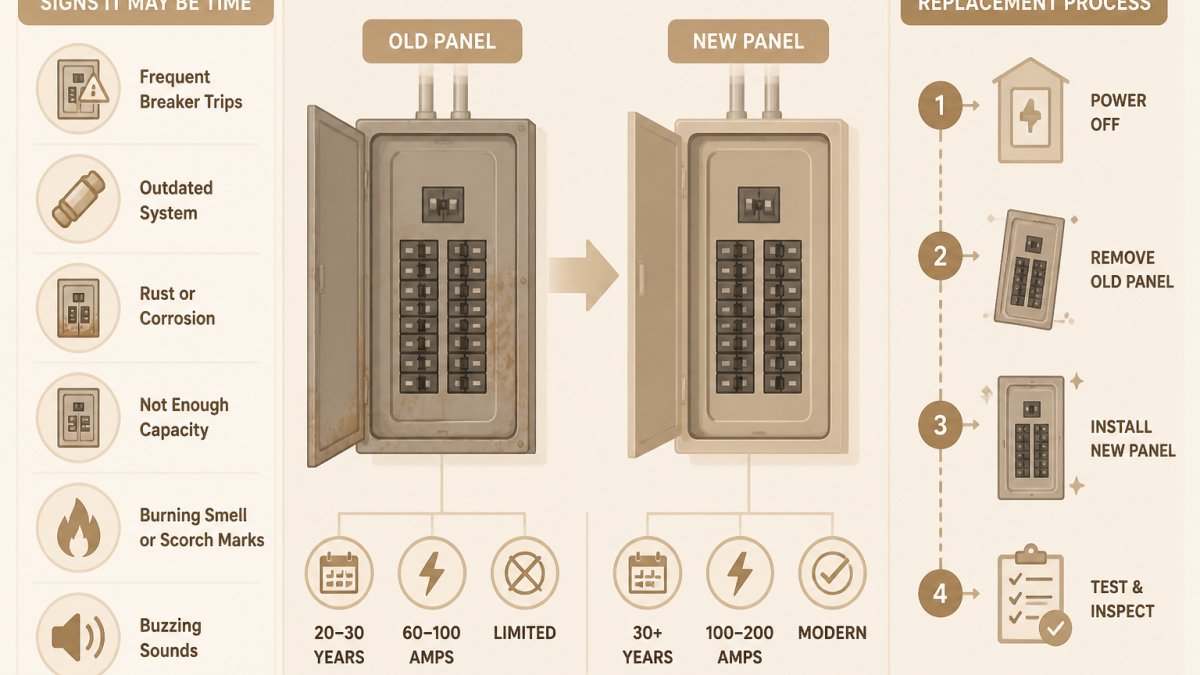
Knowing how to tell if electrical panel needs replacing starts with spotting the warning signs early. The panel distributes power from the utility service cable to every circuit, and when it starts to fail, it usually tells you first.
These signs matter most.
Watch for these red flags:
- Breakers that trip again and again
- A burning smell near the panel
- Scorch marks or melted plastic
- Buzzing, popping, or crackling sounds
- Rust or corrosion on the box
- Lights that flicker or dim
Frequent Circuit Breaker Trips and Overloaded Circuits
Breakers that trip once are doing their job. Breakers that trip weekly mean the panel can't handle the load.
Ask yourself:
- Does the same breaker trip often?
- Do trips happen when large appliances run?
- Does the panel feel warm to the touch?
Burning Smells, Scorch Marks, and Buzzing Sounds
A burning odor near the panel is an emergency, not a wait-and-see issue. It often means insulation is melting or a connection is overheating.
Frequently Tripped Breakers Causes and What They Reveal
The most common frequently tripped breakers causes are overloaded circuits, a failing breaker, and a panel too small for the home. Each points to a different fix.
Here's how to read the pattern:
| Symptom | Likely Cause | What It Means |
|---|---|---|
| One breaker trips often | Overloaded circuit | Redistribute the load |
| Multiple breakers trip | Undersized panel | Panel upgrade likely |
| Breaker trips with no load | Faulty breaker | Replace the breaker |
| Breaker won't reset | Short circuit or ground fault | Call an electrician now |
Age, Corrosion, and Other Physical Clues on the Panel
The age of your electrical panel is one of the clearest signals. Panels over 30 years old were built for homes using far less power, often 60-amp or 100-amp service feeding a handful of circuits. Today's homes pull far more.
Panel Brands That Warrant a Closer Look
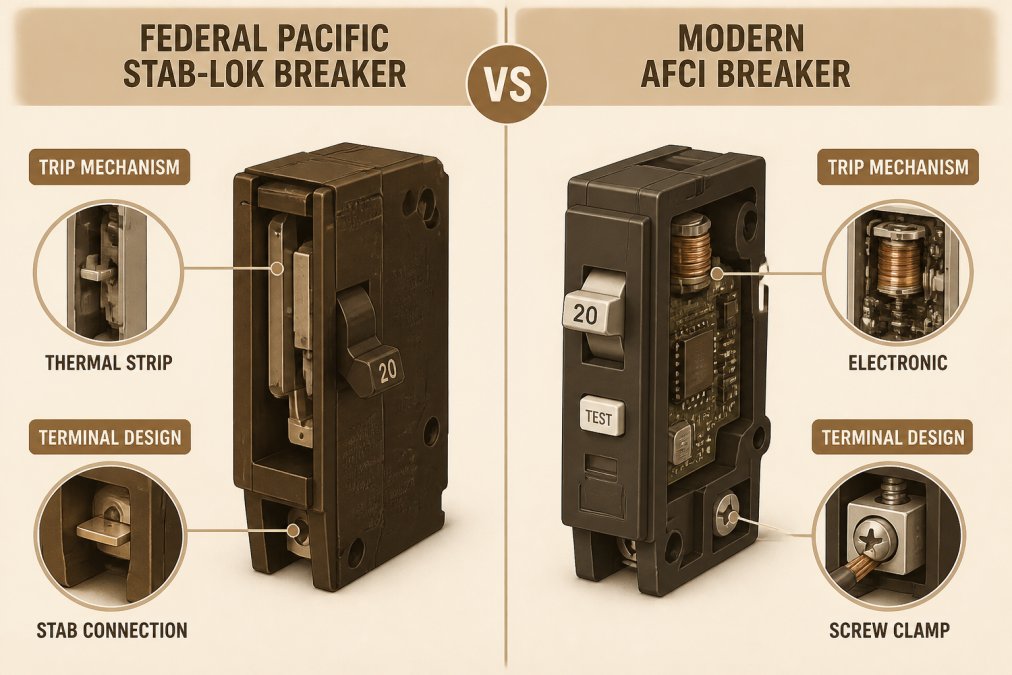
A handful of legacy panel brands have a well-documented history of failure modes. If you see one of these names on the label inside your panel door, get a licensed electrician's assessment:
- Federal Pacific Electric (FPE) Stab-Lok, Manufactured in large numbers from the 1950s through the 1980s. The breakers in these panels have a documented tendency not to trip when they should, meaning a circuit can overheat without the breaker cutting power. Many insurers now refuse to cover homes with an FPE Stab-Lok panel, or require replacement as a condition of coverage.
- Zinsco / Sylvania-Zinsco, Common in homes built or updated in the 1960s and 1970s. Zinsco breakers are known for failing to trip and for melting or welding themselves to the bus bar, which can leave a circuit permanently energized even when the breaker handle is flipped off.
- Pushmatic, A bolt-on breaker design used from the 1950s into the 1980s. The breakers have no ON/OFF markings that are easy to read, replacement parts are scarce, and the design offers no space for modern AFCI or GFCI breakers that current code expects in many locations.
- Bulldog / ITE Pushmatic, Same family of concerns as Pushmatic; parts availability is the main practical problem.
What to Look For Without Opening the Panel
You can safely inspect the exterior and the area around the panel. Never remove the dead front (the cover), that exposes live bus bars and main lugs.
Look for:
- Rust or corrosion on the box, the door, or the wall around it. Corrosion means moisture has reached the metal. In humid or coastal climates this accelerates, and it raises the risk of arcing and ground faults.
- Scorch marks, soot, or discoloration around individual breakers or the main breaker. This points to overheating or arcing at a connection.
- A warm or hot panel cover. A panel that's warm to the touch under normal load is a sign of resistance heating somewhere inside.
- Breakers that wiggle or feel loose when you press them. A breaker that doesn't seat firmly may not be making solid contact with the bus bar.
- Fuses instead of breakers. Fuse boxes are not automatically unsafe, but they're typically 60-amp service, they can't support modern loads, and they can't accommodate AFCI or GFCI protection.
- Missing or taped-over breaker spaces. Open knockouts or breakers held in place with tape are signs of improvised work.
- A double-tapped breaker, two wires under one terminal screw, visible with the cover off. You can sometimes spot the symptom from outside: a breaker that runs warm or trips under light load.
The 'Alligatoring' Clue
When an electrician opens the panel, they look for insulation that has dried, cracked, and shrunk back from the terminal, sometimes called alligatoring because the surface looks like reptile skin. It signals long-term heat exposure at a connection and is common in panels 30+ years old running near capacity.
Electrical Panel Capacity Assessment: Is Your Panel Keeping Up?
An electrical panel capacity assessment tells you whether your panel can safely power everything in your home. Most older homes have 100-amp service. Many modern homes need 200 amps or more.
Get your free electrical estimate →
Signs your panel is maxed out:
- You've added an EV charger or hot tub
- New appliances cause lights to dim
- The panel has no open breaker slots
- You rely on extension cords and power strips
Electrical Panel Replacement Cost and What Affects It
Electrical panel replacement cost depends on several factors, so pricing varies from home to home. We don't quote flat rates without seeing the job, but you can still know what drives the number up or down.
Typical Cost Ranges
Pricing for an electrical panel replacement depends on several factors, such as the amperage of the new service, whether the meter socket and service cable need replacement, and what grounding and bonding work is included. The only reliable number comes from an on-site assessment.
What Drives the Cost Up
- Amperage jump. Going from 100-amp to 200-amp service means a larger panel, a larger main breaker, and often a heavier service cable and meter socket. Going to 400-amp service for a large home with an EV charger, heat pump, and electric range pushes the number higher still.
- Meter box or service cable work. If the meter socket is damaged, undersized, or not rated for the new amperage, it has to be replaced. Same for the service entrance cable between the meter and the panel.
- Grounding and bonding upgrades. Older homes often have a single ground rod, a water-pipe ground that's no longer acceptable, or no bonding of gas and water lines. Bringing these up to current code adds labor and materials.
- Permit and inspection fees. These vary by jurisdiction and are almost always required for a panel change. Skipping the permit is a code violation and can void insurance coverage.
- Accessibility and wall repair. A panel in a finished basement, behind drywall, or in a tight closet takes longer to access and may require patching afterward.
- Branch circuit corrections. If the electrician finds double-tapped breakers, undersized conductors, or aluminum branch wiring during the swap, those have to be addressed before the new panel can be energized.
What Doesn't Change the Cost Much
- The brand of the new panel. A 200-amp panel from a major manufacturer is a commodity item; the labor is the bulk of the bill.
- The number of breaker spaces, up to a point. A 40-space panel and a 30-space panel cost roughly the same to install.
Insurance and Resale: The Costs You Don't See on the Invoice
Insurance. Many carriers ask about panel brand and age during underwriting, and some will decline or refuse to renew a policy on a home with a Federal Pacific Stab-Lok or Zinsco panel. Others write the policy but exclude fire losses originating at the panel, so an outdated brand can mean a specialty policy with a much higher premium.
How to Get a Real Number
A free on-site estimate should break out the amperage of the new service, whether the meter socket and service cable are replaced, what grounding and bonding work is included, who pulls the permit, and whether wall repair is in scope. If a quote doesn't, ask.
Budget for the panel, the permit, and the grounding work, and ask your insurance carrier whether your current panel brand affects your coverage. The upgrade is often cheaper than the alternative, and it's frequently the difference between a standard policy and a specialty one.
DIY vs. Professional Assessment: What You Can Safely Check
You can safely check a few things yourself, but never open the panel cover or touch the wiring inside.
Safe for you to do:
- Listen for buzzing or crackling
- Smell for burning odors
- Look for rust, scorch marks, or a warm cover
- Note which breakers trip and how often
- Check the panel's age and brand on the label
Leave to a licensed electrician:
- Removing the panel cover
- Testing voltage or amperage
- Inspecting the bus bar and main lug
- Any repair or replacement work
Frequently Asked Questions
What is the average lifespan of a home electrical panel?
Most residential electrical panels last 25 to 40 years. Panels installed before the 1990s may use outdated technology or discontinued components that are no longer considered safe. If your panel is 30 years or older, a licensed electrician should inspect it for corrosion, overheating, and NEC compliance. Age alone does not always mean replacement is needed, but it is one of the strongest predictors that an electrical panel replacement is on the horizon.
What are the most common causes of frequently tripped breakers?
The most common frequently tripped breakers causes include overloaded circuits, a failing breaker, loose wiring connections, and a panel that cannot handle the home's electrical load. If one breaker trips repeatedly after you reset it, the circuit is drawing more amperage than it can safely carry. That points to an overloaded circuit or a panel capacity issue, and it should be evaluated by a licensed electrician before it becomes an electrical hazard.
Should a 50-year-old electrical panel be replaced?
A 50-year-old panel should be evaluated for replacement. At that age, the bus bar, insulation, and breaker connections have likely degraded, and replacement parts may be hard to find. Insurance carriers often flag panels this old during underwriting. A safety inspection will confirm whether the panel still meets current National Electrical Code requirements or needs a full panel upgrade to handle modern electrical load.
What is the 80% rule for electrical panels and why does it matter?
The 80% rule states that a circuit breaker should not carry more than 80% of its rated amperage continuously. A 100-amp panel, for example, should handle no more than 80 amps of continuous load. If your home regularly exceeds that threshold, the panel is undersized for your electrical capacity. An electrical panel capacity assessment will show whether a panel upgrade is needed to safely support your appliances, HVAC, and EV charging.